
The Ninth International Biennial in Cuenca, Ecuador, was held in this quaint colonial city from April 25th through June 8th, on the occasion of the 450th anniversary of the town’s founding and the twentieth anniversary of the biennial. Located within the minor-elevation Andean mountain system, Cuenca is becoming an important cultural focal point in the country, with biennials for the visual arts, the performance arts, and poetry. Little by little, and while maintaining a low profile, Cuenca has been able to negotiate the obstacles that often appear in the path of international mega-events and to keep the space active; today, it is one of the better-established biennials in the region. Originally limited to the realm of painting, since 2004 the biennial has freed itself from certain fundamental constraints by paying attention to the multidisciplinary nature of analogous projects, the dominant currents in the contemporary art scene, and the deep transformations seen in art, incorporating previously excluded media such as installations, objects, photography, and video.
Being of a moderate size, the Cuenca Biennial invited fifty artists—including five collaborations or collectives—from nineteen countries. Although its scope is international, it mostly included artists from the Western hemisphere and the parallel exhibits reinforced this characteristic by opening their spaces to artists from Germany, The Netherlands, Italy, Singapore, the United Kingdom, and Spain, to cite just a few examples.

Part of the Biennial’s working system rests on designated institutions and curators who select the national delegations. Each curator can propose from three to six artists, and the Biennial’s selection committee selects two per country. (As an exception, the Ninth Biennial invited three artists each from Colombia, Cuba, Chile, and Puerto Rico, and nine from Ecuador.) Following this method, the Biennial must make sense of the diverse panorama resulting from the heterogeneous interpretations of a group of professionals with diverging ideologies, aesthetic tastes, and perceptions of the contemporary, short of a governing concept that would unify all the proposals and their dialogue within the exhibition space.
The Biennial’s theme, Space-Times of Identity, framed the controversial interaction of these categories in contemporary cities under a global lens but with a plurality of meaning; against the unidirectional logic of late capitalism and in complicity with the site’s own history and physiognomy, it gave special importance to the individual, psychological, local, social, symbolic, or communitarian threads that coexist or survive in a parallel and furtive way in the urban context, as well as the multitude of temporalities contained there—conditioned by memory, myth, and ritual—without curtailing prospects in other related realms.
The use of several sites on the shores of the Tomebamba River that crosses Cuenca, including the outdoor locations expanded the event’s interaction with the city as a whole. Along with the Museo de Arte Moderno, the Museo de los Metales, the Museo de la Medicina, and others, the Biennial incorporated the Centro de Alto Rendimiento Deportivo, an unconventional, half-finished building in which the first floor was successfully converted into an exhibition gallery and held the works of sixteen guest artists.
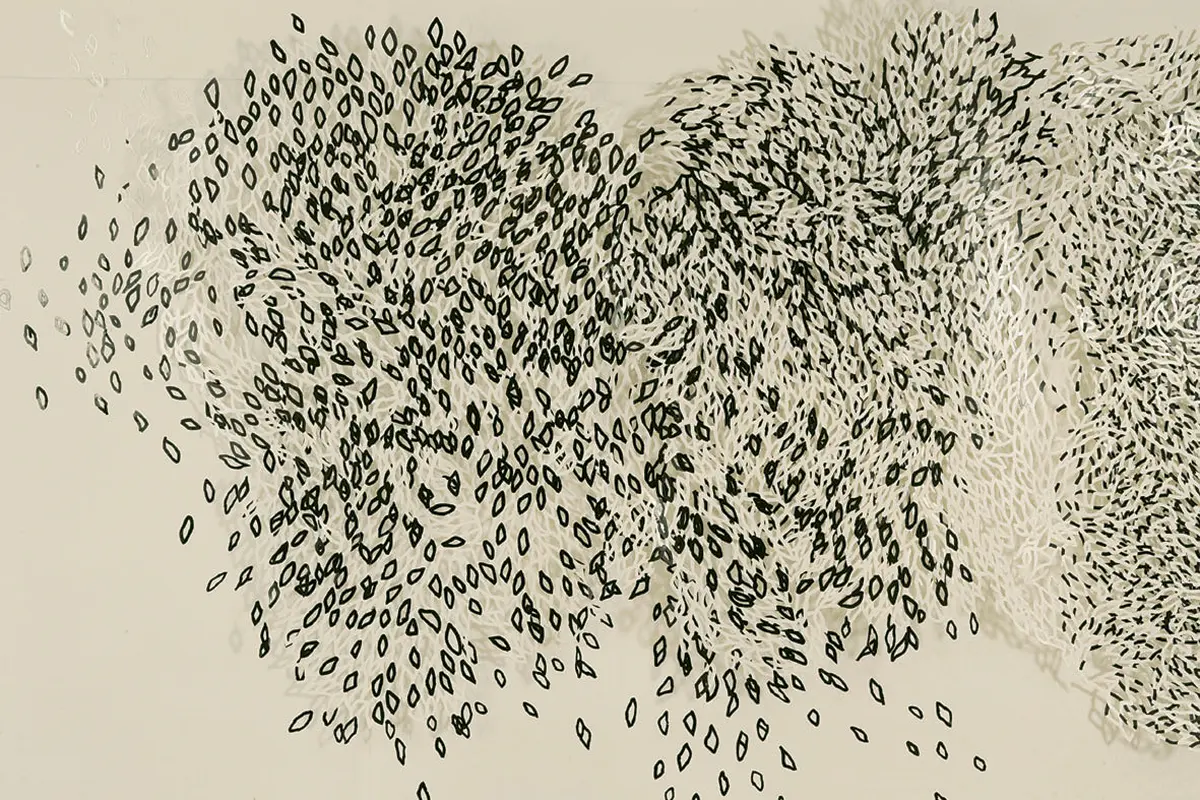
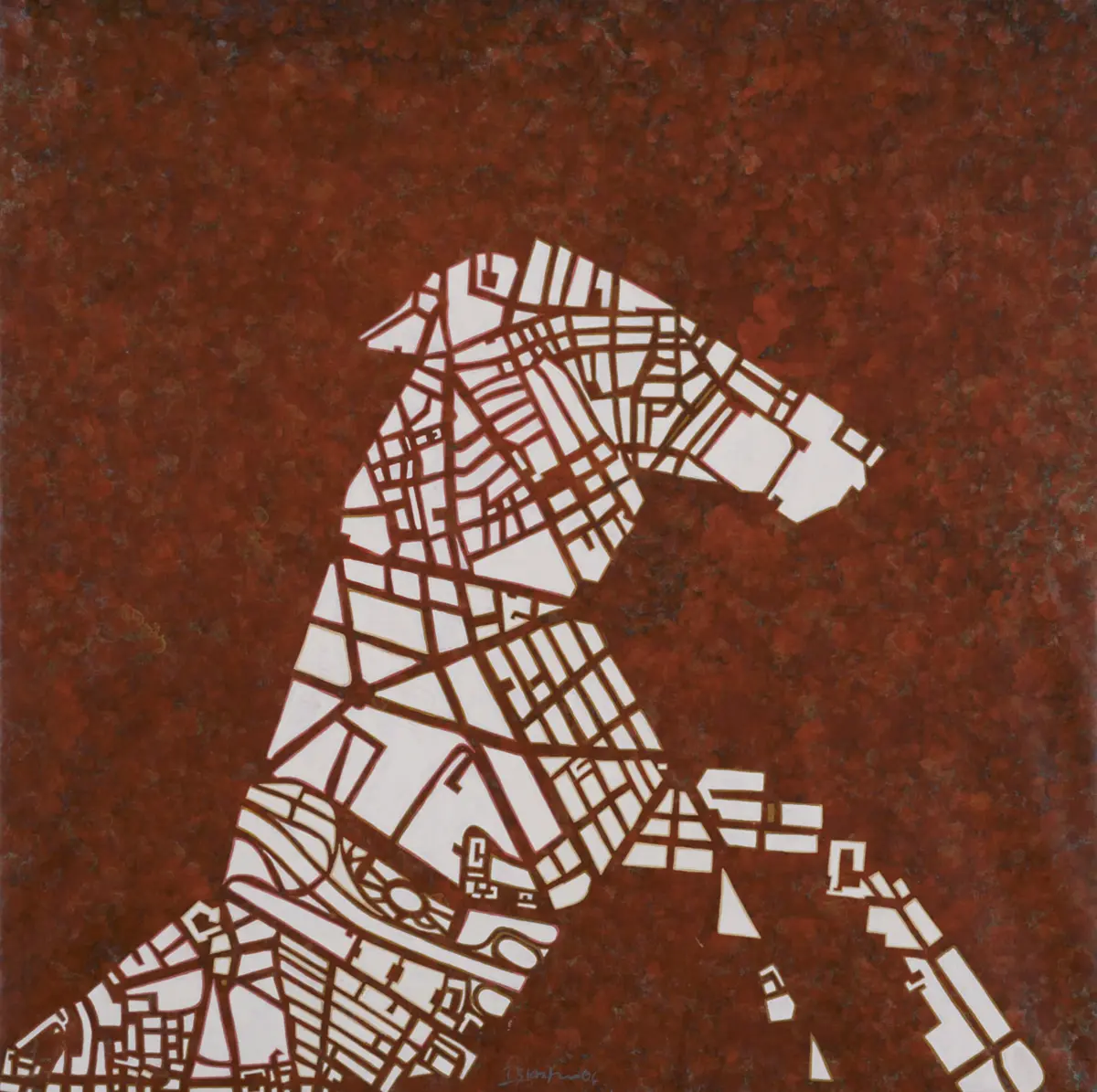
The diversity of the works in the Biennial and several occasions of artistic crossbreeding and hybridizations were notable. Similarly, the curatorial arguments were backed up by several dissimilar interpretations and readings. One would have to start with the approach to cartography seen in the selections by Aureliano Parra (Venezuela) and Ibrahim Miranda (Cuba). Parra participated with Geographic Mutations on the Landscape II (2005), an installation featuring the superposition of "woven" plastic strips. The resulting grid—very light, transparent, and highly poetic—incorporated a pristine image of Caracas from an abstract, broadly cartographic criterion guided by repetition and expansion, similar to the analysis of urban structures. The allusion to this universe acquired different connotations in the work by Miranda, who, in his peculiar treatment of urban grids, took pre-historic and ancestral iconographies as distant references. Through drawing, Miranda contemplated the manipulation of urban plans, their later transference to the field of painting, and the complementary and contrasting display of both resources, observed in the three works Rhino-Paris, Horse-Madrid, and Rabbit-Basel (2007). This triad expanded his expressive possibilities beyond the purely pictorial field and placed the viewer inside a cartographic menagerie infused with the author’s subjective experience, his travels and trajectories, and the topologies and visual suggestions provoked by their interpretation.
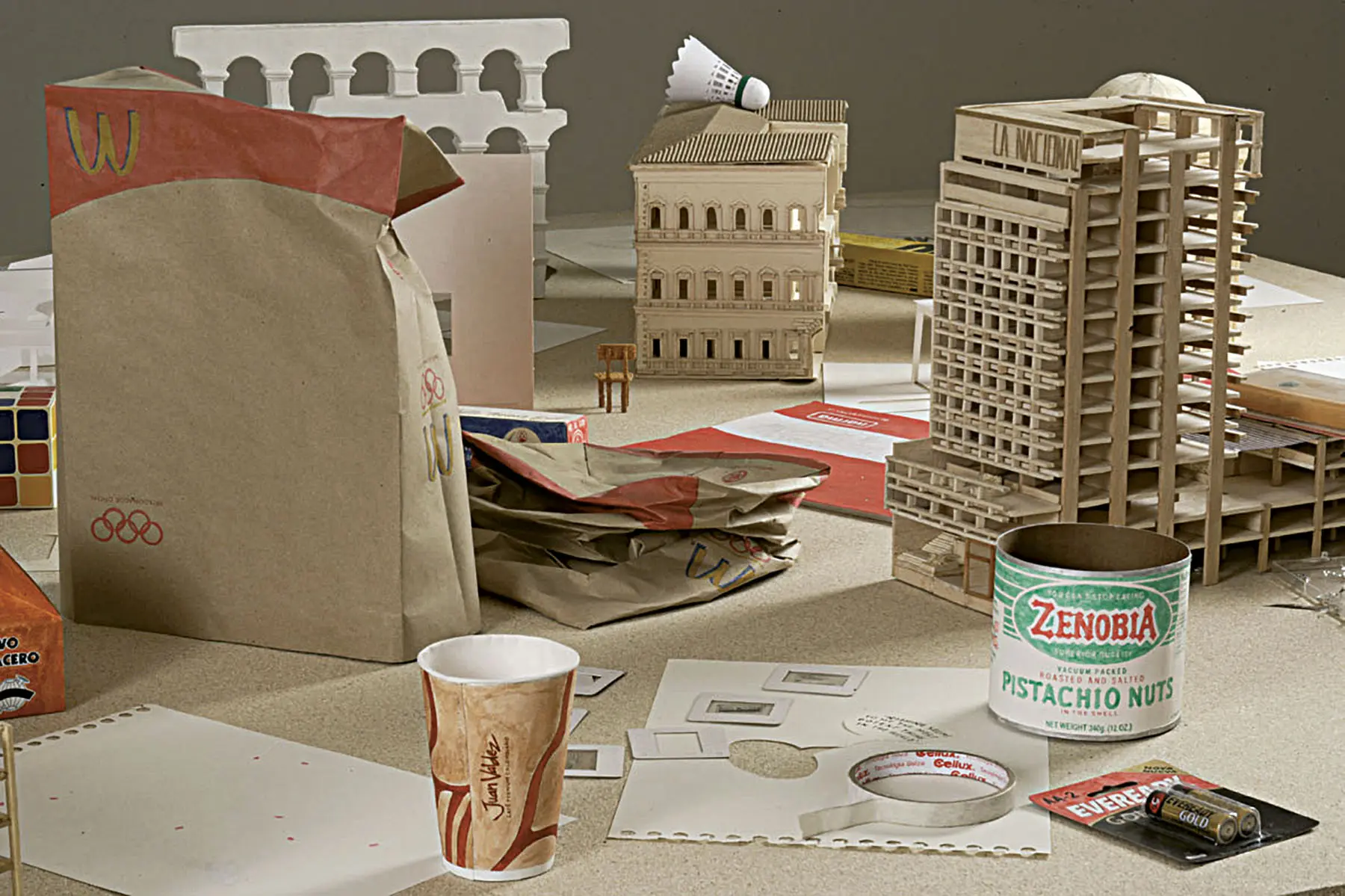
Mateo López, from Colombia attacked the urban iconography from a different angle with the Narration of casual Encounters (2006). Similar to what used to be called “paper architecture,” López used paper to reproduce buildings and objects later transformed into surfaces for drawing and painting and created models for outrageous cities—a way of working shared by Bodys Isek Kingelez (Congo), Gabriel Macotela (Mexico), or Carlos Garaicoa (Cuba), for example. Simulating a designer’s workspace, López displayed on large tables his replicas of the Light Temple and the University of Rosario Campus (both in Bogotá); Rome’s Aqueduct; works by Le Corbusier; a version of the Twin Towers made with McDonald’s bags, Coke glasses, Minora knives, and the most unexpected objects and utensils. With such elements, he configured a peculiar city, conceptualizing and de-mystifying the various uses and the political, commercial, and residential functions that are inherent to a contemporary city. The lightness of the work’s shapes and its meditated interest in portability underscored the overwhelming theme of nomadism and displacement.
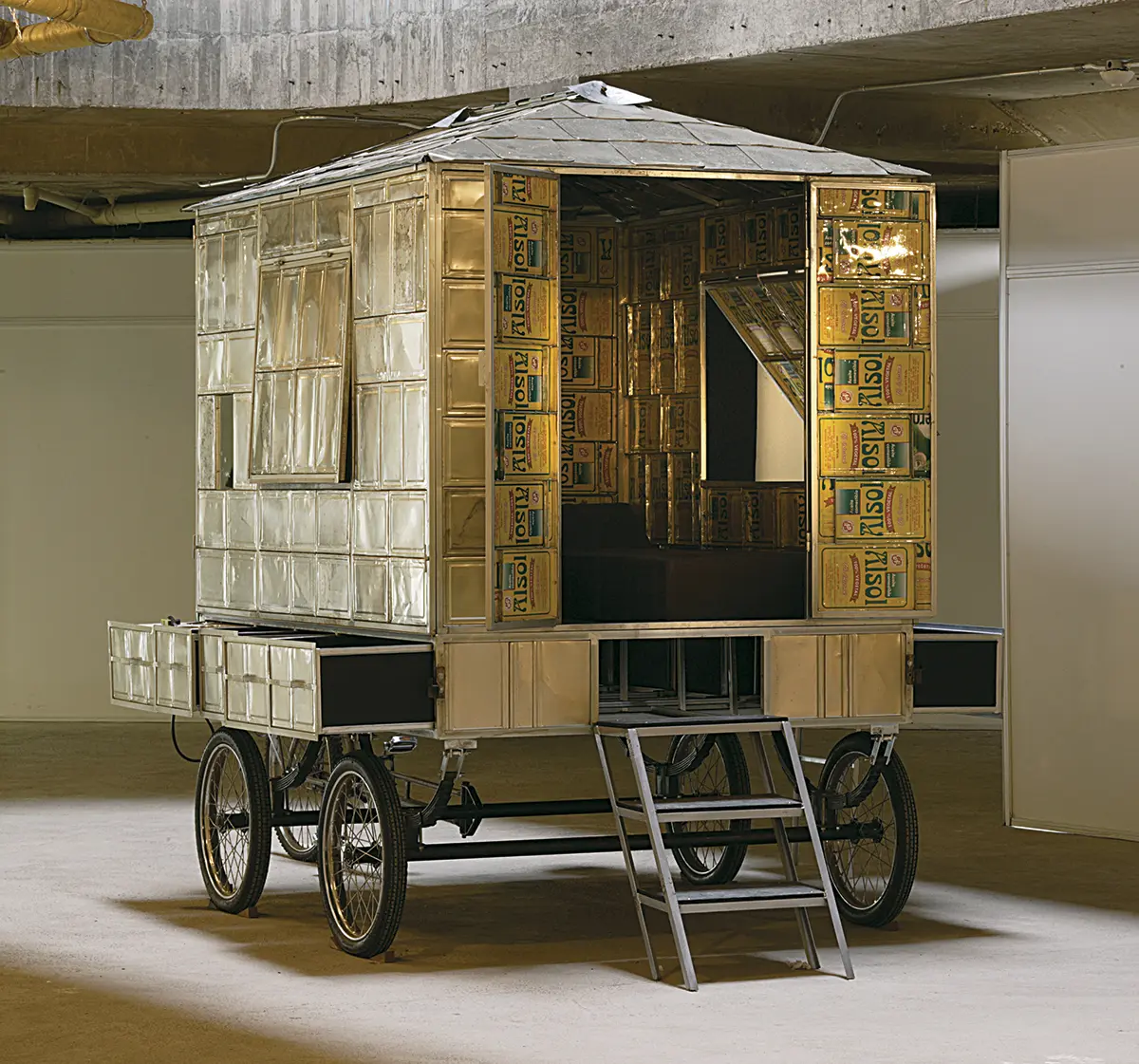
Some works investigated the habitat’s spatial and symbolic connotations. In the fashion of a self-referential minimalist environment, Esteban Piedra (Costa Rica) designed the plan of a home following the principle that a home continues one’s own self. Through a convincing use of texts, drawings, video, objects, and detritus gathered in domestic spaces (such as pieces of pipe, locks, and human hair), Piedra’s work spoke of the analogies between the body and the habitat, the vital processes of construction and destruction, the frailty and temporariness of the universe conceived by Man to perpetuate material gains that are inevitably subject to old age and death. Ishmael Randall-Weeks (Peru) brought his Nomad Tricycle (2007) by highway from Lima to preserve the essence of the wheeled invention, a prototype of a minimal and self-sufficient space for living. On the tricycle, which followed not rational architecture’s concept of a minimal dwelling but rather the ever the more common model of informal or ambulatory commerce, one could find all the comforts and services of home—a symbol of the housing urgencies of the overpopulated cities of South America.
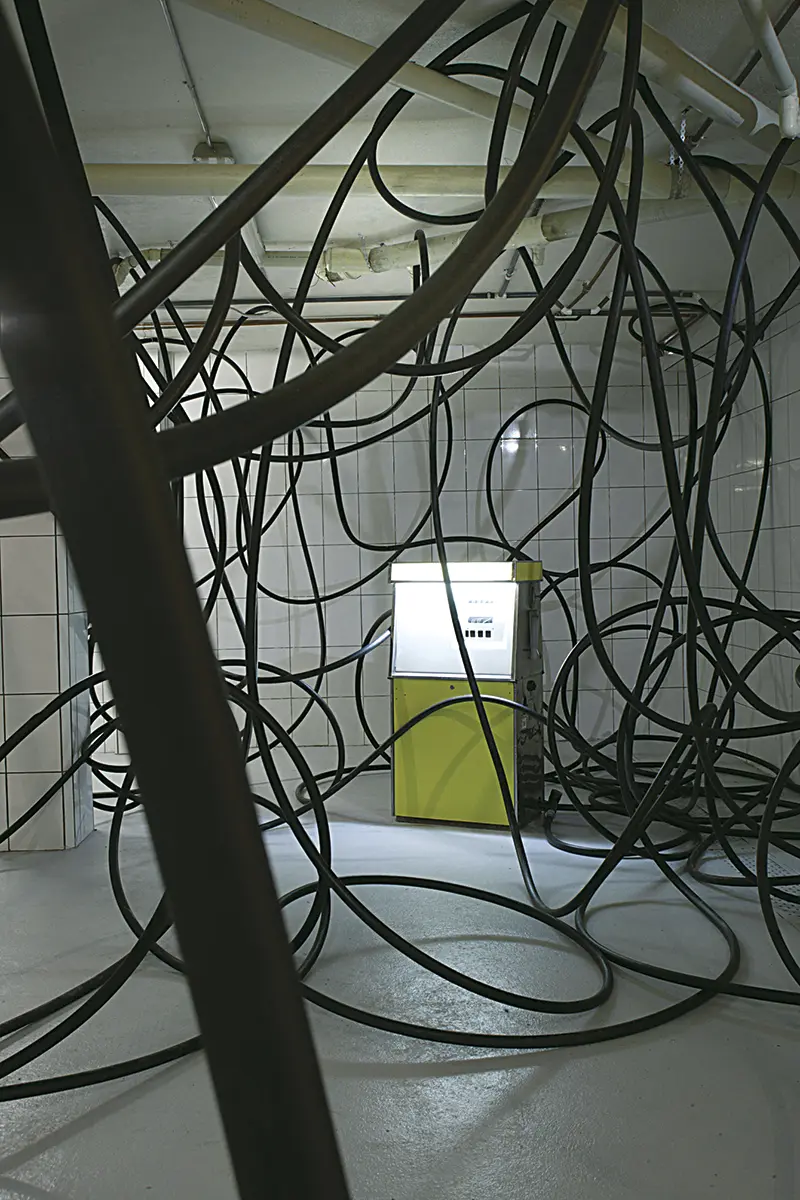
Regarding spaces, the La Limpia Collective (Ecuador) produced a powerful and provocative work titled Mobilizations. This group appropriated a large site with the placement of an old gas pump and many meters of black hose that sketched an aerial drawing of a dripping hose. Traversable and of great expressive efficacy, the abstract nature of the work did not interrupt the installation’s focus on issues of a global reach.
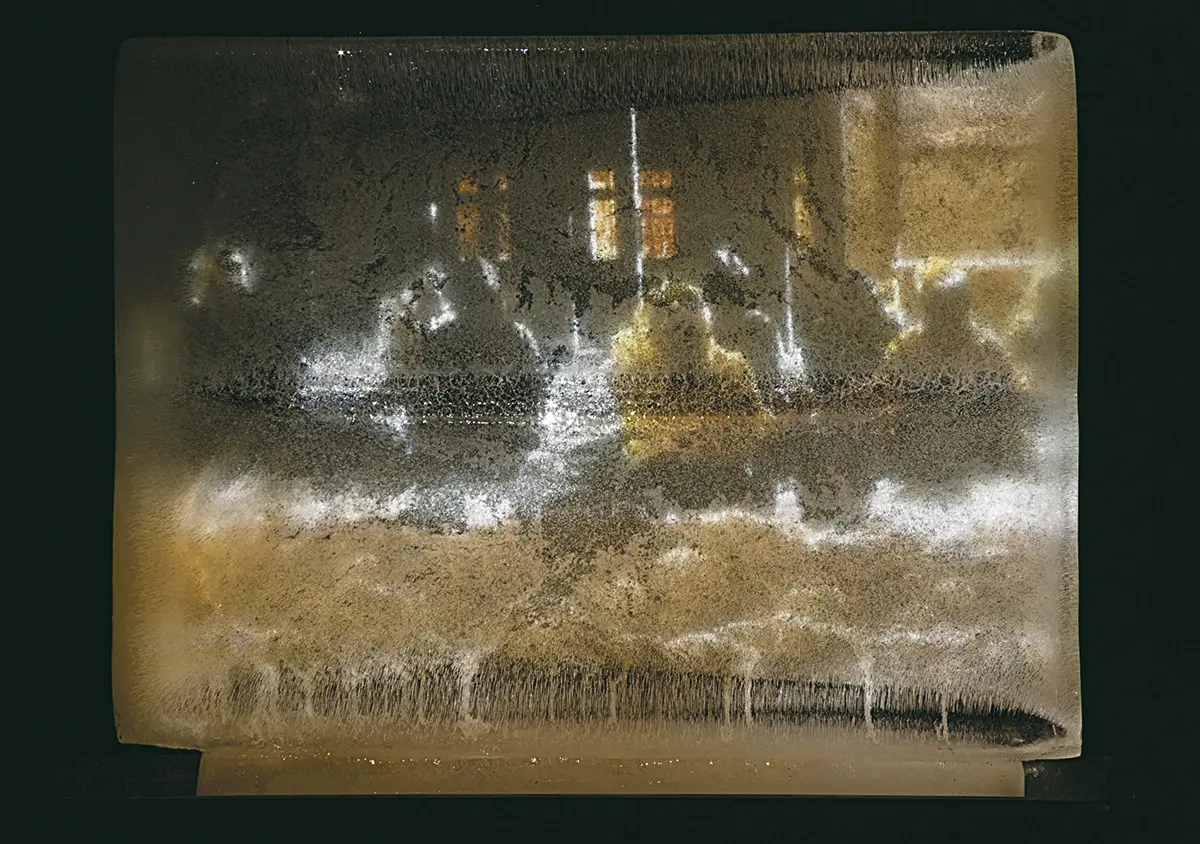
There were notably successful proposals in the video. Patricia Villalobos (Nicaragua) arranged simultaneous projections on the walls while polyethylene sculptural supports hung from the ceiling. Migdalia Barens-Vera (Puerto Rico) documented her travels through various spaces, Cuenca included, in a video installation. Donna Conlon and Jonathan Harker (Panama) explored the medium’s linguistic potential, based on urban-rooted archaeology. This operation produced a sequence of images formed by multi-colored garbage bags piled by the wind against a wire fence, which created a kind of abstract “painting” that was greatly plastic in character. With this work, the artists questioned human and social behaviors while transforming the detritus generated by irresponsibility into objects of beauty. In a similar experimental vein, Caraballo-Farman (U.S.) showed Contours of Staying (2004), which projected the prayers and actions of the Falun Gong group on an unusual screen, an ice block. Planning the work as an ephemeral video sculpture, this artist duo took advantage of the ice’s transparency, which revealed on the reverse of the block the distortions of the image in planes of diffuse and abstract colors as it passed through the translucent support.
As expected, some artists worked for the urban spaces. Located in parks and city squares, five large paintings on vinyl mounted on metal frames by Marcelo Aguirre (Ecuador) resembled picture frames commonly found in people’s homes, with quasi-urban flashes of forceful, contrasting tones. Mariano Molina (Argentina) extended the series of photograph-based murals he has developed in recent years. Juan Carlos Ordóñez (Ecuador) projected his images on the sidewall of the famous Conceptas Convent. Collecting Fragments (2007) by the Uruguayan artist, Mario Sagradini reproduced fragments of texts by Uruguayan writers on the pavement in different parts of the city. The work by Lucía Madriz (Costa Rica) was also based on text, using gardening skills to write the phrase Daño collateral (Collateral Damage) on the grass by the Tomebamba and load the work with critical meanings of human, social, economic, and political transcendence.
According to their interests, other invited artists examined the controversial global circulation of news (Néstor Otero from Puerto Rico), images and landscapes (Kelvin López from Cuba), and tourist paradises (Gerardo Goldwasser from Uruguay). Following a route similar to Conlon’s and Harker’s but on the counterpoint of photography and painting, the Costa Rican artist Ana de Vicente produced an equally abstract effect based on the decay of urban advertising. The imprimatur of the popular found a champion in Luis Salazar (Venezuela).
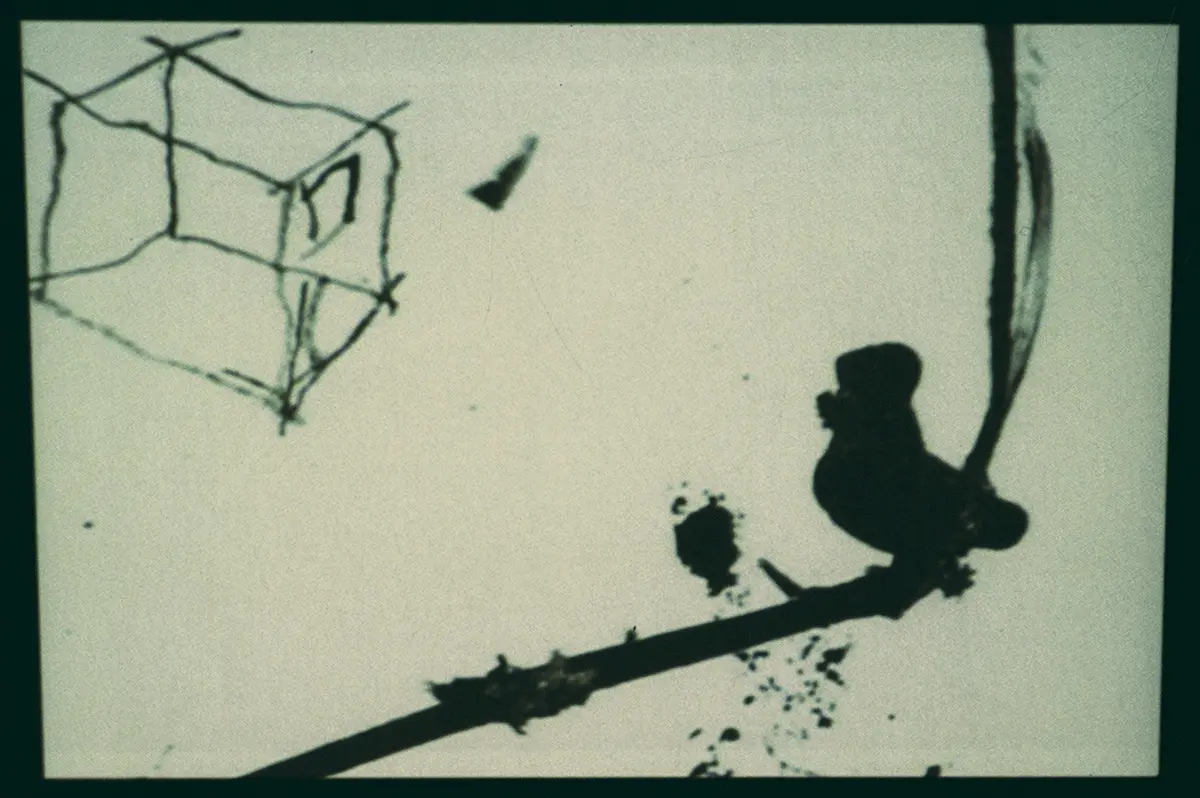
Contrary to the established bias that created two prizes in painting and one for all the other genres, the jury disregarded the good examples of painting and gave the three prizes to Juan Pablo Ordóñez (Ecuador), Mateo López, and Esteban Piedra, three artists with excellent works in video projection, object painting, and environment, respectively. María Teresa Ponce and Fabiano Kueva received the Paris Prize, while the La Limpia Collective received a Mention, as did Philippe Gruenberg and Ishmael Randall-Weeks, both from Peru.
The theory symposium that accompanied the exhibition program circulated ideas about the issue of reflection, with presentations by René Cardoso, President of the Cuenca Biennial; Ángel Kalemberg, Director of Montevideo’s Museo de Artes Visuales; María Luz Cárdenas, Director of the Museo de Bellas Artes de Caracas; Juanita Bermúdez, from the Bienal de Bellas Artes Nicaragüenses; Rubén del Valle Lantarón, current president of Cuba’s Consejo Nacional de las Artes Plásticas; and Eduardo Araujo, General Director of the Panama Art Biennial, among others.
In a significant development, the organizers of the Cuenca Biennial set new standards with regard to working collaboratively with other institutions, such as signing letters of intent with museum and biennial directors from Uruguay, Venezuela, Nicaragua, Guatemala, and Havana’s Centro de Arte Contemporáneo Wifredo Lam. A preview of these collaborations was the presence of two curators from the center in Havana and a exhibition designer appointed by the Museo del Barrio.
The Cuenca Biennial closed its doors after an intense program geared to its public. Special note should be made of the promotional activities prior to inauguration day, with the journal Bienalarte providing systematic information about the preparations for the Biennial. Cuenca faces considerable challenges, but it has become a significant platform for the international presentation of the hemisphere’s art scenes.
JOSÉ MANUEL NOCEDA FERNÁNDEZ
Art Historian.