Francis
Acea’s latest solo exhibition, at Kunsthaus Miami, was part of his series D.B.A. (Doing Business As). Acea uses the language of business, in which
D.B.A. is a common concept, to stress the relationship between art and
commerce, between the artist and the gallery. This series began with his
exhibition D.B.A. Francis Acea at Magnan Emrich Contemporary in New York,
when he was “doing business as himself.” In this recent exhibition, Acea
reconsidered his position and instead decided to do business as nobody. He
stepped back and let the gallery conduct its business with somebody who
technically represented him. He paraphrased the D.B.A. in the same way that it
is applied in the corporate business world.
The exhibition consisted of ten pieces, mainly objects, dating from 2003 to 2006, and the selection of works reflected Acea’s interest in ready-made objects. His minimalist works belong to an active current in the contemporary art world, a revival of the use of ready-made objects or art pieces that are created to resemble items of daily use. These works emphasize the aesthetic value of the design over the object’s original function. With this in mind, Acea appropriated iconic elements from American popular culture, as in McDonald’s-Fast Food-WWW, obviously based on the McDonald’s sign, which he inverted. This is a theme that Acea has been working on for years, taking advantage of his background in design. From the beginning of his career in Cuba as part of the Gabinete Ordo Amoris, he has been interested in appropriating elements of popular culture.
Acea’s 2006 interactive installation Solid Ground comprised 140,000 pennies, and it was conceived for people to walk on. The sense of literally walking on money addressed the importance of real value versus created value. Acea is betting that the artwork, in time, will be valued higher than the actual value of the money/material used. The irony of it is evident: what can be more valuable than money itself when it is precisely money that is used as an exchange tool to decide the value of an artwork?
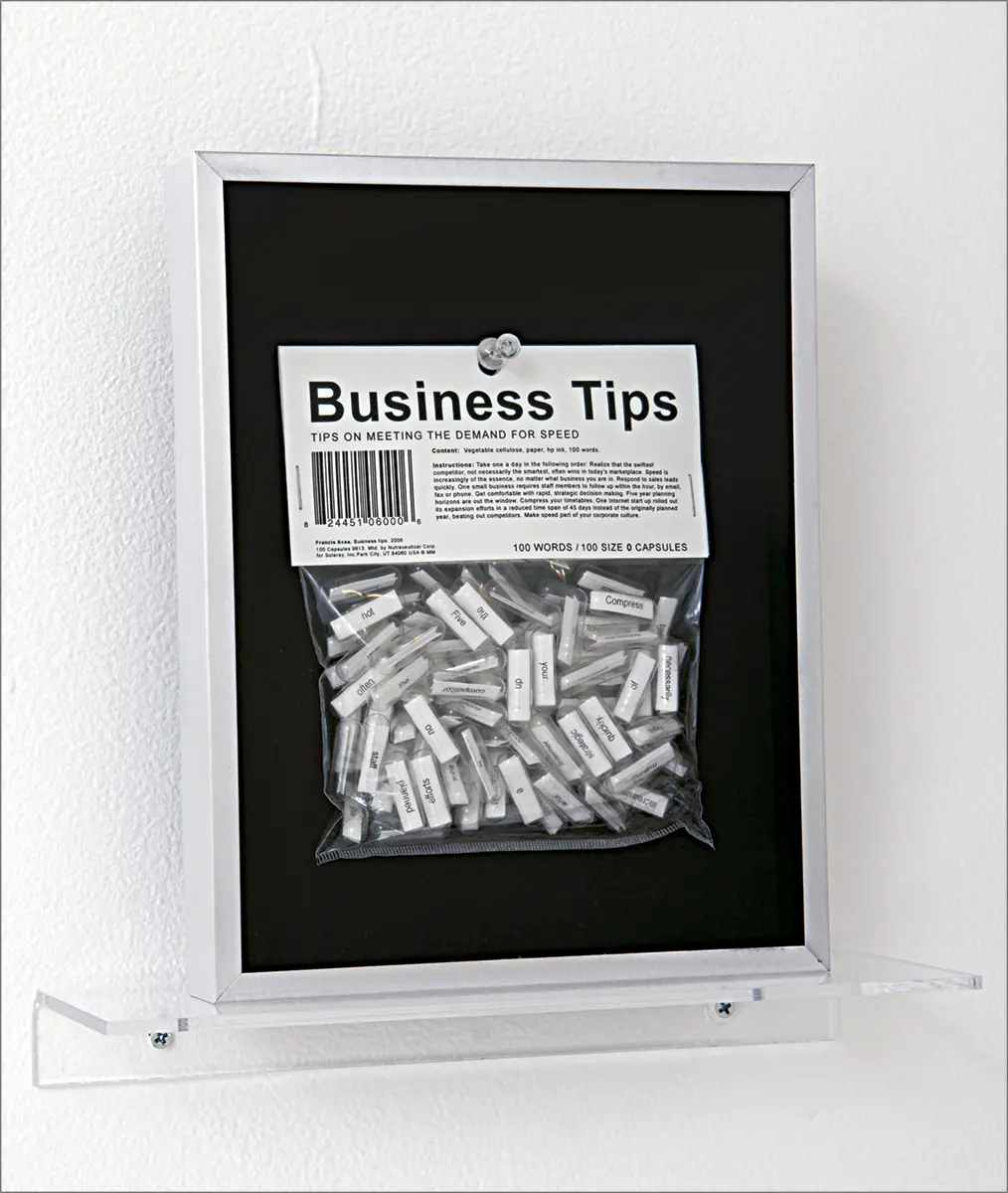
In his work, Acea acidly remarks on relationships concentrated in the business world. His boxes from the series Business Tips covered many possible aspects of today’s exchange. The boxes were full of keywords of different themes: tips on meeting the demand for speed, tips for developing policies for your business, tips for managing virtual relationships, and tips for effective business planning. Acea takes strategic words in this field and places them as if in business manuals promising the immediate success of one’s enterprise.
Doing business as nobody is an ironic statement about the contemporary art world and the process of commercialization that is becoming predominant in the field. Artists are trapped between making money and making art. In this situation, more art fairs are blooming per day and more exhibitions are purely social events, not held for the celebration of art or to admire the artist’s work. Acea’s works are about the relationship that inevitably is established between the artist and the gallery and the pecuniary exchange that comes from it. In a sense, the exhibition was a reflection of how art is being seen first as merchandise or an investment and secondly for its creative importance.
Acea’s work comments on the politics of the art world and its outcome, which can be unpredictable yet also easy to read. Where is the line between art and politics and where each artist stands? How do the galleries approach their endeavor? Just as business or as a creative adventure? Value is not directly connected to results, a daily reality in a vertiginous, changing Miami propelled by events such as Art Basel and the satellite fairs.
In a sense, Acea jokes, but he is extremely serious at the same time. A refined sense of humor and a provocative stance is in place in his work. This is his way of bringing to our attention the uneven relationships that are implemented in the art world, the commercialization that reaches new heights every day. Acea dares the art-world-savvy viewer to think about his surroundings.
IRINA LEYVA