
Since
the beginning of his career, Giuliano Bartolozzi (born in 1947, Italy) was
interested in photography as a means to conceive the representational modes
that would allow him to express the real and the imaginary. His investigations
led him to reformulate the use of this medium to allow the exploration of
different media. His creative process begins with a mixture of
images—photographed, drawn, engraved, or printed—and creates surprising hybrids
that greatly enrich the visual discourse. His themes are taken from the plant
world, and he describes tropical flora through basic components—flowers,
fruits, stalks, branches, trees, shrubs—that all form the motifs of his
artistic investigations. Shapes emerge from the plane to become high- or
bas-reliefs, and in turn space penetrates the format, fracturing and expanding
it, freeing the composition from its conventional constraints. Bartolozzi
trims, orders, structures, takes apart, and superimposes images that translate
into a poetic vision of the natural environment. The artist says, “I let reality
suggest an abstract shape in which my ever-present theme can be developed:
matter and it's potential. That reality stimulates me rationally and emotionally
to seek an icon (such as the flower) and use it as a symbolic element.”
Bartolozzi’s quest was virtually incarnated in his recent exhibition at Spazio Zero Gallery, from May 17 through June 17. The show brought together a group of works encompassing drawing, painting, and installation, techniques executed with a combination of industrial products that revealed both their material and immaterial aspects. Bartolozzi highlighted their pure and elemental finishes, which produced a visual and conceptual synthesis that was intellectually clear. Via painstaking handcraft, the artist manipulated the visible and the invisible to attain subtle, delicate results that were at the same time radical and forceful. His purpose was to underscore the curvature of the shapes, the rhythm produced by an image’s repetition, and the contrasts brought about by the confrontation of fullness and emptiness of light and darkness. For the installation Valencia, the artist made the shape of a tree leaf in transparent acrylic and repeated this element in an orderly and symmetrical fashion on the walls. With the same motif, he made combinations in cardboard, paper, and acrylic in a sequence of hanging curtains that achieved visual alternating the positive and the negative, the solid and the lightweight. Bartolozzi took the same principle to two dimensions, with monochrome shapes that invaded canvas, as in the works Sudario, Calco A, and Calco B.
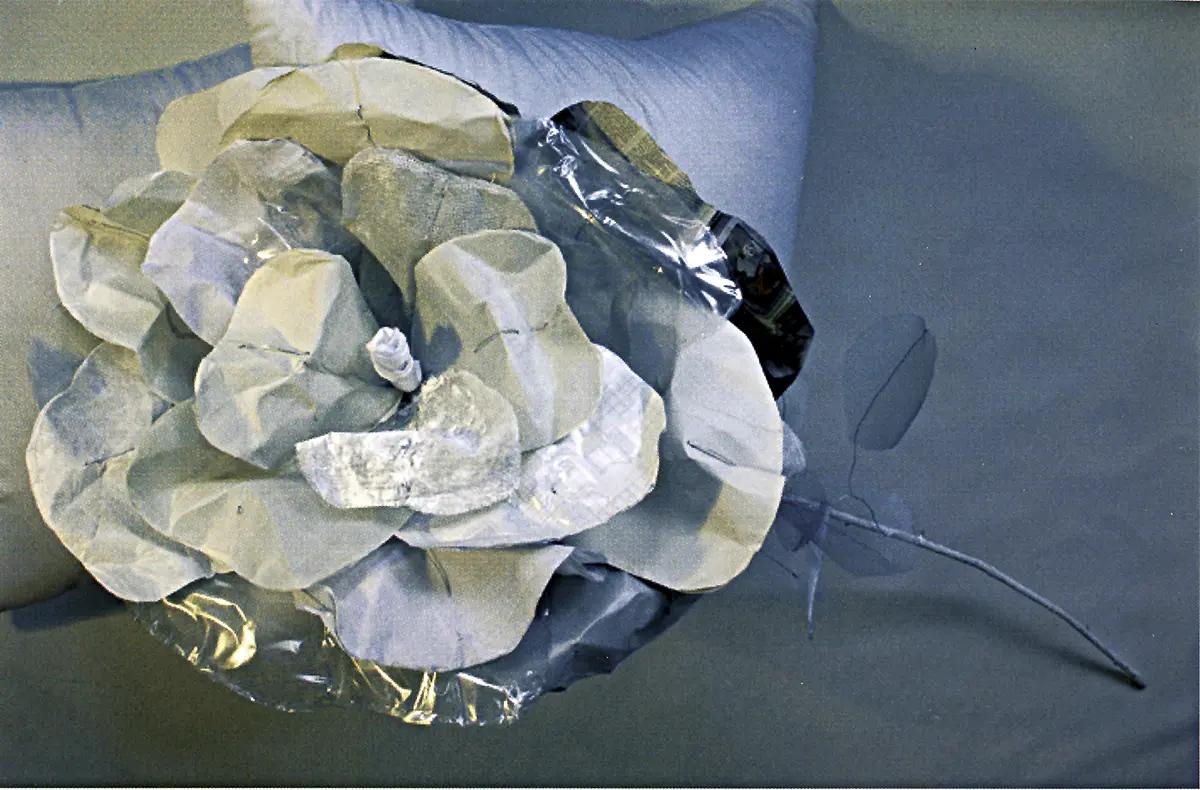
The works seen in this show were reminiscent of movements, genres, and icons from the Western pictorial tradition, such as the use of materials linked to Arte Póvera, the recreation of referential themes such as the still life, or the reinterpretation of famous works, like Manet’s Olympia, from which the show’s title and the title of its central work was derived. The latter was a sculpture made of pieces of wire, paper, plastic, and canvas, among other elements, arranged in the shape of a giant rose. Its installation alone in a separate room under lights that highlighted its textures and the peculiarities of its structure favored a theatrical reading. The object was laid on two large white pillows, arranged in a way that resembled Manet’s famous reclining nude painted in 1863 for the Salon de Refusés in Paris. Sober and majestic, Bartolozzi’s Olympia towered in the center of the structure that contained it, provoking associations with archetypes of love and female beauty. With this composition, the artist sublimated the emotions he felt contemplating Manet’s controversial nude figure, which marked his sensibility as an artist for a long time. “The Olympia,” Bartolozzi confesses, “evoked in me a sensual impulse I had never before poured into my work, and which is a part of my life. I saw this woman as a flower and transformed her reality.”
GLADYS YUNES YUNES