
The twenty years since the Panamanian artist Isabel De Obaldía began working in glass sculpture have not passed in vain. Her recent pieces are proof of a breadth of knowledge and an esthetic sense that can only be achieved with the maturity that comes from experience. Working in a medium in which fragility is omnipresent and the possibility for accidents during the execution of the sculpture is considerable, De Obaldía has proven to be a creator capable of transforming glass at her will. In her most recent production, there are sculptures that look like stone carvings or metal works—contemporary pieces that are reminiscent of archeological findings.
The title Prehistoric well describes the feeling that De Obaldía’s works provoked in her recent exhibition: objects that looked like the vestiges of some early civilization, of primitive people who adored, but also feared, the power of nature. Dominant within the ensemble were interpretations of men or animals represented mainly by the physiognomy of their heads, frequently crowning vertical forms. The crocodiles with prominent eyes and triangular jaws in certain cases seemed to gaze at the observer in a caricature-like manner. Nevertheless, a piece like Crocodile Dagger, that ended in the shape of a knife, stained a bloody red, contradicted the initial feeling of good humor. In the vertical bodies of these figures, the artist achieved splendid colors and a contrast between the translucent nature of glass and the rough quality of the surfaces that she carved with a diversity of designs.
The animal world was also represented in sculptures of sharks such as Great Hammerhead, a dramatic blue figure with eyes on either end of its head and multiple stylized fins. It transmitted a feeling that was both dynamic and ambiguous because it simultaneously resembled a sea animal and an attack weapon, such as a primitive hatchet. This double meaning in the forms was present also in Abstract Toucan, with its blue beak and silver body that resembled an object from some ancient phallocentric cult, in which the juxtaposition of animal figures were not uncommon.
The surface of most of these sculptures was rustic, almost rock-like, with textures that the artist achieved through the technique known as sand casting. This laborious process begins with the making of a model in clay or plasticine, which is employed to create a plaster cast, which is then used to produce a prototype out of plaster. With this prototype, the artist makes the mold by inserting and later removing sand in order to leave a space that she later fills with molten glass. That piece is then put into a kiln to allow a slow cooling process, under strict temperature control. The sand in the mold leaves a notable texture on the surfaces of the sculptures, both those of animals as well as those that represent human beings.
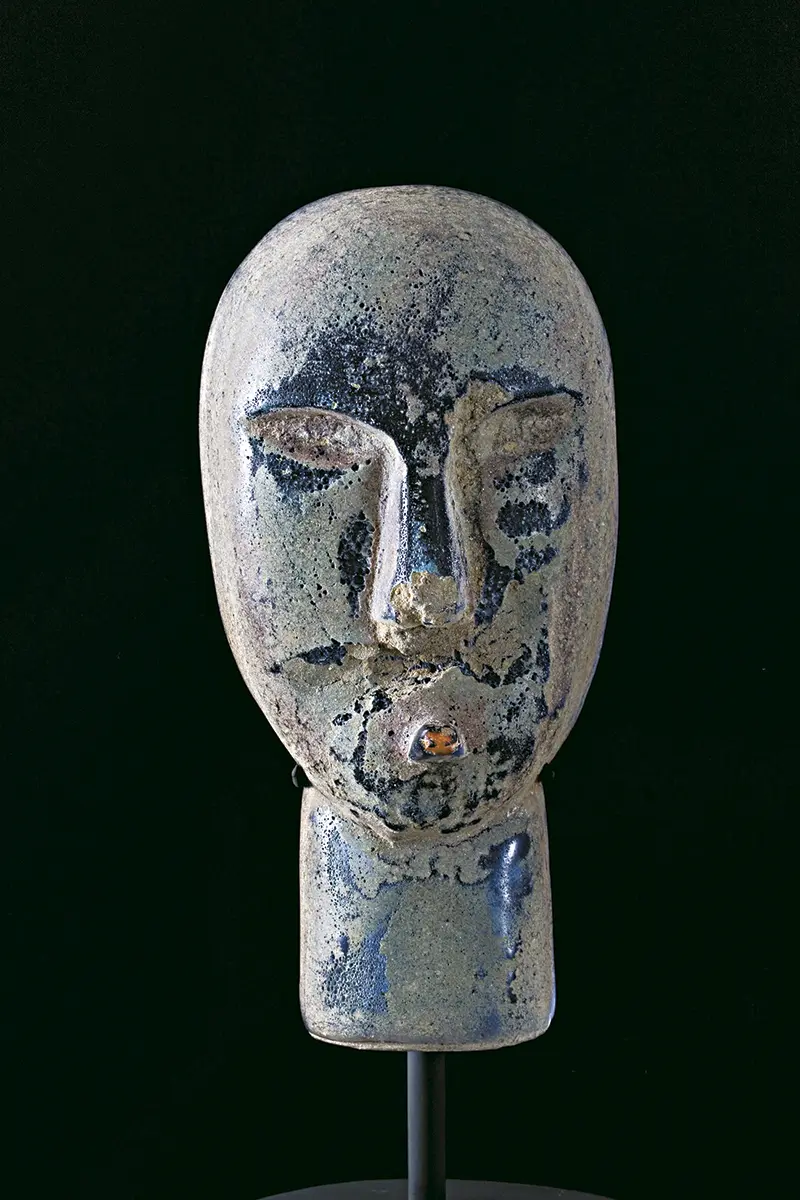
De Obaldía created a series of human heads in glass, which she exhibited mounted on, or traversed at the temples by, copper or stainless steel tubes. They had oval faces with prominent noses and ocular cavities into which the artist incorporated elements from the natural world. The fronds of a palm tree emerged from the forehead of Palmouflage, and Hammer Head resembled a cross between a man and a shark. In heads such as Prehistoric and Seashell, De Obaldía challenged herself technically by incorporating in the first one a resplendent white animal bone over the green and red glass and, in the second, by marking the surface with the patterned remains of shells that were inserted in the mold during the casting process.
De Obaldía treated these human faces like canvases on which she experimented not only with colors but also with certain iconographic and symbolic elements. There were often protuberances in the form of tongues or other body parts. In Serpents’ Nest, thirteen snakeheads emerged from a face of delicate reds and blacks like two-eyed tongues, transforming the piece into a kind of fetish.
While one looked at these works, the feeling of standing before ancient idols was magnified in the two-meter-high columns that De Obaldía created by stacking six or more cylindrical glass pieces, each one covered with a row of faces or skulls. Although she referred to them as “columns,” these works were reminiscent of the totems of North American Indian cultures, metaphorical representations of human groups interpreted through the figures of animals—columns that were believed to have supernatural powers. As always, Isabel De Obaldía’s work was ruled by the interplay between man and nature.
MONICA E. KUPFER