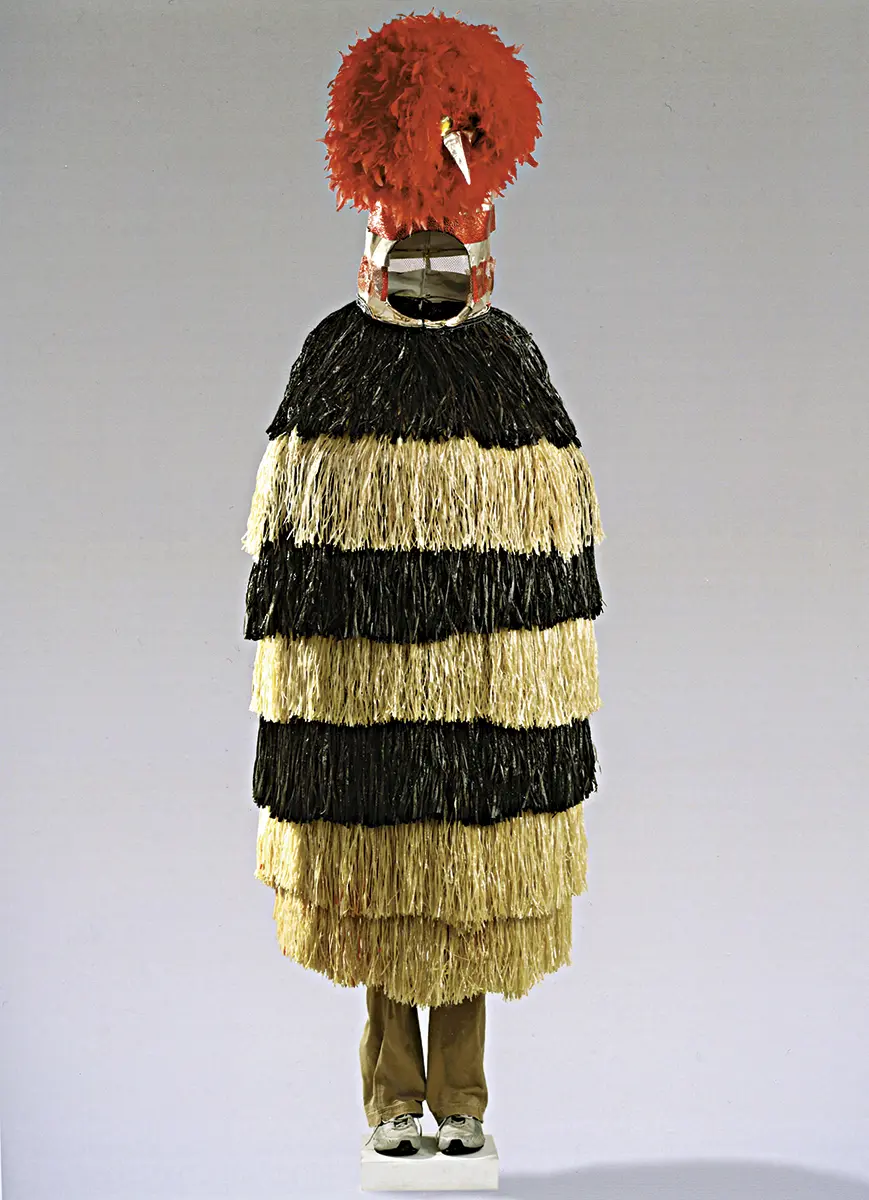
Entering the gallery meant finding an unusual gathering of forms and materials, with fibers—threads, feathers, PVC tubes, beads, recycled cardboard, papier maché added to beastlike mottled cloth masks, fiberglass, aluminum, paints, natural fibers, tin bells, silks, foams, mesh cloths, varnishes, mirrors, and anything else one can imagine. Inside the second room, there are characters wearing ritual garments monitors playing different things, and prints mounted on aluminum, the result of a collaborative effort between Anderson and photographer Stefan Falke. This collaboration produced notable lentil-shaped impressions—holograms—that besides acting as independent exhibit pieces, also added another element: reflections of costumes or dresses worn by people in the room would be constantly transforming these objects. Here and there, large inhabitants and masks would movingly, amusingly, ritualistically, and provocatively saturate the room. The approach was a dynamic exhibit: certain elements were maintained and others would change place, thus generating new relationships as pieces were moved into different areas. At my second visit to the exhibit, as I came through the door I found Laura, her back turned to me, guiding several volunteers as they stitched sections of garments to be used for street presentations, carnivals, or city parades.
Laura Anderson-Barbata’s exhibit altered the traditional conditions and appearance of the art gallery. This artist’s objective was to integrate the diverse segments of society, underscoring that intellectual curiosity should not be at odds with the interests of archaic and popular minority communities. On this particular occasion, she focuses on Afro roots as she transformed the Chelsea Gallery into a workshop for the creation of vestments fashioned for the Brooklyn Jumbies trio to wear during rehearsals and performances, and for the artist’s street performance with volunteers that took place one afternoon in the streets surrounding the gallery. At workshops scheduled weekly, people were also trained to walk on stilts and additional information was provided on the Jumbi. Few things were actually for sale, because Laura did not want to let them go, or because they were intended for future projects.
Laura was born in Mexico City and lives and works in New York. She often travels to the Venezuelan rainforest, the Virgin Islands, Trinidad, and other places. She has done several socially conscious exhibits, and many others in which the work was individual within the usual parameters of an art gallery, in other words, commercially marketable and traced to an individual author. She has recently exhibited in Mexico, Germany, and Colorado. From her beginnings in the late 1980s, Laura would integrate tela de manta (coarse cotton cloth) in her works and would participate in collective painting, textile, and installation workshops.
Besides establishing ritualistic, social, and human elements, this laboratory of projects titled Jumbie Camp also creates a direct connection between this visual artist and volunteers from different backgrounds, brought together by the common goal of activating this sociologic laboratory. To what degree can total strangers learn from each other? How would they react to the experience presented to them in this seemingly exclusively artistic environment where social diversity, tactile conductors, and sewing and gluing methods merge? Exchanging experiences and having fun together were definitely appealing factors. The opportunity to learn first-hand from the artist, and for some, the chance to comprehend the meaning of such an artistic project, attracted a large number of participants.
Color, an endless assortment of textures and materials, from natural to industrial, handmade, or recycled, converged in the space as if in a theater workshop that produces costumes for upcoming Broadway shows. The vestments/characters are mainly tall, some are objects created to adorn the heads, arms, and hands, and others are accessories such as canes. The baroque mise en scène was not reluctant to meld primitive, Afro, and Mexican elements. The entire production of this project by Laura Anderson guided the spectator to an installation outside Minimal and Conceptual parameters, so trendy now in the New York galleries.
The Jumbies have participated on several occasions with Anderson, who seems certain tribal ceremonial activities, from Afro-America in this instance, as traditional expressions of societies that were required to integrate, the majority of these by force as slaves, into other cultures and countries in the developed world. While this montage serves Anderson’s artistic project well, it also sheds light on its origins: the elements of tribalism and the practice of sharing.
GRACIELA KARTOFEL