Liset Castillo’s series of photographs in her exhibition Pain Is Universal But So Is Hope presented the sacred and secular monuments of world history gathered preposterously in one landscape, which was slowly destroyed and recorded in a sequence of images that challenged one’s notions of illusion versus reality. Each of the young Cuban artist’s eight C-prints on aluminum projected a large view of a diorama of sorts, a world of fastidiously sculpted versions of the world’s ancient and modern architectural wonders, all constructed of golden grains of sand.
In the final photograph of the series, Pain Is Universal But So Is Hope (Violet) (2007), the buildings had collapsed in a pile of rubble, with a towering crane looming above the sand-constructed heap, against a deep blue-violet sky. It was a disquieting image, one that ultimately explained the potency of Castillo’s project. (More of her work was shown, simultaneously, in the Brooklyn Museum’s exhibition Infinite Island: Contemporary Caribbean Art) Although her photographs record a fantasy world, Castillo sculpts with remarkable skill and, as one visually sifted through the destruction of each intricate tableau—marking the collapse of the Chrysler building or the Pantheon, for example—one began to read the scene as not simply an illusionistic ploy but rather as a vision of the collapse of civilization, a point of particular urgency during this time of war in Iraq.
First in the series of large, seventy-by-ninety-two inch photographs were Pain Is Universal But So Is Hope (White) (2007); its eerie white sky offered a close view of a handful of famous edifices that appeared freshly sculpted. The photograph portrayed a landscape of historical icons constructed of a deliberately fragile material, resulting in an ephemeral, imaginary world. The Roman Coliseum, the Guggenheim Museum, the Empire State Building, to name a few, abutted each other, illuminated by the ominously glowing sky, which seemed to portend the disaster that unfolded in the following seven images.
In the next photograph of the series, Pain Is Universal But So Is Hope (Pink) (2007), a rosy sky bathed a broader, more distant vista than the previous one, which bore evidence of a destructive blast. The Empire State Building leaned precariously to the right, resting upon huge slabs of concrete and the Coliseum was all but buried beneath mounds of debris. Miraculously, however, a powerful icon appeared in this scene of toppled monuments, soaring above the Coliseum. With arms spread wide, a sand replica of the Christ sculpture that stands above Rio de Janeiro perched upon the heap of the earth (sand, actually) above the Roman ruins. In a jarring reference to the mix of history, culture, and eras captured in this tableau, the large, cursive script from a Pepsi-Cola sign spilled from the mound holding the Christ figure; these two diverse but widely known symbols appeared in stark juxtaposition.
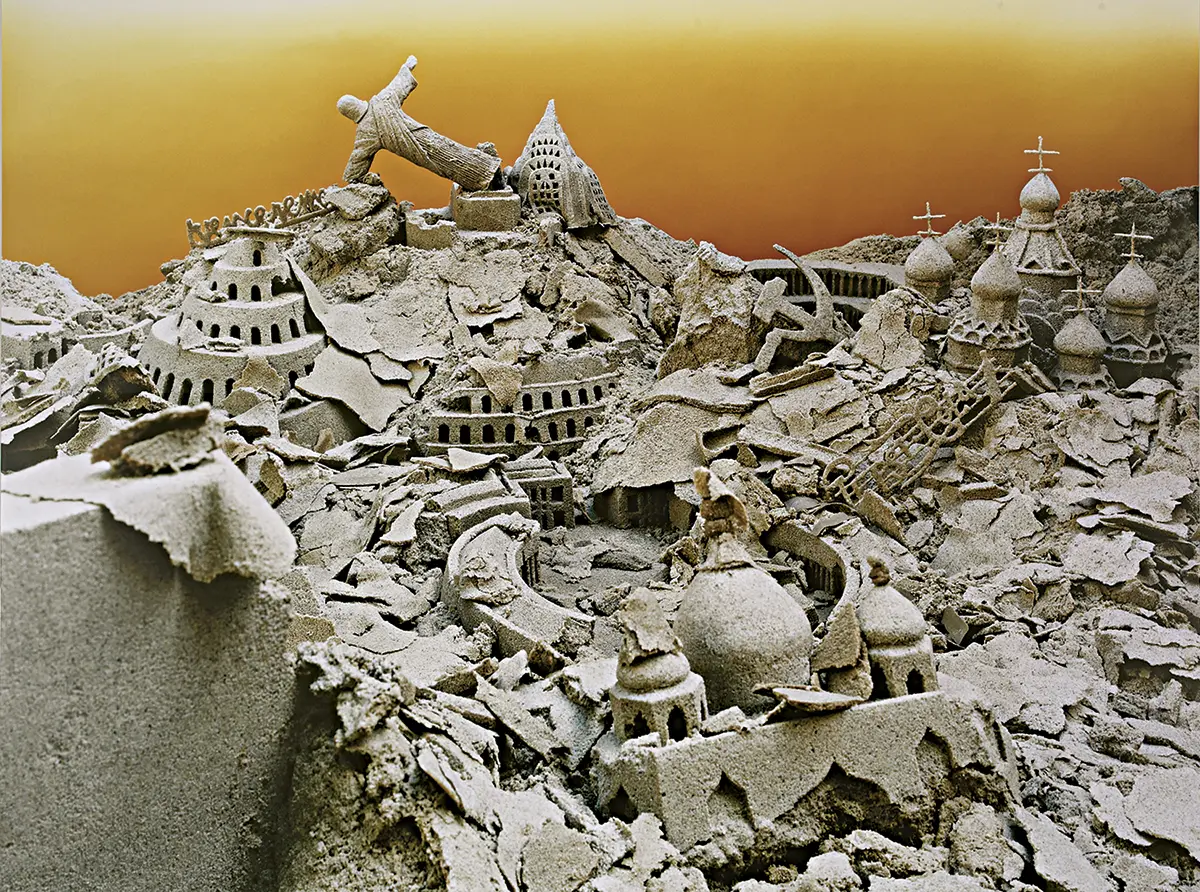
The next view of the cataclysmic destruction, Pain Is Universal But So Is Hope (Orange) (2007), portrayed a broad sweep of the setting shown in the previous image but incorporated new monuments, such as the Russian St. Basil’s Cathedral with its distinctive onion domes bearing crosses protruding above the clutter, an oversized hammer-and-sickle lying beside it, and the art deco pinnacle of the Chrysler building stationed beside the now-fallen Christ figure. This pale, even-hued scene in sand presented chaos and devastation to a far greater degree than the previous photographs, and it presaged the gradual collapse captured in the remaining works in the series.
Ultimately, Castillo’s photographs were deeply unsettling glimpses into a world gone awry. That she constructed the monuments of history and symbols of a culture’s power from sand, a material inherently fragile, demonstrated the impermanence of each building and the civilization that built it. Moreover, that she photographed this process of devastation, making a fixed record of the destruction, first aroused curiosity then sorrow. Extraordinary as these large photographic visions appeared, they were, finally, potent warnings of the cycles of history and the transience of power. Hope resided in the crane rising from the ruins.
MARY SCHNEIDER ENRIQUEZ