For
some years, the presence of Luis Ruiz’s work in exhibitions has been a
mysterious occurrence that rapidly captures the interest of many followers.
Ruiz is an artist whose main professional work had been finding locations for
film productions, an activity that required his recreating scenery on more than
one occasion. To do so, he chose to enclose models of locations in clear resin,
with characters, furniture, and objects included; these unusual scale models
conveyed the idea of the sets to movie producers and directors. Later, Ruiz
found this form to be a creative outlet. With these scenes, he conveyed
narratives—with occasionally personal accounts—and left the beginnings and the
ends of these stories to the imagination of the spectator.
Acidic humor, extreme situations, and elaborate sagas full of voyeuristic implications underscored Ruiz’s unique way of bringing the observer closer to the work. When one looked through the transparent walls of each piece, bedrooms, kitchens, and other interiors formerly hidden were open and vulnerable to the viewer’s gaze.
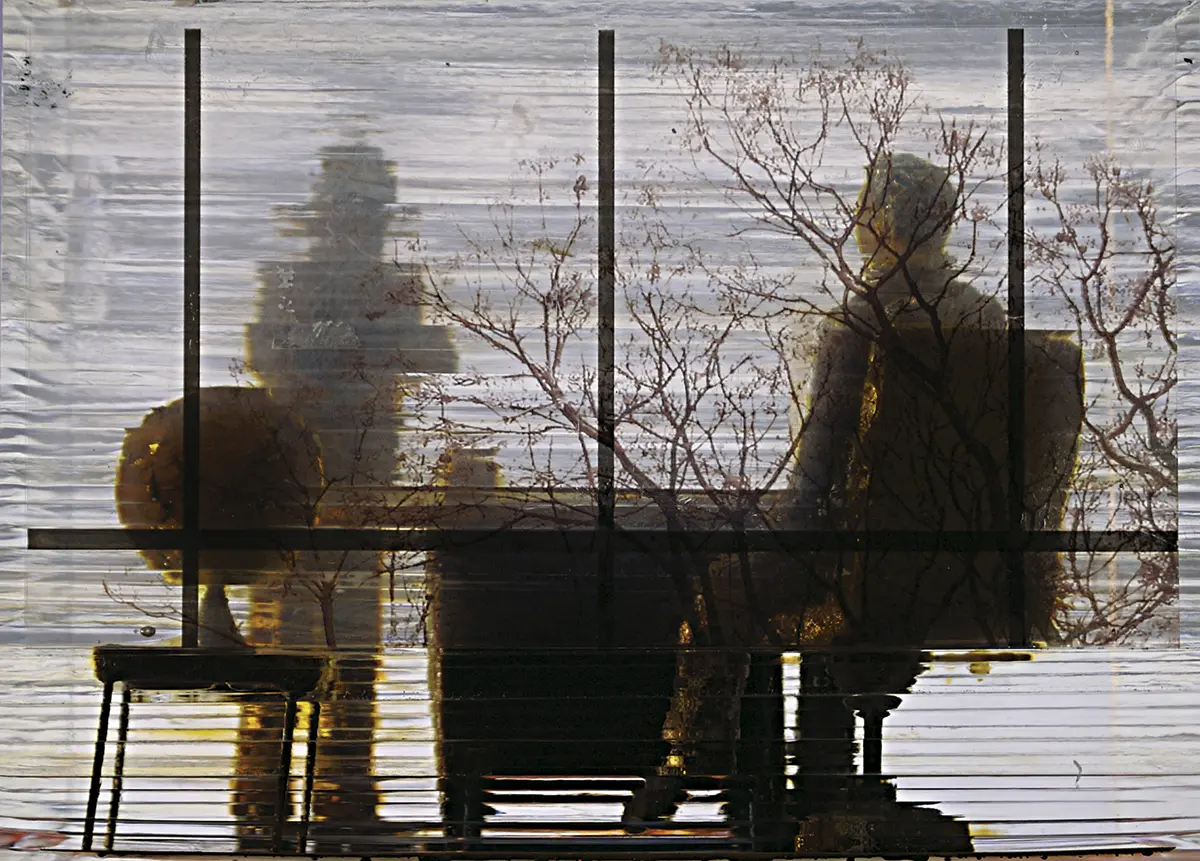
Something similar occurred with scenes from the exterior world (although the “exterior” is not the outside of the boxes and is not contained in them): one witnessed moments such as a countrywoman distractedly milking a cow or three men urinating on a car half-buried in mud, celebrating the event described by the title La Muerte del Contador (The Death of the Accountant).
In the artist’s last series, entitled Hasta el Viento Está en mi Contra (Even the Wind Is Against Me), a title is undoubtedly taken from the exacerbated monologue of a character in an extreme situation, Ruiz encapsulated soap-opera-like stories linked to sepia-inked photo-romance novels. These stories, filled with corrosive humor and approximate realities often more intricate than the intrigues on TV left the spectator with the sensation of safely witnessing scenes in which he or she was not asked to play a leading role, at least not for now.
To emphasize the dramatic narrative, some of the characters had word balloons or lines of text near them that reconstructed the language of these publications and subverted the reality found outside the space containing the works. Accordingly, one read in one of the texts, “Engineer Cudberto Stanfor felt apart from the news of his divorce. He could not stop thinking about the idea of being abandoned... On the other hand, Paulet Nicol was determined and firm, as if her urgency to remove the ring from her finger was filling her with renewed hope...”
Also presented at the Terreno Baldio Arte the exhibit, the publication Cuadramas de la Vida Real featured the exhibited pieces and underscored the photo-romance novel experience and the relationship it has with the scenes found inside the resin boxes. Consequently, the objects appeared to be the materialization of the events narrated in the publication: characters, furniture, dialogue, and even settings particular to the worlds constructed in leaflets and printed by the hundreds of thousands were invoked in the series Hasta el Viento Está en mi Contra.
Luis Ruiz is an artist of special relevance for his independent character, distant from the commercial market yet representative of a conglomeration of personalities brought into popular culture by means of literary pathways, in magazines such as Lágrimas y Risas (Tears and Laughter). His boxes/scale models/cubes inform the distracted spectator of the existence of a sort of the underworld in which extreme situations develop to limits that Ruiz has learned to entrap in a container to render them lasting and undeniable.
SANTIAGO ESPINOSA DE LOS MONTEROS