
The
room’s walls and floor were painted white. The dresses hanging from a hook
could be seen through the glass. Rosebush thorns emerged from the supposed
cloth, which was really papier mâché and plaster, the kind used to immobilize a
body after an accident. Some elements appeared protected inside glass urns:
shoes, handbags, hoods, and braided hair. Others, like wedding dresses, hung in
the air. In her recent exhibition, Mari Carmen Carrillo’s work explored the
female will, at once fragile and rigid, in relation to the external world.
Through her complex designs made with rose thorns, the Venezuelan artist spoke
of human violence, mercilessness, and resistance.
The exhibition Armadillo was divided into several stations. In the work Escaparates, one found small paper rolls that simulated encrusted flowers, the sketch of a wedding mattress. Two outfits that referred to the “immaculate” matrimonial game hung from a sharp branch. Carefully folded canvases—miniature bedsheets—were seen in an armoire, looking like parchment. A feather penetrated the cloth. What tortuous signature was hidden under the white sheet? The glass had thorny decorative motifs in the background. Could the victim of a curse traverse this amalgam of labyrinthine paths? The handbags with eggs and feathers reminded one of the certain domestic impulses associated with witchcraft. A piece of a photograph was lost inside one of the urns. The image documented a simple instant in the midst of the sacred act of conjugal union. Could one talk with any certainty of a possible spell, a magical tie between two damned souls that meet in the practice of witchcraft?
Experts concur that magic or medicine using thorns is often very powerful. In Theban witchcraft, for instance, the ritual of thorn-crowning could disfigure the victim. A thorny tree—planted by a witch—can attract mortals who develop feelings of faith and hope. Carrillo, however, works her ritual in a different way. Thorns become a protective layer, a shield for the artist to defend herself against danger or alien influences. At the same time, thorns have allegorical connotations in her work. They refer to weeds that grow in any terrain without cultivation—the wasteland of T. S. Eliot—or the profound withering of Yerma, Federico García Lorca’s childless woman. Frida Kahlo painted herself wearing a thorn collar to represent the pain of her mutilated, paralyzed body; her back, especially her spine, often appears fractured and covered in nails or arrows that would make it impossible for her to move or breathe. Carrillo, in turn, uses rosebush thorns as a blanket, a defensive weapon, a refuge. Her thorns can grow outwardly or inwardly, toward the interior of the dress, scratching the skin, the carapace, the armadillo’s skin.
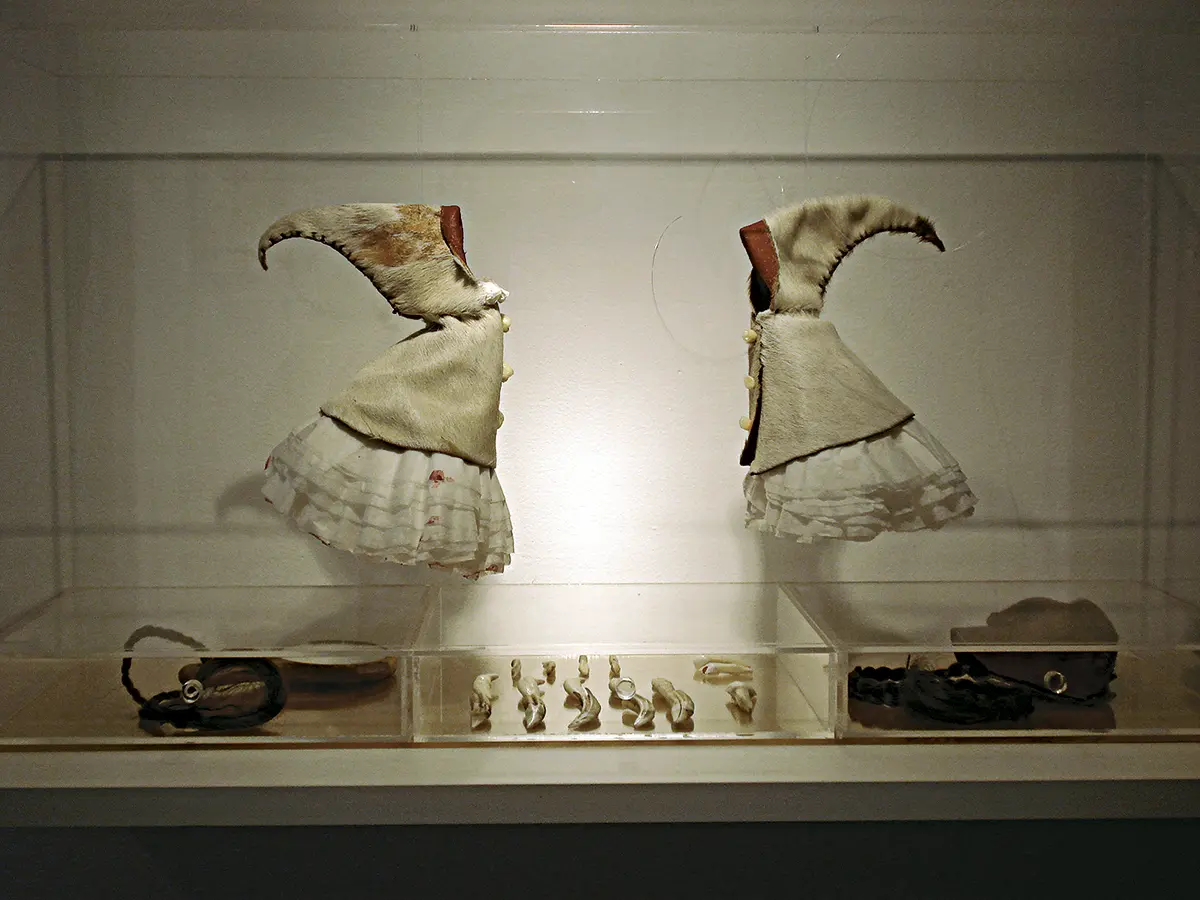
Hoods were also placed inside the glass cases, one in front of the other, separated by an invisible line. A few drops of blood stained the dress hidden under the cape. Incisors and molars (from animals or people?) were exhibited without reserve. Perhaps a legend was being recreated, a caustic narrative of the history of humanity. The viewer could open drawers and see her reflection (in horror) in a mirror, touch the pointed molar bones, or caress the blood-red hood. Perhaps, little by little, one could discover one’s essential nature from looking carefully in the mirror; perhaps one would cease to be a human being and become a hungry, sharp-toothed wolf. Then one wouldn’t need to imagine where lost, bitten, threatened, and provoked bodies were interred. One could understand the structure of the absent shapes, the thorny dress’s empty space, and the need to build a model to express dark feelings.
Gauze, wire, plaster, and imaginary bites wove the frightening story that underlay the dresses’ multiple, scabrous representations. The visual experience was amplified with the story’s denouement: the girl in the red cape rebelled against the wolf, tore its skin off, and covered herself with it. At times, one thought of the possibility of an asylum, where the white of the walls fused with the patient’s outfit. The insinuation of blood referred to certain extremely painful situations in which modern women often find themselves involved. Over time, the shield of thorns becomes more resistant, but the scar remains forever on the surface.
DINORAH PÉREZ-RENTERÍA