In
1969, when Marie Orenzanz (born 1936, Mar del Plata, Argentina) was invited to
create new work at a gallery in her hometown, she covered the entire perimeter
of the exhibit room with a frieze-like layout of posters that read “The town of
La Gallareta fights to keep its only source of income,” next to an installation
of sand and cement bags by the artist Mercedes Esteves. The political and
conceptual operation of transcribing text from a leaflet that protested the
closing of the town’s railway workshops did two things: it brought to light the reality of the problems of that community from Santa Fe Province, and it drove
the artist away from minimalism. The country had already experienced one year
of the military dictatorship of General Juan C. Onganía, and the exhibit was
suspended one day after it opened. This provoked an extensive period of
reflection for Orenzanz, who wondered about the role art should play in
society. Although few posters of La Gallareta were exhibited at the Retrospectiva 1963–2007, Orenzanz’s reflexive non-conformist spirit and her desire for freedom and justice were evident in her work displayed at the Museum
of Modern Art in Buenos Aires. “One of the reasons for my involvement and
evolution in the art world is to struggle against injustice through artistic
expression,” Orensanz affirms.
The artist, who lives and works in Argentina and France, was a student of two great Argentinean masters: Emilio Pettoruti and Antonio Seguí. The exhibit included drawings, paintings, primary structures, acrylics, photographs, videos, and works in marble. It covered Orensanz’s artistic trajectory from her beginnings in 1963, from minimalism to the present, passing through conceptual pieces and to those belonging to fragmentism, including some large-scale works she began to show in Milan in 1975.
A theoretical maverick, Orensanz defined fragmentism in a manifesto as “[the search for] the merging of a part to the whole so that it is transformed, by its multiple interpretations, into an unfinished and limitless object in time and space.” Accordingly, sculptural objects alternated between the fragment and the whole. “We are at once fragments of a past and of a future,” she said.
The presence and undeniable appeal of the unfinished was central to the videos and actions at public environments recorded in photos such as Apropiación de una Base (Base Take Over) from 1982. There were incomplete drawings, graphics molded on imperfect yet beautiful pieces of Carrara marble or on paper using India ink, and movies with deferred meanings and fractured thought-generating phrases. After working in white with small objects and sculptures, Orensanz moved on to the color black, creating large-scale pieces made with light materials: acetone-hardened canvases painted black, suggesting the inside and the outside, the natural and the feminine.
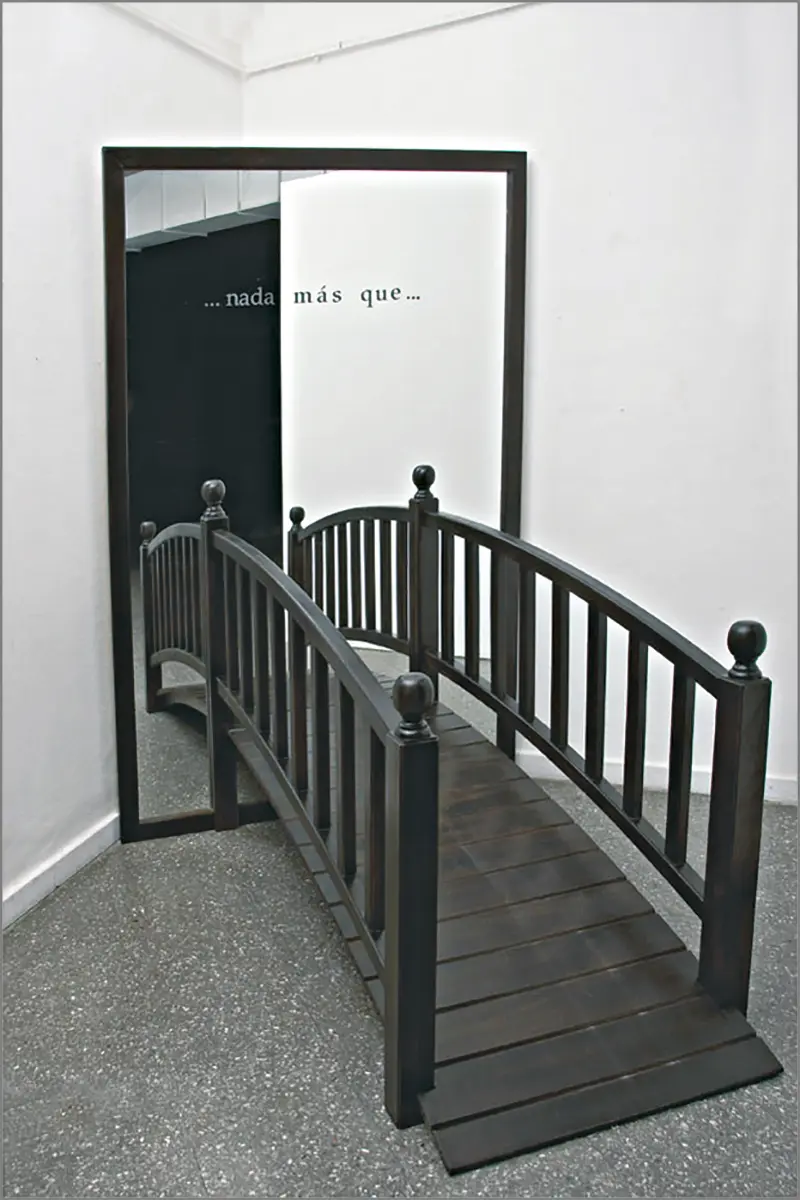
In one of Orensanz’s videos, which showcased segments of her life, there is a girl who is the present woman’s predecessor. The recorded laughter accompanying the smiles seems like an exasperated chorus, aware that time travels through space and memory ultimately brings us to the end—is not the latter the same as the beginning? This ambiguity was also present in the installation…nada más que… (…nothing more than…) from 2007, fashioned from a 250 x 150 cm mirror and a 90 x 200 x 80 cm wooden bridge.
With muscular thinking, Orensanz continues to believe in utilizing words for conferring meaning on everyday objects that, having lost their original function, adopt other definitions. In her manifesto Eros 12 (1974), the artist affirms that: “Thinking is a revolutionary act,” a phrase that is the backbone of another work to be displayed at the Parque de la Memoria de la Ciudad de Buenos Aires (Remembrance Park of the City of Buenos Aires), adjacent to Río de la Plata, where hundreds of Argentines disappeared as victims of state terrorism. The scale model from Pensar es un Hecho Revolucionario was included in the retrospective because the actual work is still in the process of being completed. It consists of two hardened blocks, each six-meters-high by two-meters-wide (four meters wide in all) by fifty-centimeters-thick, their interiors housing the text and perforated in such a manner that the viewer must reconstruct the phrases mentally. The artist elaborated: “Thinking means to doubt, to analyze, to search, to project, to dialogue, to reflect... To think is to have regard for others . . . to bear in mind that when one speaks there are others listening. Thinking means liberty... To think is to build the future.”
This retrospective of the work of Orensanz (who has truly earned her place in the art world) was privileged for being the last exhibit at the provisional MAMba site, operating for a few months in 2007 at the beautiful Palacio de Correos. This building was vacated to make room for a project to commemorate the Argentine Independence Bicentennial. In the meantime, remodeling work at MAMba remains suspended.
VICTORIA VERLICHAK