
The
exhibit Bedtime Stories by the French-Chilean artist Nathalie Regard was
exhibited in September at the Myto Gallery in Mexico City. The four pieces in
this show were connected thematically by one of the most enigmatic expressions
of the human mind: dreams. The first piece, the dreams diary Bedtime Stories (1999–2007), was a box
containing one hundred dream diaries written by the artist over eight years
(box: 27 x 51 x 49 cm; each book: 16 x 11 cm; ink on paper). The author’s
objective was for the spectator to share her dreams, and she built a sort of
mimesis between the diary’s narrative and the reader’s potential to dream. She aimed to sabotage the traditional
structure of the language so that the reader could reconstruct the dream and
integrate it into his/her intimate world. The creation of meaning between the
diaries and the exegetic possibilities of the co-inhabitant of that dream world
was the end result of the work. Dreaming, therefore, appeared as an
ever-evolving plot.
In another room of the gallery, there was a projection of the video The Dream of Cristo de San Juan de la Cruz (digital video, 42 minutes). Overtly referencing Salvador Dalí’s painting entitled El Cristo de San Juan de la Cruz, the video showed Regard writing the dream diaries. Filmed from above so that the diary appeared at the center of the image, the sequence showed the originating moments of the narrations. The body, involved in a process of mystification and mythification, was presented as the vehicle that allowed the vigil: a necessary moment for fictionalization. The body a transitory tunnel, the written dream as the energy capable of creating two simultaneous images: the silhouette writing and the shadows generated by the contrast of light.
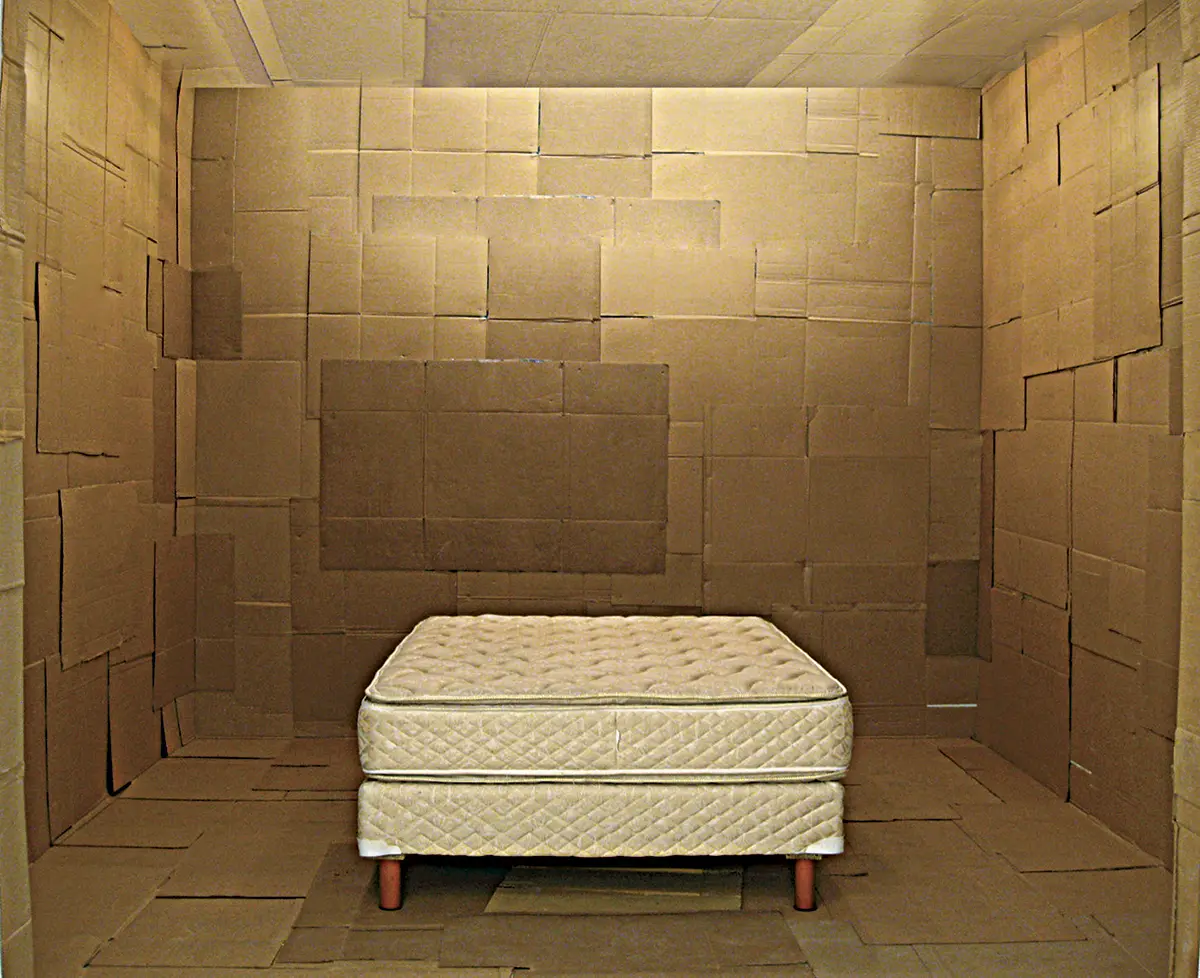
In the gallery’s central room, the third piece in the series was on display: The Voices (forty-five digital recordings in French, English, and Spanish). The viewer was now before the acoustic reconstruction of dreams and perhaps within the most harmonious exchange experienced in the show. The observer reclaimed his/her part as co-protagonist in the dreams, as he/she was the one who gave meaning to the narrated stories. The king-size bed in the middle of the gallery room began the process of reconstructing the dream world, the haziness of the stories of the unconscious, the invisibility of the spectators from their other-selves. The spectator, lying on the bed and wearing a pair of earphones, listened to a selection of random narrations—dreams that could belong to everybody and to no one.
The last part of the exhibit was a series of paintings titled Representations (oil on canvas, 60 x 90 cm each). Comprising four works, the series was based on four photographs taken at night with a webcam. Randomly captured, the images represented the author’s dreaming stages in that particular time period. Once each digital photo was taken, the image was amplified and visualized as a reconstruction of each pixel as a square of painted color. The paintings corresponded to 5:12 am, 7:47 am, 8:03 am, and 8:33 am; the four photos were selected from a total of 360 images. The paintings marked the completion of the exhibit in a transcending fashion. They were visual representations of the dream moment. The pixilated photo designated the last act of the dream as it moved toward the representation of the unanswerable, toward the sinuous malformation of the narrated episode, toward the required approach of a painting that alluded to imaginary numbers, insinuating the dreams of all humanity. Fragmenting the image and recreating it into a second plane of significance via the fictitious pixel-by-pixel reconstruction of the real image permitted the momentary representation to come to rest in a phase much more mundane for its proximity and naturalness, and much more humane for its inapprehensible essence.
Bedtime Stories was a visual project that evaporated any traditional notions of time. It restored one’s weakened and eroded look into the human soul. The dream, perhaps the greatest reassurance of being alive possessed by humans occurs within a setting in constant transition and movement and, more importantly, it inhabits a multifaceted expressive grid of endless connecting threads. In Regard’s works, there are voices (perhaps obtaining from conscience) and images that can be static or dynamic; her work also showcases a human action that ensures we will never forget: the enduring written word.
CARLOS ANTONIO DE LA SIERRA