
For over a decade, Paul Henry Ramirez has made a name for himself as an abstract artist, producing paintings and installations with lively, energetic forms rendered in bright, bold colors. His imaginative compositions often combine squiggly lines with bulbous shapes that result in whimsical, often sexualized biomorphic imagery. For his fourth solo exhibition at Caren Golden Fine Art, Ramirez embraced a somewhat more austere set of forms, relying on a stricter sense of geometry to create a thriving, cohesive body of work.
Ramirez’s exhibition consisted of ten paintings, each of them square in format, ranging from thirty-six square inches to sixty-six square inches. The title of the series, CHUNK, although somewhat ambiguous as a term, has multiple references for the artist. Ramirez explained that over the last year he created this new body of work by drawing upon existing motifs, or chunks, from paintings and installations he had produced over the past ten years. One design element in particular seemed to dominate this series: two large circles set side-by-side, connected by a straight line to two smaller circles. This motif, which Ramirez refers to as cannonballs, first appeared in his Liquid Squeeze series of 1997, and in CHUNK 1, they were repeated several times, horizontally, vertically, and diagonally. They punched and protruded a larger red form, stretching and pulling it sometimes in opposing directions. As a result of the impact of these multiple forces, the malleable chunk of red seemed close to bursting in certain places.
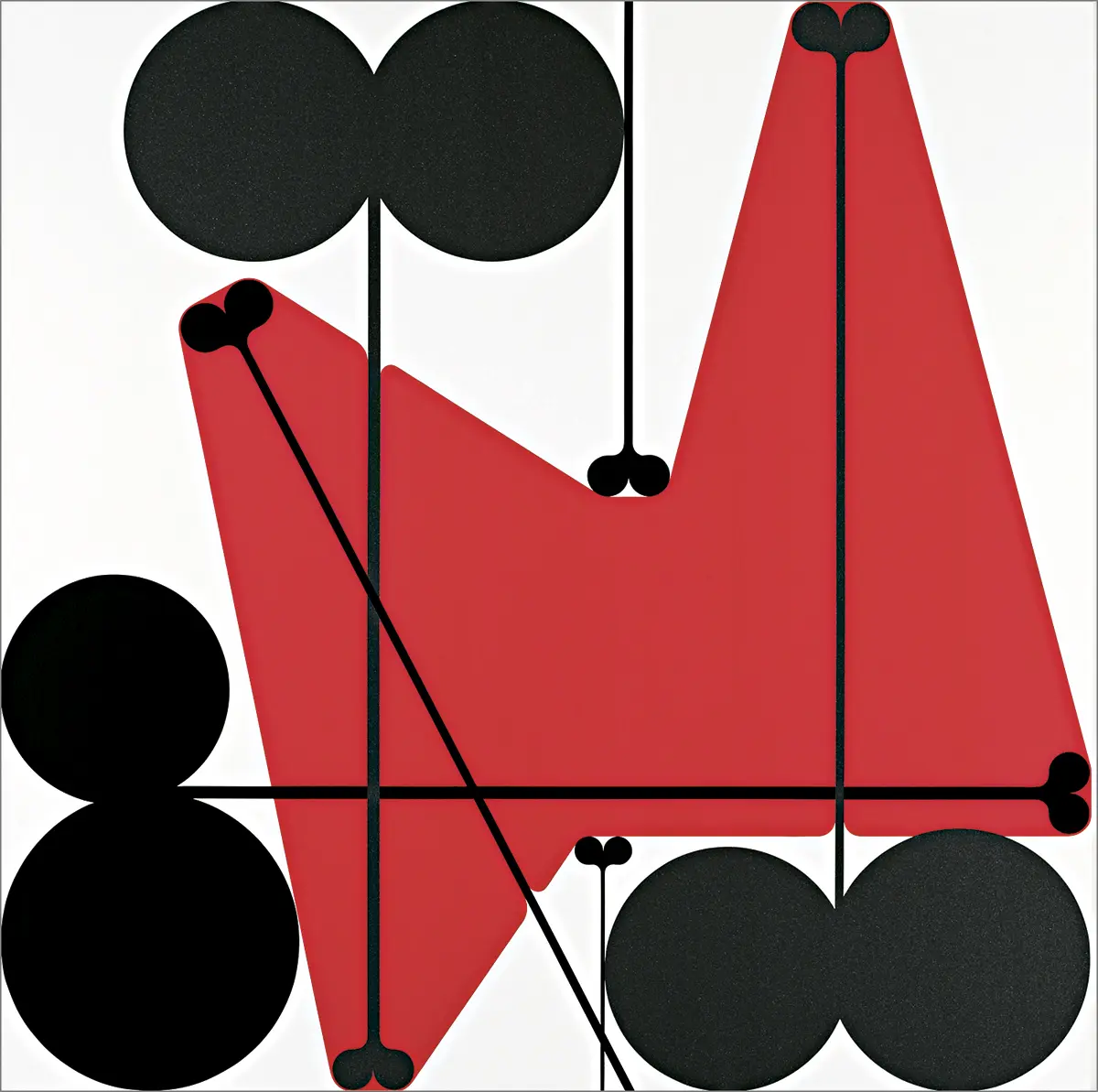
Such imagery and terminology might recall another, perhaps less obvious use of the word “chunk.” As a verb, “to chunk” means to make an explosive noise, much like protruding cannonballs might do. Yet this interpretation of “chunk” might be an overzealous reading of Ramirez’s imagery. Although he was successfully able to produce a sense of tension with his forms in his compositions, Ramirez’s imagery in his CHUNK series remained fairly controlled and balanced. Ramirez was quite clear and precise in rendering his shapes. In CHUNK 7, the blue was neatly delineated from its white ground; in the working process, the artist used tape to outline the form before he painted, and the edge of the shape appeared slightly raised as a result of the tape being removed. Ramirez also laboriously applied layer upon layer of various acrylic paints to produce distinctively shiny and matte surfaces. His technical prowess was readily apparent.
While Ramirez’s CHUNK series celebrated a clean sense of geometry and was, therefore, less obviously biomorphic than his earlier work, the suggestion of the body was still apparent. His doubled cannon balls looked suspiciously like stylized testicles and the protruding straight line almost appeared to be a single vas deferens. Such a reading seemed to make sense, given that Ramirez uses terms like “masculine,” “bold,” and “impactful” to describe his CHUNK paintings. In addition, some of the other forms in his CHUNK series suggested different body parts, like breasts or buttocks, and Ramirez also relates his paintings to the body in general, referring to his shapes of color as skins, calling them “chunky” in form.
In the past, Ramirez’s work conjured up a variety of influences, most notably the biomorphic Surrealist forms of Jean Arp, the 1960s hard-edge painting of Ellsworth Kelly, and the animated imagery of Lari Pittman and Carroll Dunham. His new works, with their slick geometry, added to this list of references: the geometric abstraction found in the Russian Suprematist work of Kasimir Malevich and various Constructivist paintings by László Moholy-Nagy and Alexander Rodchenko, as well as other movements predating World War II including Abstraction-Création, de Stijl, and the Bauhaus. Ramirez’s CHUNK series, composed of vigorous, dynamic forms, was therefore not only a reflection on his own past imagery but also a reworking of chunks of various geometric abstract ideals found in the larger canon of modern art.
CRAIG HOUSER