
Few
Cuban artists return to their provincial hometowns after studying in the
capital and maintain the expectations surrounding their artistic endeavors. The
2006 winner of the National Fine Arts Prize for his lifetime body of work,
Pedro Pablo Oliva, is one of these few. Despite the fact that he is fifty-seven
years old and lives in Pinar del Río, his youthful and renewing spirit has
afforded him great popularity and name recognition in the Cuban and
international art worlds. Artists bestowed with this kind of acknowledgment are
invited to exhibit at the National Fine Arts Museum. Oliva’s show opened on
September 7 under the title Historia de Amor (Love Story). Comprising
twenty-three clearly neo-expressionist pieces (seven ceramics, eight canvases,
and an equal number of works on pasteboard), the exhibit revealed an excellent
artist greatly concerned with human conflicts.
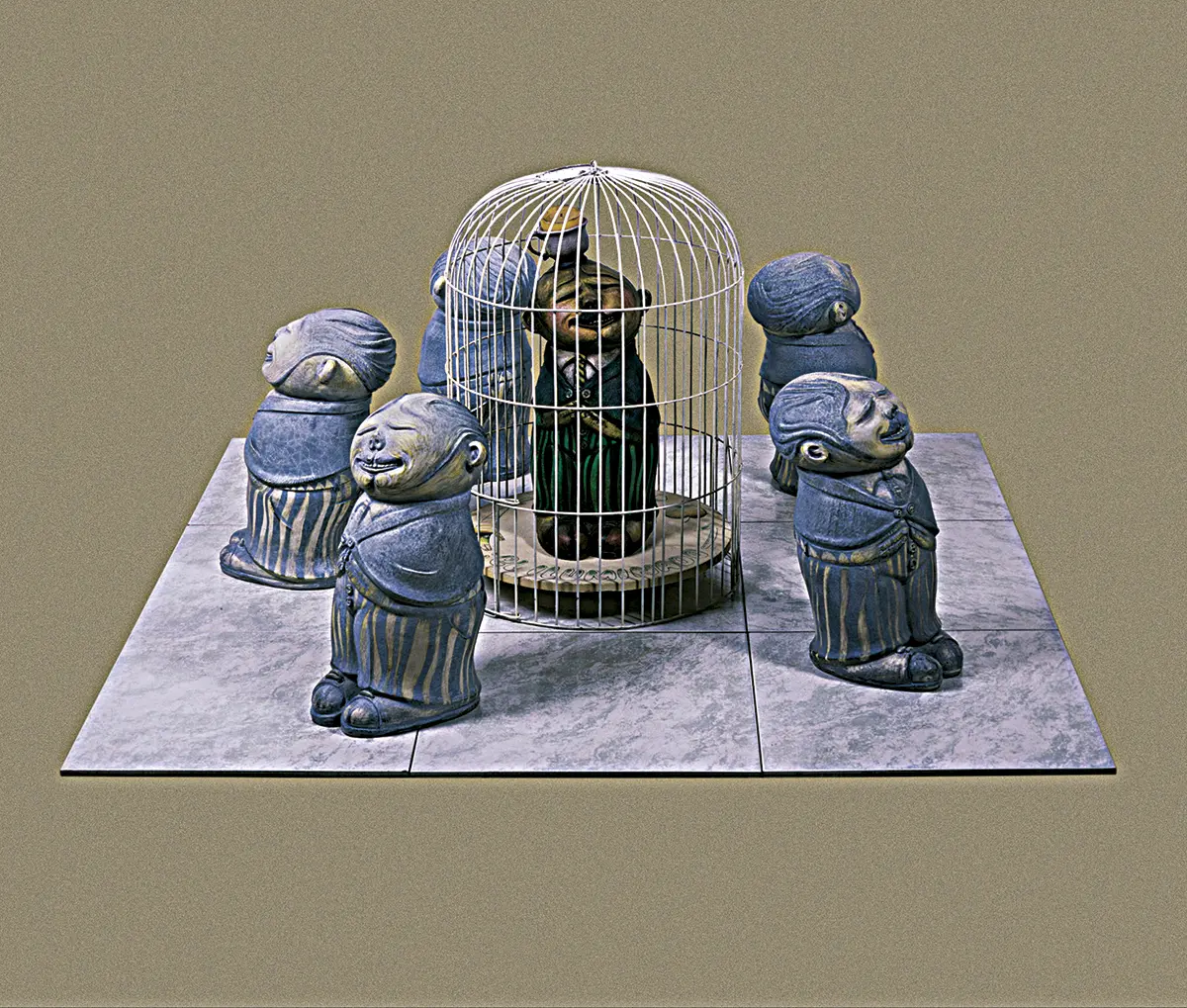
The most relevant aspect of this show, which brought together important pieces from the artist’s work in the 1980s, 1990s, and 2000s, was his strength as a ceramist, something often overlooked by those contemplating his art. The first part of the exhibit focused on several of Oliva’s most significant works in glazed ceramics. Loas para El Iluminado (Praises to the Enlightened)—which received the most recent Ceramics Biennale Amelia Peláes Award—and Morboso Juguete Chino (Morbid Chinese Toy) addressed certain human archetypes frequently found in today’s society. The former piece paid homage to scapegoats, the valuable individuals who are condemned in order to save others. The second piece lashed out at the usual demagogues, who under the auspices of their rhetoric become dangerous opportunists. Unveiling negative human attitudes and transcending the social status of individuals were two of Oliva’s preferred themes.
The majority of this exhibit featured works that pertained to National Museum treasures, so Oliva’s best-known work, El Gran Apagón (The Great Blackout) had to be included. It is, without doubt, a canvas that shows off (in the best sense of the term) a high degree of technical skill. This work presented the important and difficult period of Cubans “on foot”—during which Cubans had to resort to ingenious domestic solutions for lighting their homes due to the frequent blackouts that took place due to the U.S. economic embargo of Cuba, among other reasons.
This work, along with other canvases and pasteboards, comprised the second part of the exhibit. Here, one could see, for the first time, the meaningful piece El Inconcluso Milagro del Pan y los Peces (The Unfinished Miracle of the Bread and the Fishes). This piece is also a kind of homage to the significant meeting held between Fidel Castro and Pope John Paul II when the latter visited Cuba. Oliva, with his usual sense of humor, presents these two figures seated very close together in a wicker chair. Variations of green are predominant in this piece, symbolizing the hope surrounding this encounter.
Oliva has chronicled his time with a skill that few of his generation can rival. He has adapted to the artistic innovations in Cuban art while remaining consistent in his neo-expressionist approach, influenced to a great degree by Chagall, Abela, and Eiriz. His greatest formal virtues reside in the quality of his drawings and the exquisite manner in which he colors his work. Nonetheless, what continues to attract interest in his work is his ability to capture personalities, particular moods and emotions, and human conflicts.
Historia de Amor presented a lyrical way of approaching problems, of looking at reality, and taking advantage of its positive aspects. Despite being an insightful critic, Oliva expresses positions in his work that are never incisive or piercing. His reflections engage tenderness, forgiveness, tolerance, and dialogue. These tread a narrow expressive path, for they touch upon the burning issues concerning the reality of Cuban society.
Several exhibits could be curated on the vast work created by Oliva over the past three decades, for he is tireless. His value as an artist goes beyond the sum of his exhibitions. For a large part of his life, he has also been a teacher and a promoter of art and art criticism, usually in his home workshop in his native province.
This exhibit presented an artist preoccupied with deep philosophical questions, one who continues to believe in the bettering of humankind in spite of social instability. The technical mastery of his artistic endeavor confirms Oliva’s important role in Cuban art.
AMALIA BOMBÍN