Art
and rationalism, research, and pursuit: these are conflicting elements in humans
that, together with crushing and pervasive reality, sink them into helplessness
and violence, nightmare, and convulsive beauty sheltered by the fire of poetic
imagination. These elements are part of an artistic approach that has not been
globalized and remains unique in Latin America, a part of the world that is
independent from insensitive standardizations and mannerist aesthetics. We find
ourselves prior to the culture of violence, revisiting the life versus art
aesthetics of the 1970s.
In this context, Rafael Gómez Barros (born 1972, Colombia) presented his formal and thematic approach. His sculptures, painting sculptures, and installations were created from old materials worn by time. Conveying complex meanings, they were similar to tombs and mummies, some of the first presences of Colombian life. Gómez Barros’s objects leaped from the pre-Hispanic to the contemporary, from the bucolic to war and destruction. The work shocked the viewer with its central and meaningful realism. Gómez Barros’s artistic sensibility conveyed an inescapable theme that is also frequently found in Colombia’s contemporary art scene.
Gómez Barros exhibited three series at the Durban-Segnini Gallery in Caracas. They perfectly expressed the principle proclaiming that “Art cannot be the result of an idea, but it must instead generate these.” In other words, there should be no distance between the theme and the manner in which it is expressed. It is about an action going in two directions: the idea that generates it, on the one hand, and the ideas it generates, on the other.
To describe these three series, here is a quote from the catalog introduction by the Colombian art researcher, critic, and historian Álvaro Medina:
This exhibit consists of three very different series that have been created in the following order: Urnas, Sonajeros, and Carbono 14. The first comprises drawings and paintings only, while the remaining two are three-dimensional and composed of modules that the artists layout in suggestive installations. These are series that are easily identifiable and distinguishable from each other but, despite their notable differences can be connected by what they express: the desolation and the uncertainty we all feel when confronted with events we consider incomprehensible.
In Gómez Barros’s work, circular shapes, and rattles recognized from folk culture hid secret meanings. Images of urns were like x-rayed bodies with no scientific value. In conclusion, they were all “containers” filled with a good part of the collective unconscious.
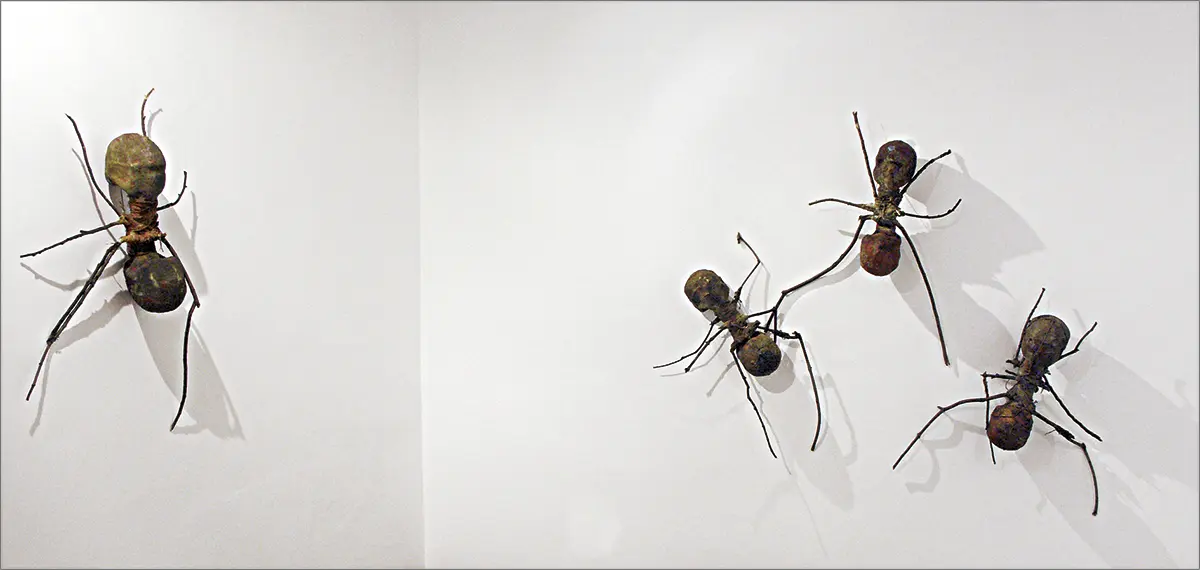
With this work, Gómez Barros confronted a conceptual reality that he successfully expressed through form. His color was limited, almost monochromatic—yellow, red, and black earth. Sand, fiberglass, and canvas produced coarse textures on the rattle objects or on the Ants. The resulting objects appeared as if they were unearthed from archeological sites. The two- and three-dimensional forms effectively conveyed the meaning the artist sought. De-Mentes, the title of the exhibition, implied a multiplicity of connotations; it subversively alluded to insanity and to the mechanisms of mind and thought. It was about formal and conceptual plasticity, the profound elaboration of distinctions between the unequivocal values that today’s society offers as a possibility for an existential space, determined by the objects and situations polluting it. Paradoxically, this is the space where artists uncover new means of expression.
De-Mentes was an extraordinary exhibition. The objects in it did not speak in imaginary or abstract terms but rather underscored an experimental and rational sensibility, the intellectual side of universal absurdity, and the negation of dying in the search for an inefficiently contemporary moral philosophy. It spoke not of postmodernism already obsolete but rather gave voice to an aesthetic revolution.
BÉLGICA RODRÍGUEZ