Rosario
Dellepiani de Pinasco’s recent solo exhibit was prodigiously adorned with bells
and many vibrant colors. Once again, her work revolved around this instrument
of sound. Pinasco’s abstract works consisted of paintings and installations in
which bells are understood in the context of their religious symbolism.
Throughout history, bells have moved us toward a spiritual life. In the Western world, Catholicism has used them as a means of communication. Bells may be symbols for the gathering of the faithful, but they have also been applied to other aspects—and have belonged to other experiences—of the society at large. Their presence throughout the centuries has materialized into shapes that range from monumental to easily portable dimensions. Similarly, bells can be valued for their practical or artistic characteristics.
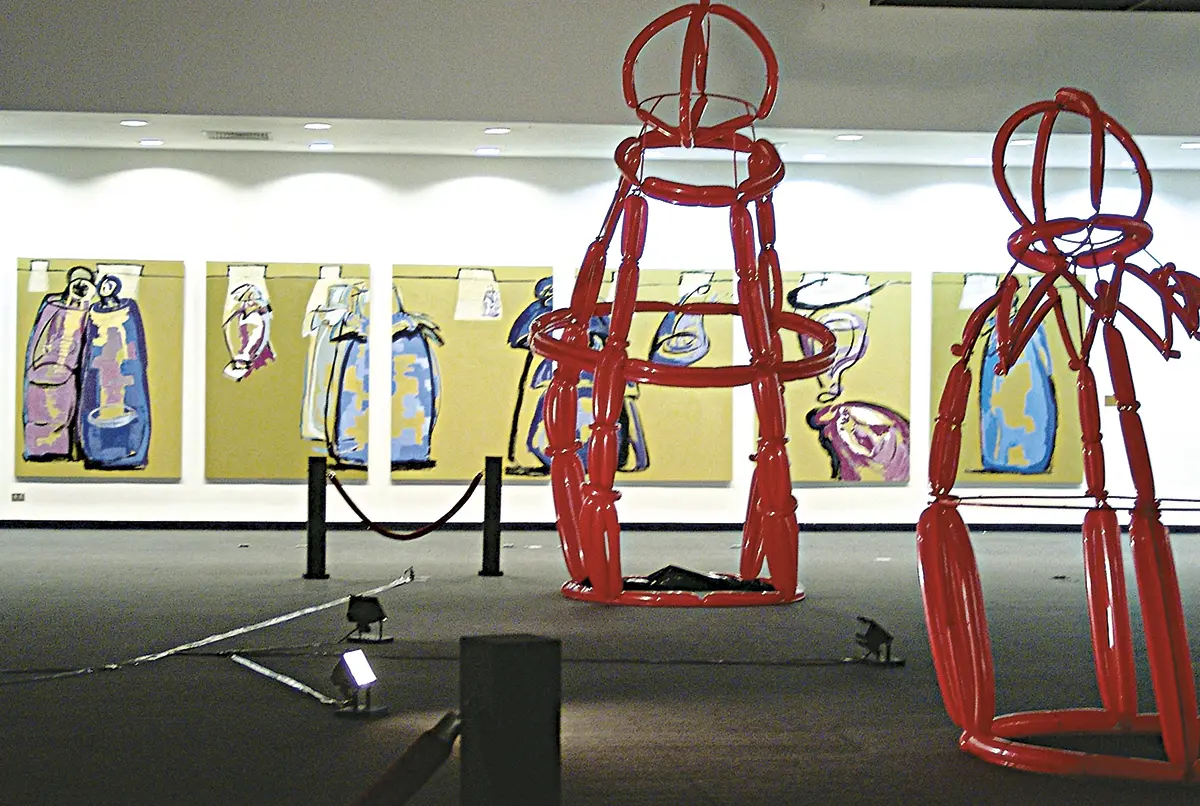
The exhibit included sixteen paintings divided into two series, two others presented individually, and five pieces of sculpture. Pinasco revealed a characteristic desire to feel the sound of bells and to immortalize them on canvas. She vibrantly colored images of childhood bells and reinvented the colors of the divinities in her memories. She conveyed the sweet call of the bells from her childhood, drawing from her personal collection, which grows with her ongoing travels. The artist says: “The bell stands as a symbol for God, for spiritual communication. I collect them. Wherever I go I always buy one. That is why I began finding more about them and realized why I like bells so much: it is because of the strong symbolism that exists in them that has been used in nearly every religion and ritual.”
Pinasco observes: “There is an old book titled The Autumn of the Middle Ages [by Johan Huizinga, from 1929]. On its first pages, this historic document tells of the importance bells had as a form of communication in that historical period. In the France of the fourteenth and fifteenth centuries, bells were rich instruments of communication, so much so that the time lapses between tolls from one bell tower to another and the rhythm of the tolls held particular meanings. Catholics went to the extreme of making bells sound during the entire ‘holy’ day (and night).”
The artist pours her soul into her work: “I have had a lifelong obsession with bells. When I was a young girl, I used to go often to Ica, where we had a farm and where we would use bells to communicate. There were no cell phones then, and the number of tolls would vary depending on whom one would like to call.”
In the constant search for self-reinvention, Pinasco did not stop at solely painting bells. She also employed the volumes, shapes, and dimensions of sculpture to depict these sound objects. She captured avant-garde ideas in her work, in installations with bases fashioned of metal and red balloons that gave the effect of force transformed into movement. The individuality of Pinasco’s work relied upon the movement that took over each piece. It allowed the viewer to experience a personal communion with each work; with a little imagination, the abstract forms became flowers or colorful Andean women.
The characters created by this master of the brush suggested silences as if they were involved in personal rites that achieve a group harmony beyond the art exhibit. The objects represented on the canvas, whether bells or fruits, broke from representative shapes to reaffirm their presence in strokes, as in a dance. In the process, they rendered an account of communication that flows from the intimate to the sacred and divine. Through these rites, the succession of characters conveyed a suggestive and silent discourse on abundance, in which the fruit was the sacrosanct symbol that became an affirmation for a prosperous future. Each image had its own quiet gestures that revealed careful movements in which colors were not merely stated but also suggested nature in absolute harmony.
It is important to underscore Pinasco’s commitment to her work; the artist and her creations cannot be understood separately, for each color reflects the sound of the artist’s soul. Each stroke invites us to visit her richness of depth and the beauty of her fertile imagination. She has gained well-deserved attention thanks to exhibits of her work in New York, Washington, Miami, Quebec, Santa Cruz, and Caracas, and other important cities. Pinasco’s imagination guarantees future exhibits that will inevitably present us with continuing innovation and beauty.
MERCEDES FERNÁNDEZ-GÁLVEZ