
From mid-September to mid-October, Valeska Soares (born 1957, Belo Horizonte, Brazil) exhibited her most recent solo show After, at the Fortes Vilaca Gallery. Once again, Soares, who lives in New York, broke away from representation and the usual systems of perception, underscoring their unreliability and the danger lurking around those who allow themselves to be lured by the compulsive gaze, artistic delight, and aesthetic enjoyment solely for their own sake. Her recent works overcame the facile retinal addiction toward what could be called poetry of surfaces and moved along the intricate path of vast post-conceptual research to analyze the materiality of the immaterial, the energetic forces that visual perception cannot catch.
Nine works constituted the three themes of the exhibit: time (chronological and internal), art history (German and French Romanticism in particular with an aesthetic of the sublime), and expressions of love. The pieces Love Stories, For To, and La Dedicace put into motion an ample meta-discursive mechanism of the latent meanings that frequently occur in literature, which is part of Roland Barthes’s semiological and philosophical legacy. “Love is deaf,” affirmed the German Romantic poet Novalis, “and speaks to us only through poetry.”
In Love Stories, Soares offered a work-in-progress, an ongoing editorial project of books; 125 of these were placed on a white shelf. Inside each book, the word “love” appeared in the title in five different languages, to reinforce the potency of the aesthetic tautology, and the names of the authors were printed on the volumes’ bindings. Meta-languages, para-texts, and hypertexts converged as a triad in this self-referential library. The books contained blank linen pages as if they were diaries waiting to be filled with individual and untransferable memories.
Metonymy appeared again in La Dedicace, the central piece of After. Here, Soares produced a literal deconstruction that stemmed from an essay in Barthes’s Fragments of A Lover’s Discourse. Employing the same irreverence found in Barthes’s The Pleasure of the Text, Soares removed all the letters and punctuation symbols from his essay La Dedicace to reconstitute them later in white ceramic as site-specific sculptures. The text was transfigured as objective and sculptural bodies, on which Soares superimposed her own text over that of Barthes. All this was done with the awareness that one cannot love two constellations of signifiers in the same body at the same time, for it could be excessive: either the other is loved for himself, or for his writing, through transference or cathartic identification.
Deconstructing one paradigm and replacing it with another does not imply the annulment of the first; it echoes through other means. Also, every work of art presents a layer of meaning that implicates and underlies the originating ideas. The work For To was a collage mural made of hundreds of pages subtly superimposed, which the artist removed from old books. These pages contained the authors’ dedications, the “soul” of these books: these inscriptions were symbolic marks of affection. They ranged from the most literal declarations of love to the most neutral, laconic, and phlegmatic, suggesting the coitus reservatus of language that is secret, or coded allocution.
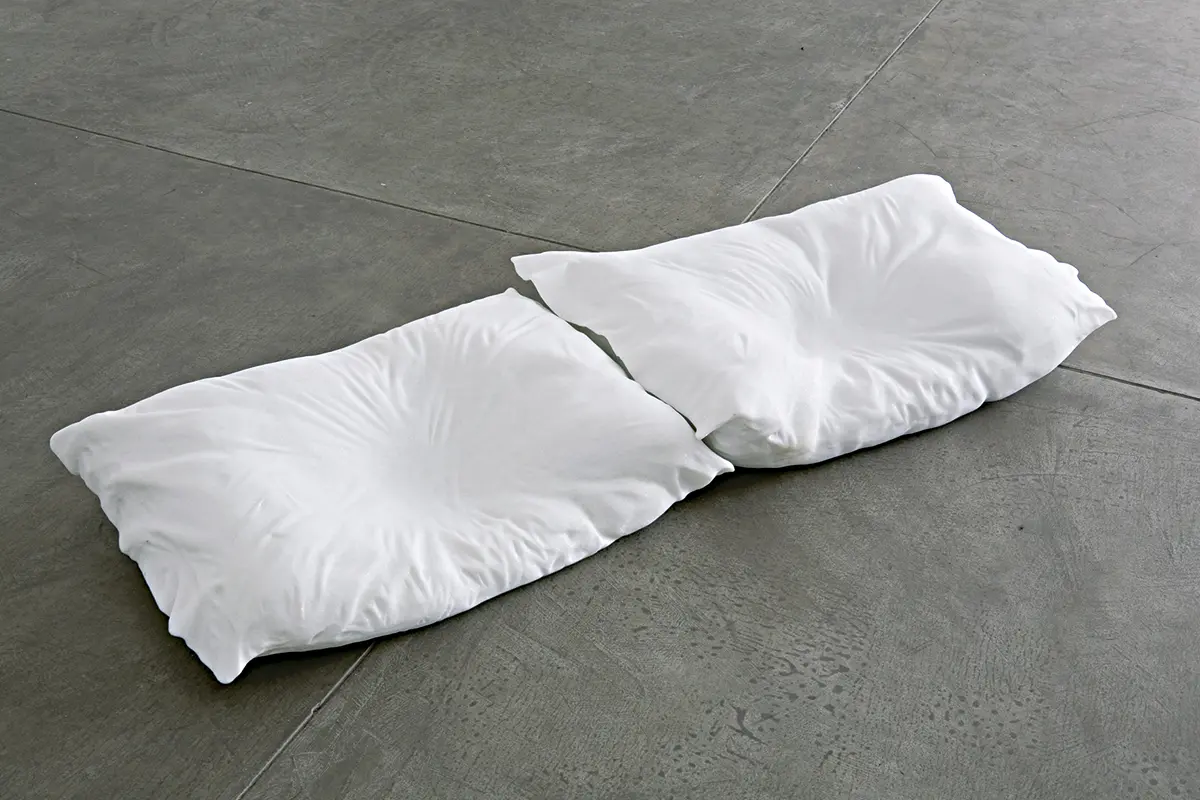
In After Images, the artist presented a series of twelve photographs of skies printed on canvas (the source images were made in the artist’s garden in Brooklyn, New York). These quoted eighteenth-century Romantic paintings with a feeling of melancholy, “a more grave than sad sentiment,” as Victor Hugo said. Of particular relevance were three pillows and a mattress fashioned from white marble, intentionally hyperrealist in their execution, in which Soares gorgeously made evident the crevices, folds, and marks of the transformed objects and the presence-absence of that which is no more. To summarize, “After” displayed the paradoxical forms and the infinite plenitude of chaos confronted by logical beauty.
CLAUDIA LAUDANNO