
Retrospective, a collaborative project by Alejandro Cesarco and John Baldessari, comprised
twelve serigraphs on aluminum. Each serigraph reproduced a page from a book;
the text on each page was covered by a block of color, with the exception of
one or two footnotes. All one saw on the page was the color block, the footnote
number within the text area, and the footnote itself in the lower margin. Off
the page, there was a brief ironic comment toward the assertion or
clarification represented by the footnote. Each serigraph featured a strong
color that corresponded to Baldessari’s recent palette: orange, pink, green,
turquoise, yellow, red, blue, black, and violet.
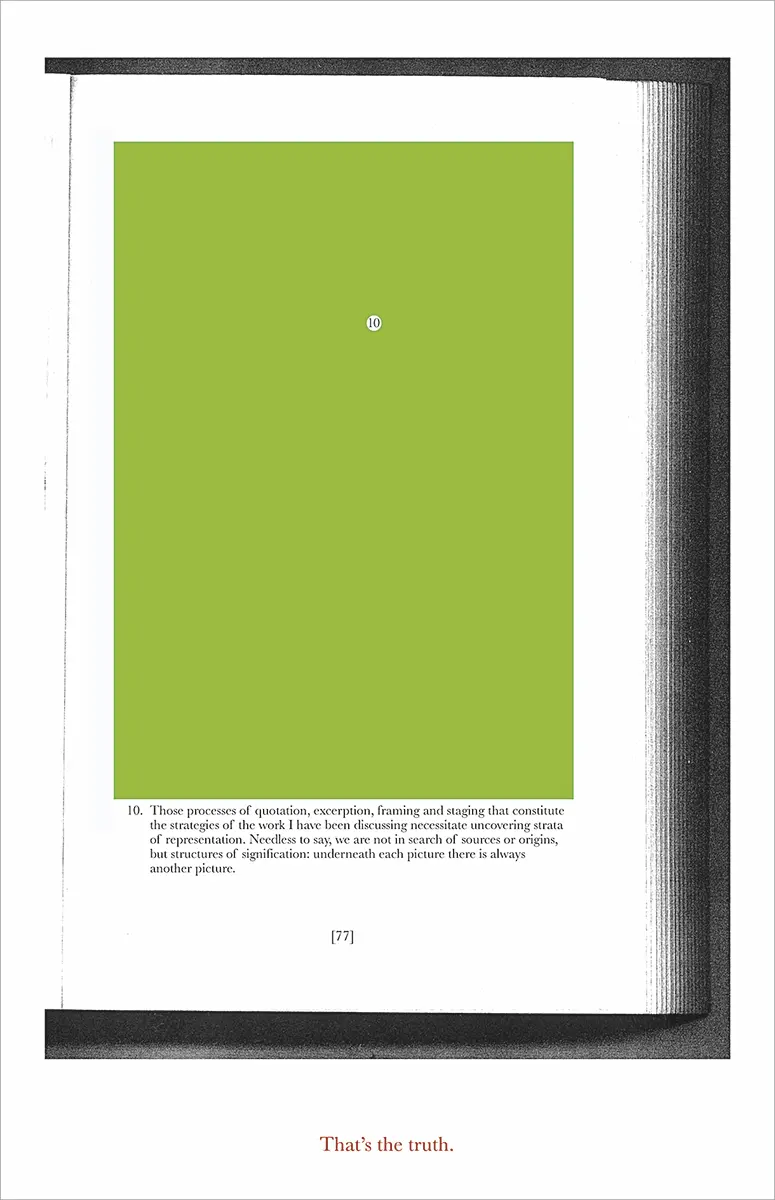
For example, one of the serigraphs reproduced on page 77 of some book. A green layer covered the words, except for those of footnote 10, written in English: “Those processes of quotation, excerption, framing, and staging that constitute the strategies of the work I have been discussing necessitate uncovering strata of representation. Needless to say, we are not in search of sources or origins, but structures of signification: underneath each picture, there is always another picture.” This quote, clearly connected to Derrida, brings to the fore the existence of “strata” or layers of meaning, which emerge gradually through a variety of interpretive plays. Thus, teleological-analysis models are useless to explain the process of signification, for these processes harbor no first cause and no directionality, only juxtaposition, and slippage. Apart from the reproduced page, the serigraph included another note in pink, also in English, “That’s the truth”—a witty and ironic comment, as there can be no truth in the absence of a center and of certitude.
As in this example, the quotations and passages within Retrospective made one suspicious of any totalizing narrative that achieves precision and closure on the basis of oversimplification and omission. The quotations revealed a world comprised of thousands of points of view, where framing any one thing or idea means leaving other perspectives out. And if meanings are many, it is impossible to define the past univocally. Thus, the project’s title, Retrospective, was important: what is the meaning of a retrospective, of looking back, of examining prior developments? Moreover, how does one build a retrospective with the knowledge that the thread holding the whole is arbitrary? Baldessari and Cesarco share a privileged position to dispel these questions. Not only do both of their oeuvres question the very nature of representation, language’s ability to evoke one thing while occluding another, and the power of the written word and of the image, of translation, and of subjectivity, but the generational distance between them (about forty-four years) allowed a beneficial exchange regarding the nature of a retrospective—what is implied in selecting and exhibiting the art of a lifetime. With explanations that insisted on matters of narration and attribution, Baldessari and Cesarco spotlighted the traditional form of the retrospective exhibition, which presents the works of a single artist chronologically in order to fully display his or her career path.
In this era, the biographical exhibition has been radically revised in response to innovations in the work of art, creating such forms as interdisciplinary laboratories, expeditions, seminars, and site-specific interventions. The Musée d’Art Moderne de la Ville de Paris is a key testing ground for the format, with experimental exhibitions by Philippe Parreno, Pierre Huyghe, Rirkrit Tiravanija, Dominique Gonzalez-Foerster, and Fischli & Weiss. As this roster indicates, the reexamination of the retrospective format is associated with relational aesthetics, to those artists who promote social relations and, in consequence, find it difficult to exhibit material works. This revisionism, however, should move beyond that aesthetic theory and force us to imagine a much deeper change because the retrospective, an essential vehicle for art history has thus far remained immune to structuralist and postmodern debates. Baldessari and Cesarco’s project attempted to break the format free from its ideological prison. It is impossible to anchor authorship on an exhibition space and Retrospective turned the past into a gloss-in-progress, where there is always enough margin space to make a new observation.
FLORENCIA MALBRAN