
The career of Ani Villanueva—a visual artist, dancer, performance artist, video
artist, and digital photographer—is marked by great vitality. Indeed,
Villanueva’s workflows from a passion for life and art that is expressed
through the various media she has explored. In the 1980s, she created
performances to accompany works by other artists, intending to give them
movement and life: as Villanueva has pointed out, she used her body to
introduce “the human factor into the motionless” and to create unexpected
situations. In one of José Antonio Hernández-Diez’s memorable works (Annabel Lee, 1988), Villanueva created
this emblematic act: the image of a living female body moving within a coffin,
filmed at an angle and seen via a monitor inside a box. She went on to create
performances for works by many well-known artists, such as Alejandro Otero,
Gabriel Morera, Diego Barboza, Milton Becerra, and Felipe Márquez. Her first
performance was presented at Sala Mendoza alongside a work by her mother, the
painter Mary Brandt. Indeed, it was Villanueva’s family environment that guided
her toward art after studying psychology, sociology, business, and contemporary
dance. As the daughter, granddaughter, niece, and cousin of artists, Villanueva
benefited from the natural accumulation of artistic references since childhood.
Villanueva’s passion for life is fueled by nature. From performance art, which she still practices, Villanueva moved on to painting. This period coincided with the construction of a bahareque house in the coastal rainforest town of Choroní. The region’s lushly forested landscape and Villanueva’s own feeling for environmental conservation combined to lead her toward a highly colorful figuration, representing fish and birds with contrasting textures. Her representations were highly organic, almost biological. She declares that exploring that kind of figurativism was “a way to understand nature.”
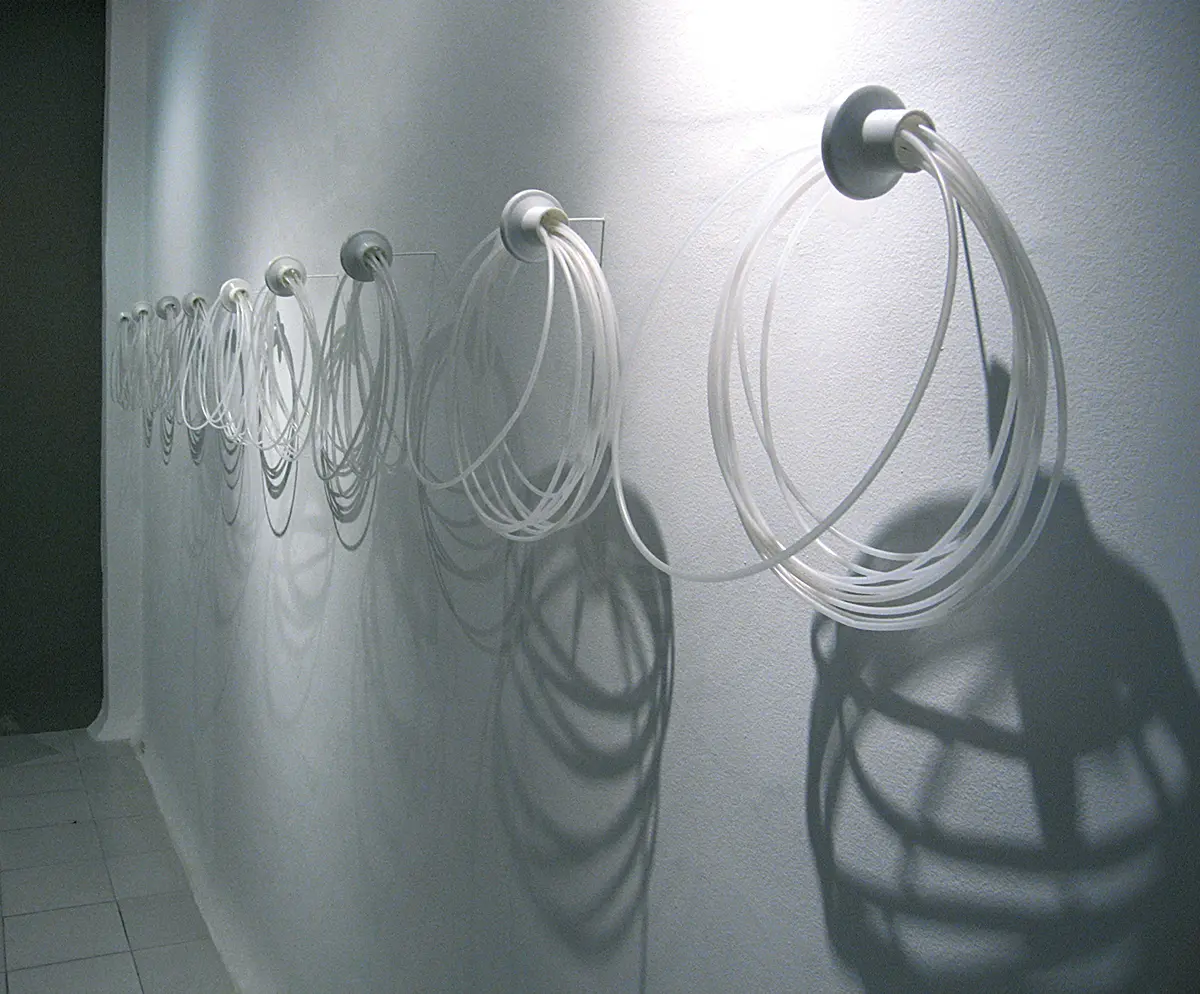
Knowing about this process is important to understanding more recent changes in Villanueva’s work. After the explosively chromatic paintings, which were subject in a way to visible reality, she explored three dimensions by assembling industrial scraps into sculptural objects that also expressed her vital passion. This process began a few years ago when Villanueva presented the exhibitions Useless Objects (2002), Casos de cosas (2004), and +casos (2005). These demonstrated an explicit concern with intentionally organic works, reminiscent of caterpillars, anemone, spiders, etc. But in the exhibition Reflexiones, presented last October at Alternativa Elvira Neri Galería de Arte, nature was expressed in actions that suggested bird flight, in the act of recycling (with circular hoses as symbols of the eternal return), or in the “concretization” of inner and intimate events (sighs, yells, oblivion, or thoughts)—topics that are difficult or impossible to materialize. Yet Villanueva achieved just that. Already in 2005, she had begun to investigate such topics with the work Lágrimas (2005), which won First Prize in the Eighth Sculpture Biennial presented at the Museo Francisco Narváez in Porlamar.
The hoses in the installation Suspiros had the rhythm of slow, prolonged breathing. The several hoses (some longer than others) were metaphors for sighs, of the time it takes to complete an exhalation. The material was conjoined with the work’s activation when seen in time and space. Because these were aerial, very light, and almost volatile works, the direction of the hoses or rods suggested an interior animation. If before, as in Casos de cosas and +casos, the artist created—as described once by critic Víctor Guédez—“a visual ecology based on plastic and an organic register based on the non-organic,” the process here was the reverse: she started from plastic and from the non-organic and arrived at the human and the reflective.
All of this resulted from acts of tying, assembling, and adding banal, everyday materials bought in hardware stores and supermarkets. White or transparent hoses, rods, power plugs, and clamps spoke poetically of our intimate human condition, a condition as light as forgetting or as a sigh. These materials lost their original utilitarian function and became aesthetic events. Villanueva uses the consumerism and materialism that drive the world in order to transform objects and deploy them as part of her own poetry. But she does so on the basis of contemporary codes; she appropriates industrial elements and creates new objects. Thus, she materializes the immaterial, yet her works never lose an immaterial condition. This is one of her most important achievements. Contemplating Villanueva’s installations and other works, a viewer suspends one’s routine emergencies and gains an appreciation for the subtle and the beautiful.
SUSANA BENKO