
The Panorama of Brazilian Art is a regular exhibit presented at the São Paulo Museum of Modern Art (MAM).
Since 1969, it has been characterized by focusing alternately on conventional
categories of artistic expression: painting, sculpture, art on paper. The
Panorama show began when the Museum of Modern Art redesigned its programs and
sought to rebuild its collection as the original one was transferred to the
University of São Paulo in 1963.
In 1995, the strategy of the Panorama exhibition shifted: it became a biennial exhibition to display Brazilian contemporary art. Since then, invited curators organize each edition; consequently, the Panorama offers critical readings and particular interpretations of contemporary art by specialists in the field. The exhibition is not a map of artistic production in the country; the point is to present a critical look at contemporary artists who have a presence in the cultural circuit.
The curator of the thirtieth edition of the Panorama was Moacir dos Anjos (who was also a co-curator of the sixth Mercosur Biennial). The 2007 edition brought together thirty-seven works by Brazilian artists and included one artist collective, Chapa Ferro (formed by Luiz Zerbini, Sérgio Mekler, and Bãrrao). The artists came from eleven different states; a Peruvian artist who works in collaboration with Lucia Koch was also included on this occasion. The curatorial project of the thirtieth Panorama was to highlight the contradictions of national life as revealed in the work of a series of artists. Dos Anjos said that his goal was to create an exhibition that, with a varied roster of twenty-eight individual artists and one collective, “revealed the expressive state of Brazilian art at a moment when all rigid boundaries between different cultural expressions are dissolving.” With this curatorial direction, he inserted the discussion of contemporary art onto the stage of globalization. Through a critical reading of the art of the moment, Dos Anjos also sought to identify the most significant trends following his curatorial premise. The title of the show, Contradictory, signaled the features he considered common in Brazilian art: first, its flexibility and agility in articulating internal and external cultural referents, which generate ingenious hybrid works, and, second, the implication of stagnation or waste, which reveals an aspect of Brazilian life.
The central point of dos Anjos’s thesis was that one of the principal directions in contemporary Brazilian art is “to promote an approach and a contagion between elements that in different contexts are antagonistic and repellent to each other, such as the vernacular and the erudite, the unfinished and the finished.” According to the curator, this gives it a hybrid and flexible character that “expresses the country’s capacity for adaptation to the world’s adverse and complex situation”—a situation he characterizes as gambiarra.1
For dos Anjos, the concept of the gambiarra doesn’t just have a positive connotation. He says: “In the symbolic field and in the field of the sensible, it expresses Brazil’s incapacity to universalize basic rights when synchronically it must confront previously unseen fundamental matters.” The curator continues: “The character of such an affirmation of identity condenses and exhibits the ambiguities that permeate the country’s recent history.” In dos Anjos’s opinion, that character is not the metaphor of a passing situation but rather the integral symbolic warning about the conditions of life in contemporary Brazil. Thus, the gambiarras are not materially present in the works of art but in their symbolic dimension. The improvised mechanisms reveal Brazilian creativity born of the need to deal with social, economic, and political precariousness. The gambiarras reveal “not only an adaptive capacity and ingenuity, but also a rough finish, a constructive fragility, and at times a risk of accident or punishment for those who use them.”
“Also implicit in the gambiarra,” dos Anjos observes, “is the relative impossibility of interchanges between local culture and a hegemonic culture since the process from which it derives does not resolve into a synthesis but rather in opaque and inconclusive constructions. The gambiarra is the product of an approach between disparities that never cease, expressing a ‘third space’ for the negotiation of differences that are never compatible.” Thus, emerging from the works are points of tension between opposite concepts or situations.
The direct contact with contemporary artistic languages has been one of the Panorama’s achievements. The work by Rivane Neuenschwander, an installation titled [...] and first seen at the 2005 Venice Biennale, employed a series of typewriters with modified keyboards (in which all of the keys type dots). With the presence of typing paper, tables and benches, and a felt-covered board on which to pin what each visitor “wrote” with the special machines, visitors were invited to participate in creating the work. Resulting from this participation were not only linear “writings” of sequential dots but also drawings made with the dots produced by the typewriter—some conventional, some not—and also phrases built using letters created with different configurations of dots.
In Puzzling Over, Marilá Dardot brought to the fore the articulation and disarticulation of signifiers. Dardot put together pieces of a puzzle into a single whole. One expected an autonomous configuration to appear—an objective and stable image, as often happens with this kind of pastime—but the images formed by the designs printed on the puzzle pieces presented no clarity or continuity. The fragmented images repeated and made no sense. The puzzles were placed in acrylic drawers within an acrylic box, which allowed the viewer to verify each finished game.
In Tótem, Paulo Neflídio presented a construction in wood with ultrasound sensors and amplified audio. The viewer could see how each of the pieces was articulated within. Neflídio’s work was like a communications tower broadcasting different sounds, like superimposed recordings of the din of the world. In another work involving sound, Laura Belém’s Fragments of the Landscape of São Paulo, the city center’s noises of transit—the rumbling of people and automobiles—formed the central theme. Visitors stood under an acrylic sound dome; there, they could hear the sounds of the city’s most populous streets, where the artist had recorded the sounds of the metropolis.
In Untitled, an installation from the series Flash, Milton Marques projected lighted images on a wall, which were visible only for a brief instant like an ephemeral narrative. These were flashes from a photographic camera that was focused on nothing in particular—only the light flashes were projected as if the viewer witnessed photographs being taken.
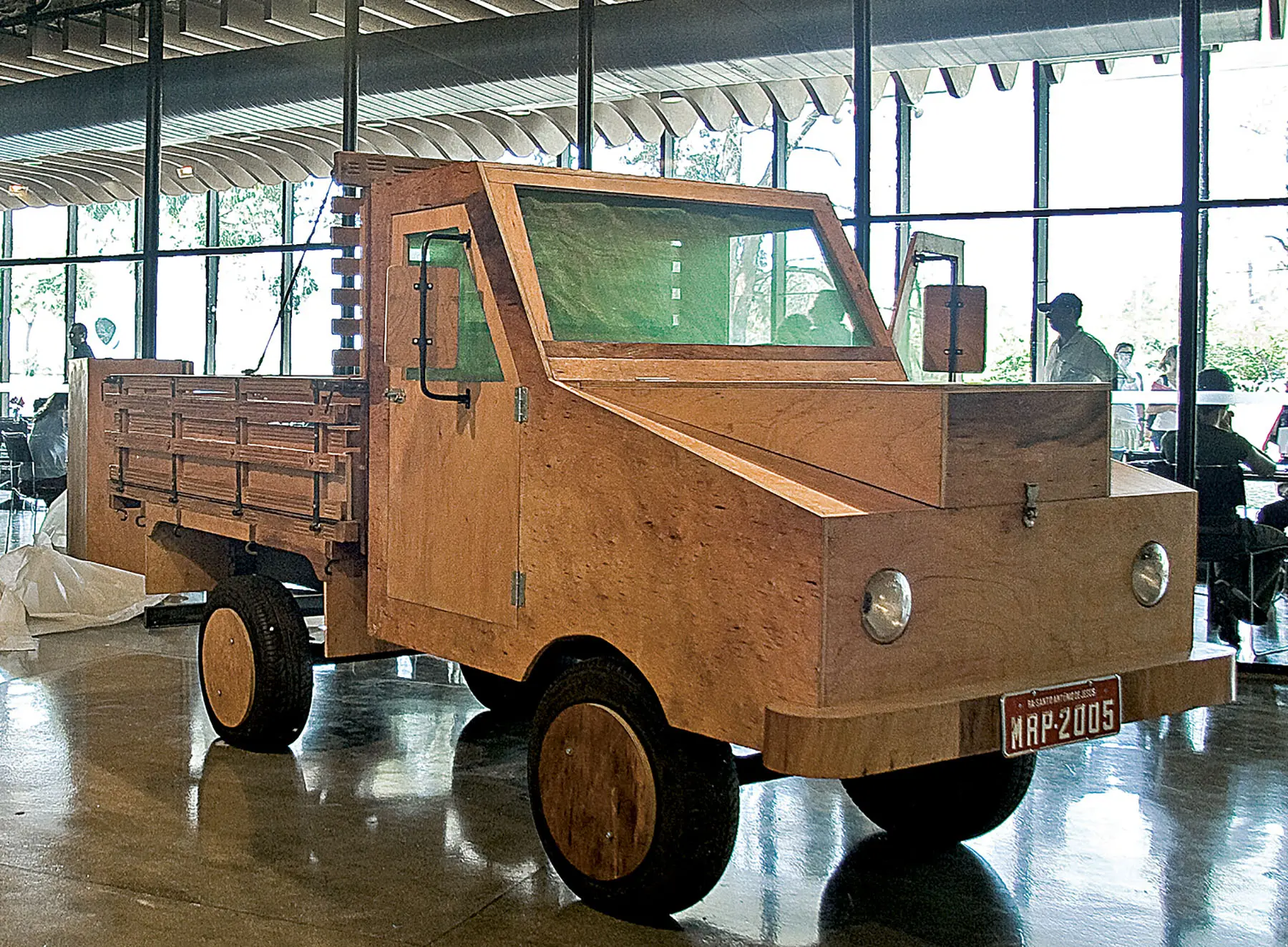
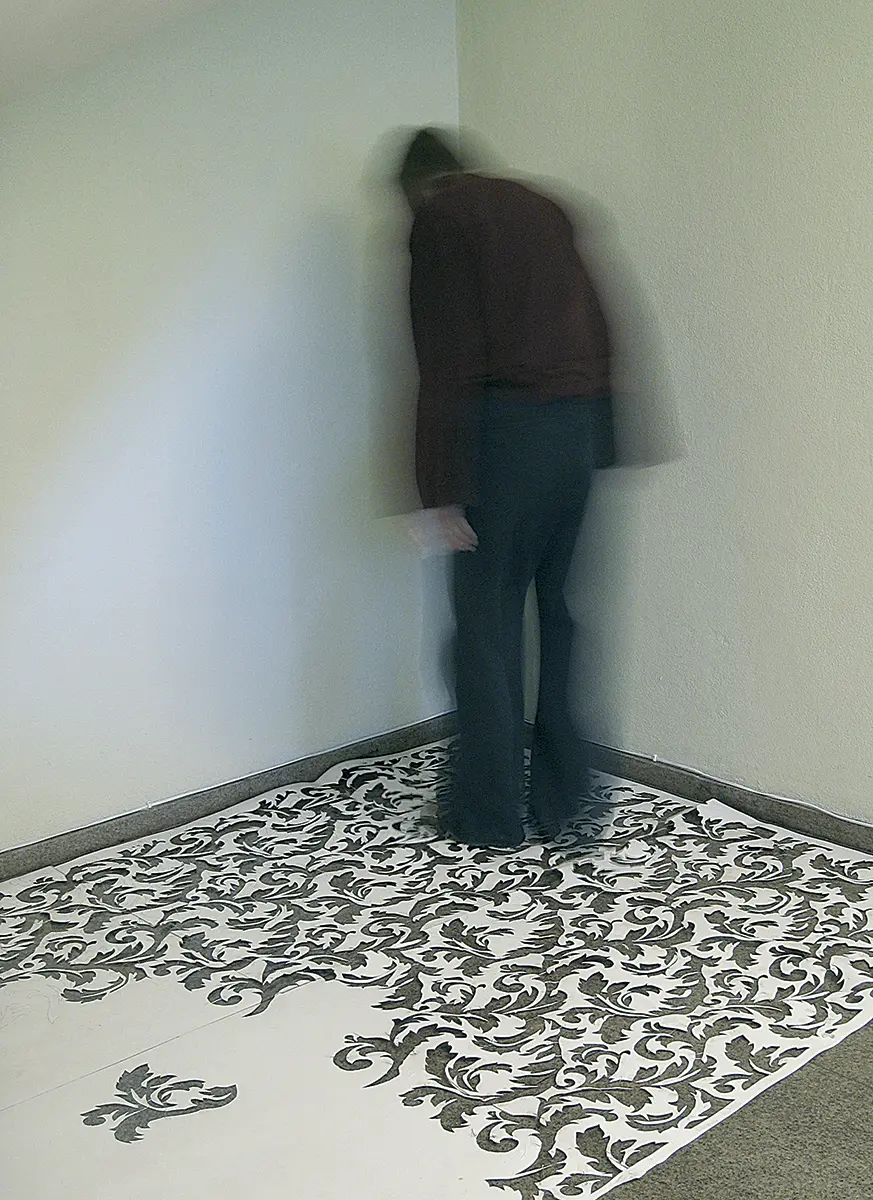
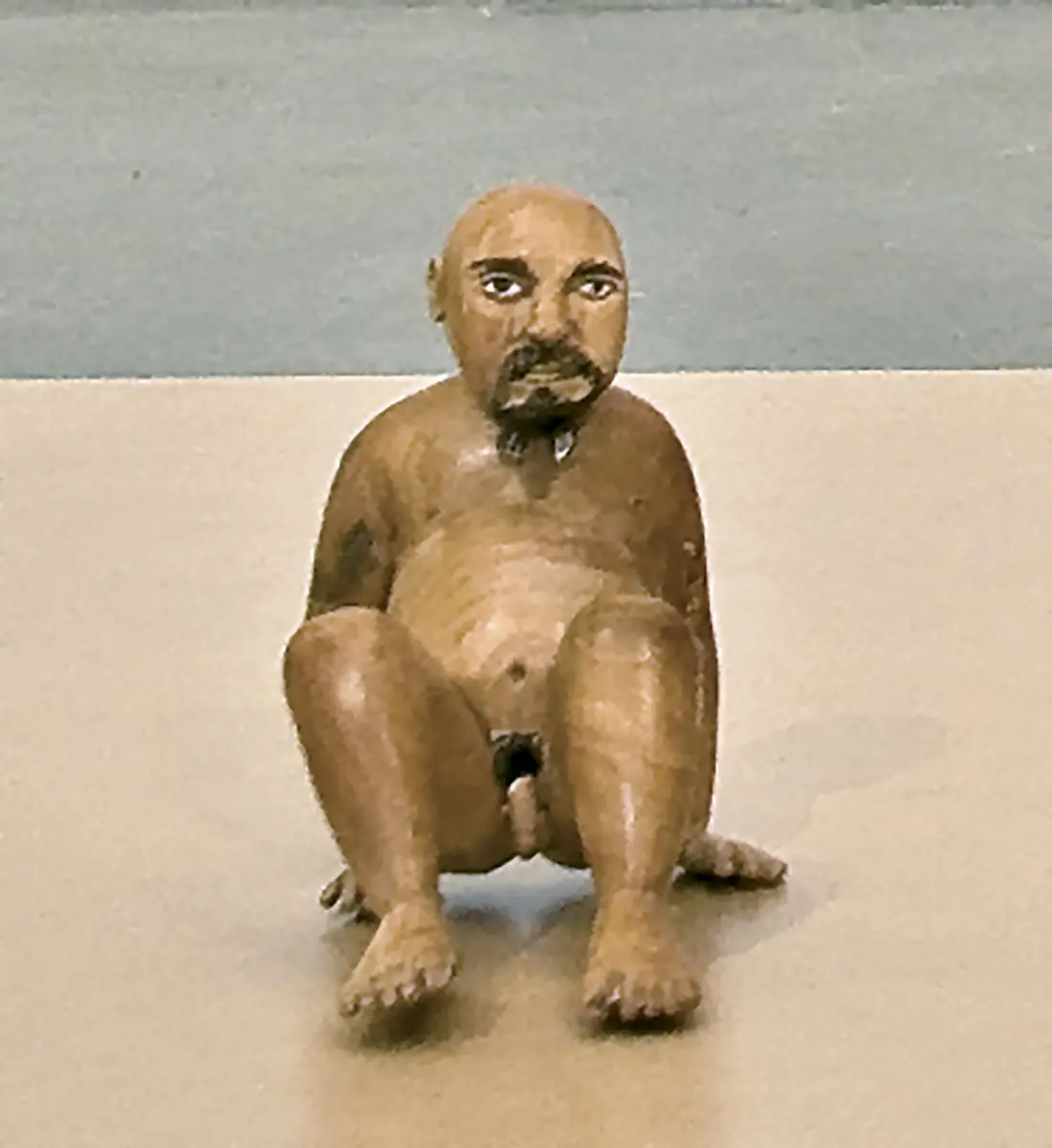
Efraim Almeida presented an untitled sculpture. Modeled on the artist’s own nude body, a figure in a crouching posture was exhibited alone on a large podium, which suggested loneliness and vulnerability. Brígida Baltar’s drawings titled Cantos were made with brick dust using a broom guard on the floor. They resembled common landscapes—faint, almost faded images, like old memories—of a location that referred to a fluid situation or a process of dissolution. Marepe’s work El Trasteo was a near life-size moving truck made of wood, like a toy. The truck was loaded with objects such as furniture and appliances, also of wood. The wheels were fixed and could not move. As the curator said, the truck was “divested of its functionality.”
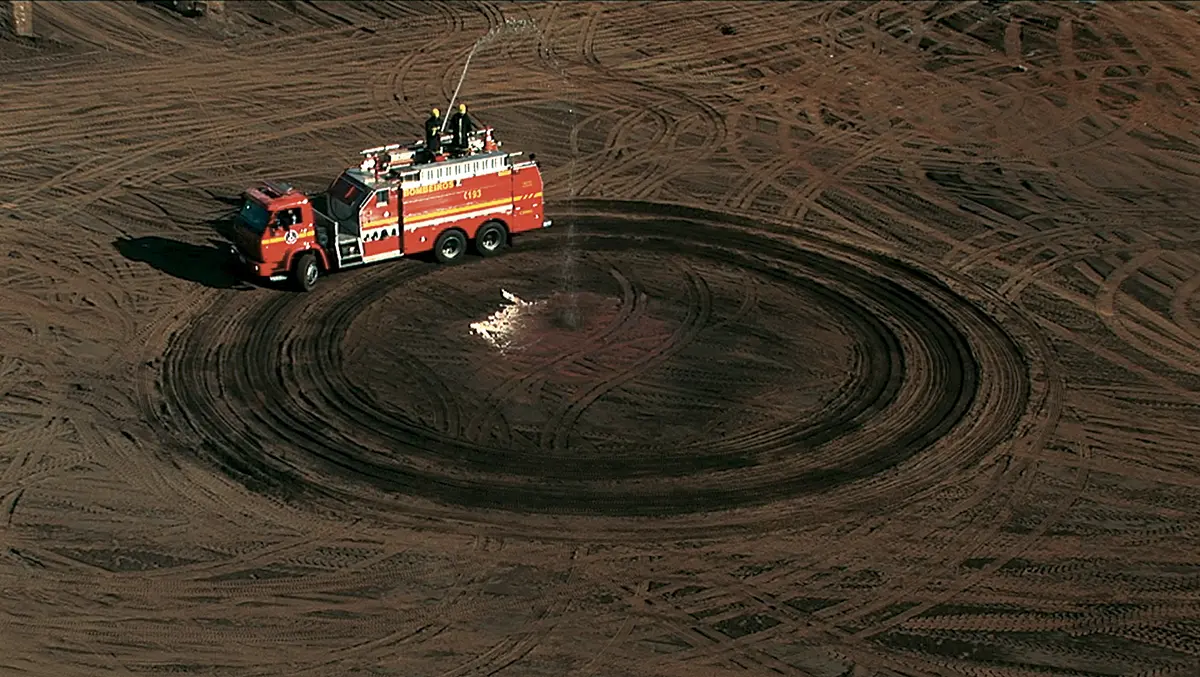
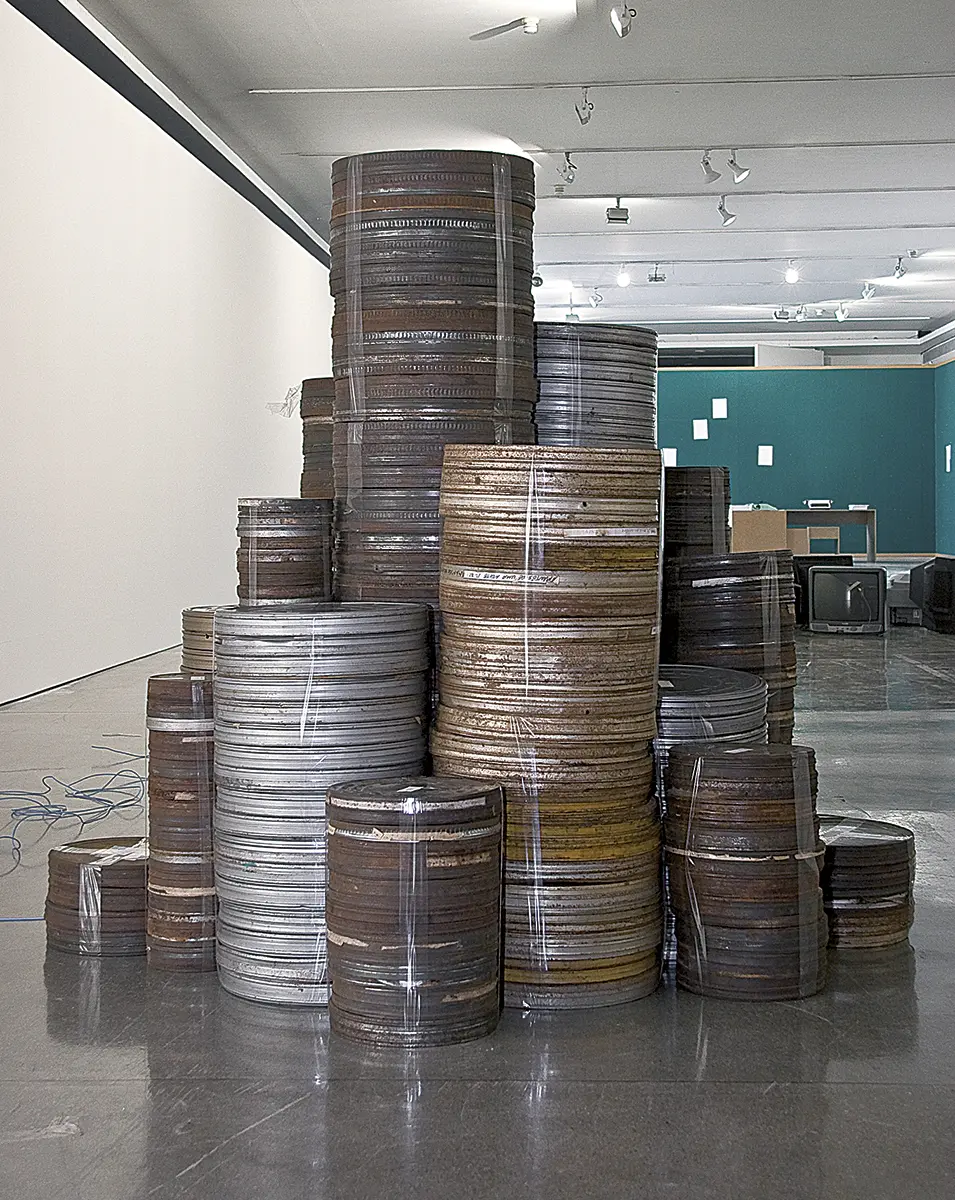
Titles, an installation by Matheus Rocha Pitta was built from empty and rusted film cans piled on the floor. Joined together with tape, they indicated a system in which everything is indistinctly consumed and loses its meaning. The Chelpa Ferro collective’s On-Off Poltergeist presented a sequence of televisions playing simultaneous images. Without relating to each other, the different screens created layers of information that garbled the content of the messages and, in truth, held little interest for viewers. Cinthia Marcelle’s video Fonte 193 showed a fire truck driving in circles, which continuously spilled water on the sandy ground—an incessant action with no result.
In her installation Quebra-mola-passadeira e rampeneira, Débora Bolsoni referred to the speed bump (quebra-mola), a device built to restrict the speed of vehicles.2 On the street, these forms are made of hard, durable materials, but in Bolsoni’s work they were made of organic, fragile materials; the meaning of the original object was altered and lost its character. Bolsoni’s works resembled a popular type of peanut candy, the paçoca.
The works discussed generated observations and experiences similar to when one travels in unknown places. Despite a well-defined curatorial concept, the exhibition design did not generate closed areas or force links between the works of art, allowing the visitor freedom of interpretation. On the contrary, it created a fluid trajectory through the different works, one that facilitated free reflection of relationships and suggested senses, meanings, and new interpretations of the reality of our time.
The curator Moacir dos Anjos invited Milton Hatoun to write a text for the exhibition catalog; Hatoun offered an unpublished short story titled Nature Laughs at Culture. A short excerpt will convey the experience of the visitor to the show:
The traveler, in coexistence with strangeness, privileges the gaze. And it is in the silence of the gaze that everything takes place: the desire to possess and to be possessed, abandon and rejection, the fear of getting lost in the Other. The silent gaze weaves an image that memory, in time, can evoke, lose, and invent.
NOTES
1. In dictionaries, this term is defined as a precarious arrangement between parties of diverse order. It comes from the field of the theater arts, where it designates a battery of lights of different colors that shine on the stage and is placed at the back of the stage, on the ceiling, or over the balcony. In colloquial usage, it means “an arrangement.”
2. This title is almost impossible to translate. Quebra-mola, literally a “tooth breaker,” is a speed bump. Pasadeira is a long and narrow carpet covering a hallway and also a woman who irons clothes. Rampeneira is a wordplay between “ramp” and peneira, a strainer.
LISBETH REBOLLO GONÇALVES