
Cristian
Segura (from Tandil, in Buenos Aires province) is one of the most multifaceted
artists in Argentina’s young generation. He is not only a visual artist but
also a museum scientist, and he served at the helm of his native city’s local
museum. Segura is also an independent curator and researcher. He is interested
in the complex network that extends from the creator to the user of the work of
art, in its many variants and possibilities.
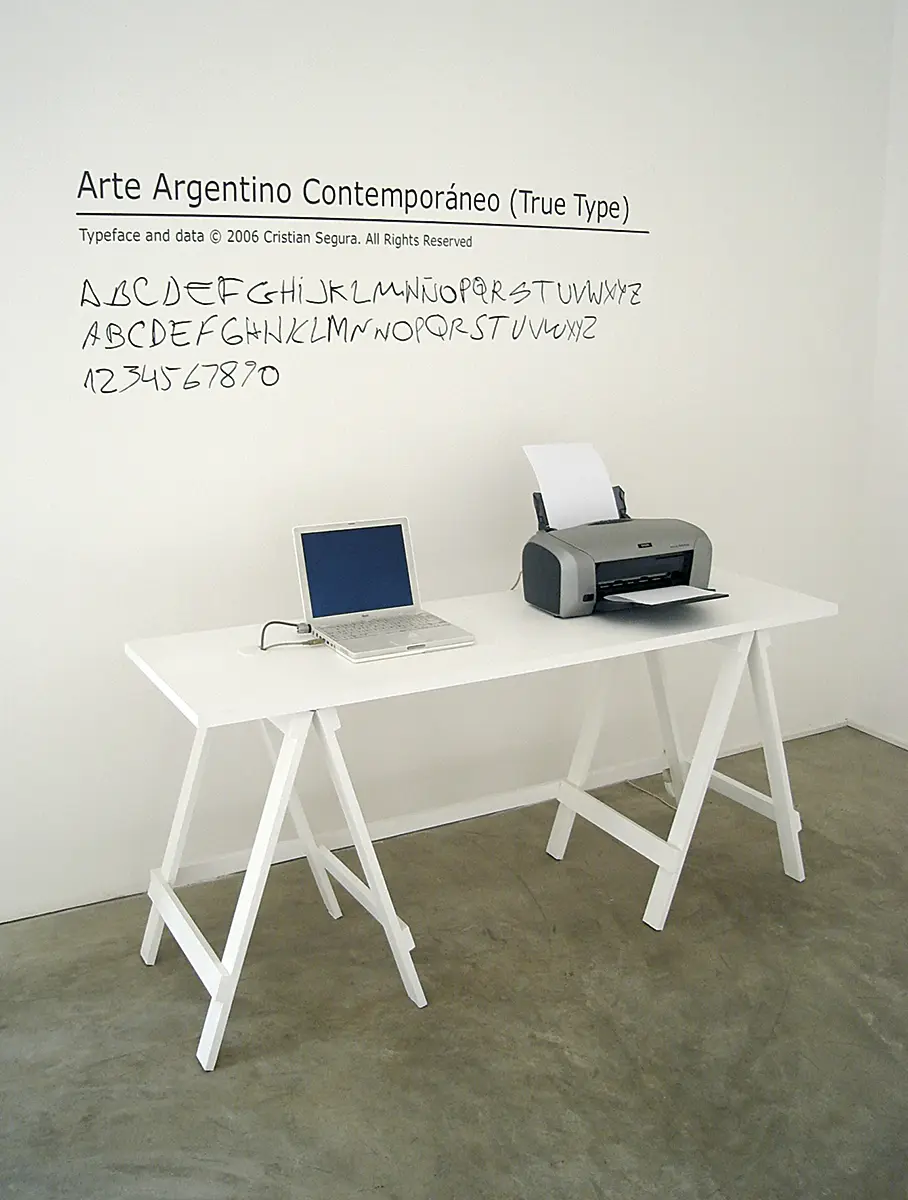
For the Florencia Loewenthal Gallery in Santiago de Chile, Segura presented a site-specific exhibition that filled the small area with a half-dozen works in several techniques. Taking note of the fact that this space was recently a movie-rental shop, Segura attempted to restore the locale’s pre-existing connections with the public of the Santa Isabel neighborhood.1 For that purpose, he gathered twenty video-art works by his Argentinean colleagues packed them inside manipulated boxes and placed them on shelves along with one of the walls as if in a video-rental shop, and, indeed, the public could rent the videos. Only one of the videos was exhibited in the gallery, one by Segura himself, showing his frantic run through the Tandil museum, taking advantage of the opening of several rooms that had been closed for renovation. (When this video was made, Segura was no longer director of the institution, which in 2001 won the award of Museum of the Year, given by the Argentinean Association of Art Critics.) On another wall, a video loop showed the customary copyright warnings that are part of domestic-use videos. Taken from many sources, in various languages and formats, they all featured the color red to emphasize the warning. The poster-like intervention on the gallery’s glass door, in red and white, played a game of mirrors with the exhibit:
WARNING TO THE PUBLIC
NON-EXPLICIT CONTENT
Two artist books were present. In one, published by the now-defunct Velox Foundation and focusing on painting in the Mercosur region, Segura made a series of cuts that suppressed the images and text, generating an empty container. The other was a suitcase made to contain an old Tandil Museum catalog, equally cut up and filled with a device that reproduced the noises of visitors to the museum. The artist sees it as a “portable museum.” This was a corrosive critique of book culture and an invitation to the direct experience of non-mediated art. But what would we do without art books? Audio-visual media is far from providing a complete substitution for books, and this in fact will never occur. Another work, still unfinished, consisted of an invented alphabet based on the handwriting of several Argentine artists, digitized and restructured. A computer allowed visitors to write using the new typefaces.
Aside from the seriousness and depth of his works, Segura assumes a playfully serious pose, which connects his work to the public. The content in his meditative works is lighthearted, jovial, and fun. And that saves him from the dangers of excessive conceptualization, which would completely isolate his work from the common public. A video invites a viewer to watch; a computer in an exhibition invites visitors to use it. This is real interaction with the public, which is the artist’s goal.
NOTE
1. This new exhibition space is located in an area that is not part of Santiago’s established art circuit. However, many artists of note have their studios there.
MARÍA ELVIRA IRIARTE