
Domingo
Garcia’s Obra Selecta – 60 Anos: 1947-2007, at Museo de Arte de Puerto Rico,
can be best defined as an awesome and necessary retrospective exhibition, a real tour de force where both, art
connoisseurs and the public, in general, will recognize the greatness of an
original/provoking artist (and a solid art philosopher), who will eventually
transcend the confines of Puerto Rico and will be paired with the best Latin
American artists.
Domingo, as he likes to be called, is a key member of the important/crucial Generacion del 50 (which includes Rosado del Valle, Rodon, Tufino, Marin, Homar, just to name a few) who, because of his talents, his ideals, and his leadership has become a true “Maestro de Maestros”, and at this Autumn of his life has decided to give his people in this exhibition a brilliant lesson of what a genuine and extraordinary painter (and now sculptor) is supposed to do/be: a visual poet who can translate into art (using his own aesthetic discourse) what he sees – “Everything I have seen I have seen it as a miracle. And I have tried to make it immortal.”, the artist will say — in order to help the viewers see in a new and different way, to help us see more and therefore live life more intensely, with more passion, with more love.
From the first paintings exhibited in this show, which date to l947 ( excellent student exercises within the realm of figuration, conceived under his own style of realism), to his present splendid “flowers”/”forces” (product of the inspired free stroke that defines expressionism at its best) or his magnificent landscapes or his breathtaking wood or bronze sculptures, we know that we are in front of significant/consequent/enduring art.
In the first room, the public is “received” by three monumental paintings, a triptych, according to the artist (the same size of his historic Icons), that clearly let us know where he stands: “We are a combination of three cultures: the Tainos (the painting is titled Atabiera, the daughter of the god of evil, Huracan and the loving god, Yuquiyu), the Spaniards and the Judeo-Christian tradition (a superb Sagrado Corazón) and the Africans (represented by the Yoruba god of war and sexuality, “Chango” ) —this Tríptico de Los Dioses del Caribe should be immediately acquired by any respectable local or international museum.
After that fascinating experience in the realm of Domingo’s unique power of syncretism (“Chango” and “Atabiera” are looking at the “Sagrado Corazon”, who has his eyes closed – in pain? in shame? grateful for having been forgiven?), we see a deliriously celebratory collection of still lives – prodigious “flowers”; ancestral lyric “forces”, formidable “explosions” of color and life– so sensual, so enigmatic, so erotic, so mysterious, and all so beautiful and enticing. And now we realize that the artists have consciously been creating paintings that can be constructed and deconstructed by the viewers as seen/read indifferent moments (Eco).
And it is with the other paintings in this room – the three spectacular Icons: Lolita Lebron and Luis Munoz Marin and Eugenio Maria de Hostos, his Gandhi, his landscapes and paintings such as La Crucifixión and El Hijo del Sol – that we realize that Domingo masters light and color like the maestros from the Renaissance, and that he fully understands that light in a work of art is its essential element. Domingo uses light, however, within the context of a 20th &21st Century aesthetic discourse: expressionism in all its forms. This, of course, makes his colors – which are quite special to start with – acquire the uniqueness that defines every one of his paintings – from his astonishing set of self-portraits which date from l957 to 2007 (and which reveal his evolution/growth as an artist and an interesting/intense process of aging and, yes, sainthood — a la Domingo…) to his more experimental work from the 60’ to the ’90s, in what is called “color field painting”.
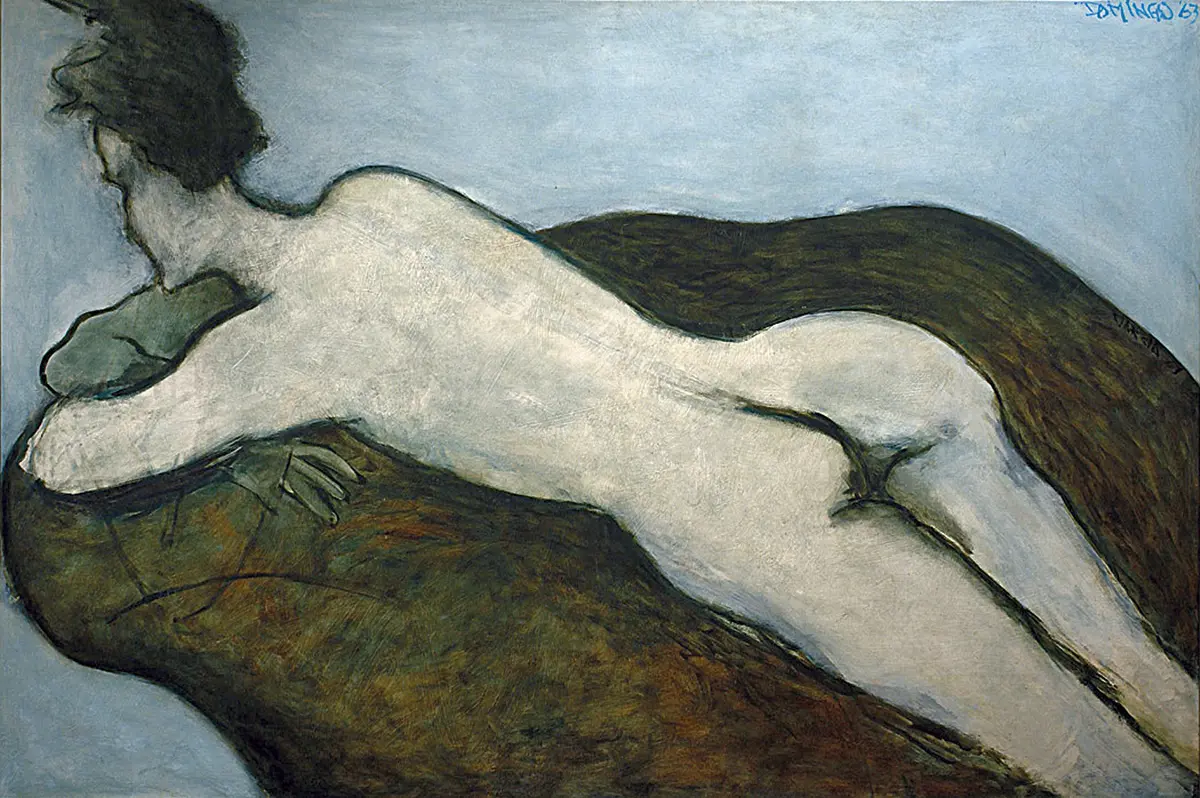
In the other Room, the viewers could see from Domingo’s first paintings, Lirio, painted at the age of l4, to the best collection of his famous female nudes ever. This artist’s female nudes from the ’50s to the present (from Adriana to Isabel Volando) are always full of poetry, passions, dreams, hunger, mystery, love. In these still dazzling/provoking paintings (remember that in 2007 we have seen almost everything), Domingo is not only able to capture the physical beauty of each one of his women but the spiritual essence of each one of his muses/models/rites. They are truly magnificent works of art – and seen together they let you know that this controversial human being (Domingo has always been controversial), that this brilliant but wild thinker believes in all the possibilities of Love (Plato).
And it is here that we will see Domingo’s powerful/intense/ beautiful sculptures, together for the first time, (so different from Judd or Mueck but so powerful and good). And it is, without any questions, and incredibly sensual experience – his “sculpture garden”, full of “personages” (from Huracan to Hombre Milenario), full of phallic elements, full of unknown but shocking energies, full of complex dialogues (asking for de deciphered). And it's in this Room that the public will see his daring experiments with color, his color field painting (a la boricua), an answer/take-off of OP and POP Art – so full of humor and games (El Galan esta en la Playa, a formidable self-portrait).
This extraordinary exhibition – an exhibition that should travel around the world – clearly proves that Domingo Garcia has been, and still is, is one of the best semi-abstract and figurative expressionist artists in the world since the ’50s, with nothing to envy the greatest expressionist talents from Germany or any other place, an artist who can look directly in the eyes of those (at times) questionable newcomers who presently sell their paintings for tens of thousands of dollars in present-day international fairs.
And for Puerto Rico it makes it very clear that, as a painter, he has to be considered at the same level of importance and excellence as Jose Campeche, Francisco Oller, Julio Rosado del Valle, Manuel Hernandez Acevedo, Francisco Rodon and Arnaldo Roche-Rabell.
MANUEL ÁLVAREZ LEZAMA