
“Therefore, Jephthah gathered all the males from Gilead, and
warred against Ephraim, and the Gileadites defeated Ephraim […] and occupied
the margins of the Jordan, through where Ephraim’s people would have to pass on
their return. And as some of them arrived there and prayed to be let through,
they asked him, Aren’t you from Ephraim? And as he answered, No, I am not, they
replied: Then, say schibboleth, which means wheat spike […] And they
pronounced it sibbolet, as they were unable to pronounce the same letters […]
and were beheaded […] so that forty thousand men from Ephraim died in that
war”. (Judges 12, 4–6)
Derrida says that schibboleth is a Hebrew word containing a multiplicity of meanings: river, wheat spike, olive branch. Beyond these meanings, it signifies a transit or passage. But as the biblical example shows, knowing how to pronounce it can indicate belonging or exclusion.1
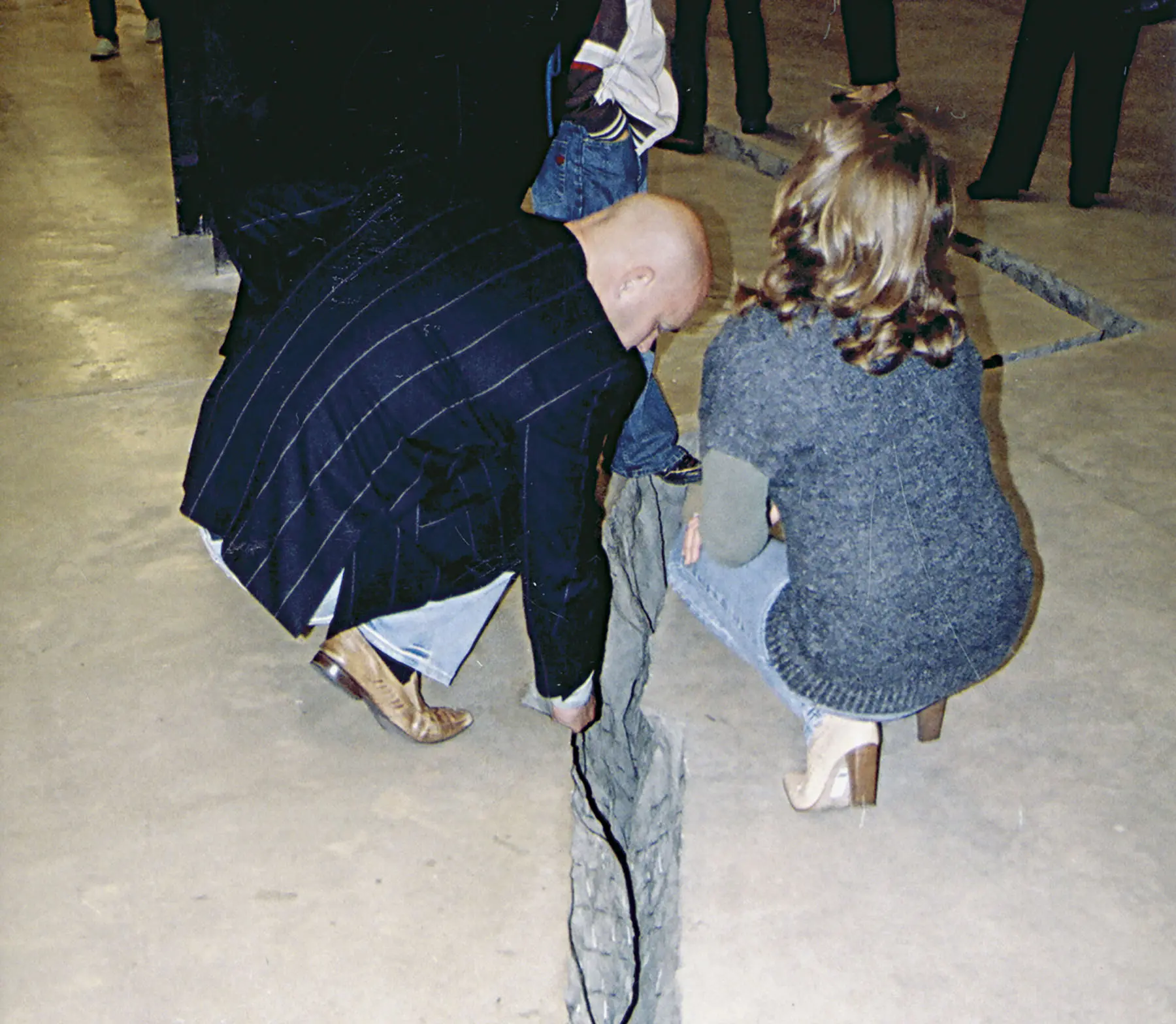
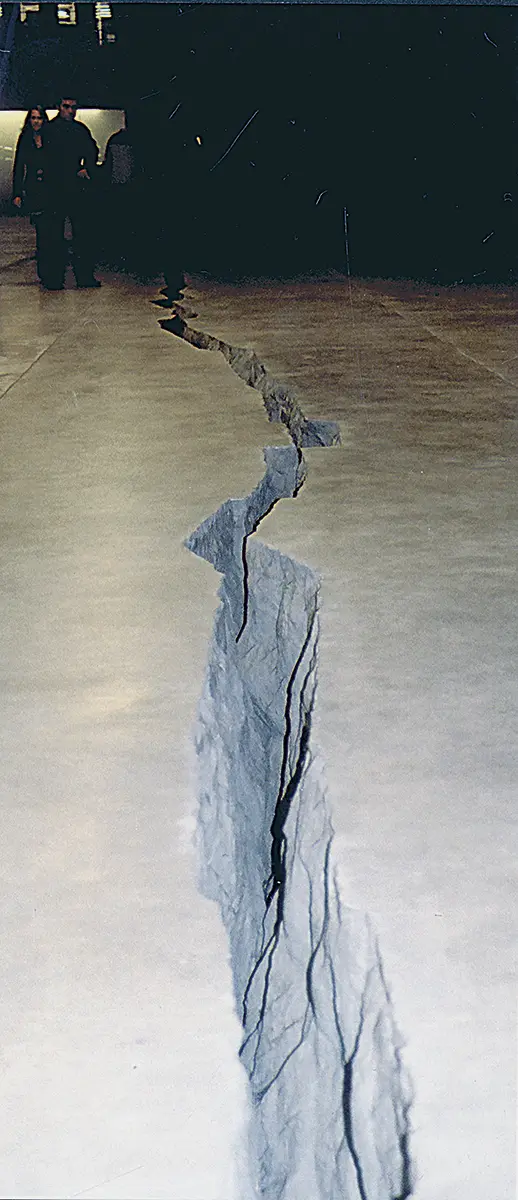
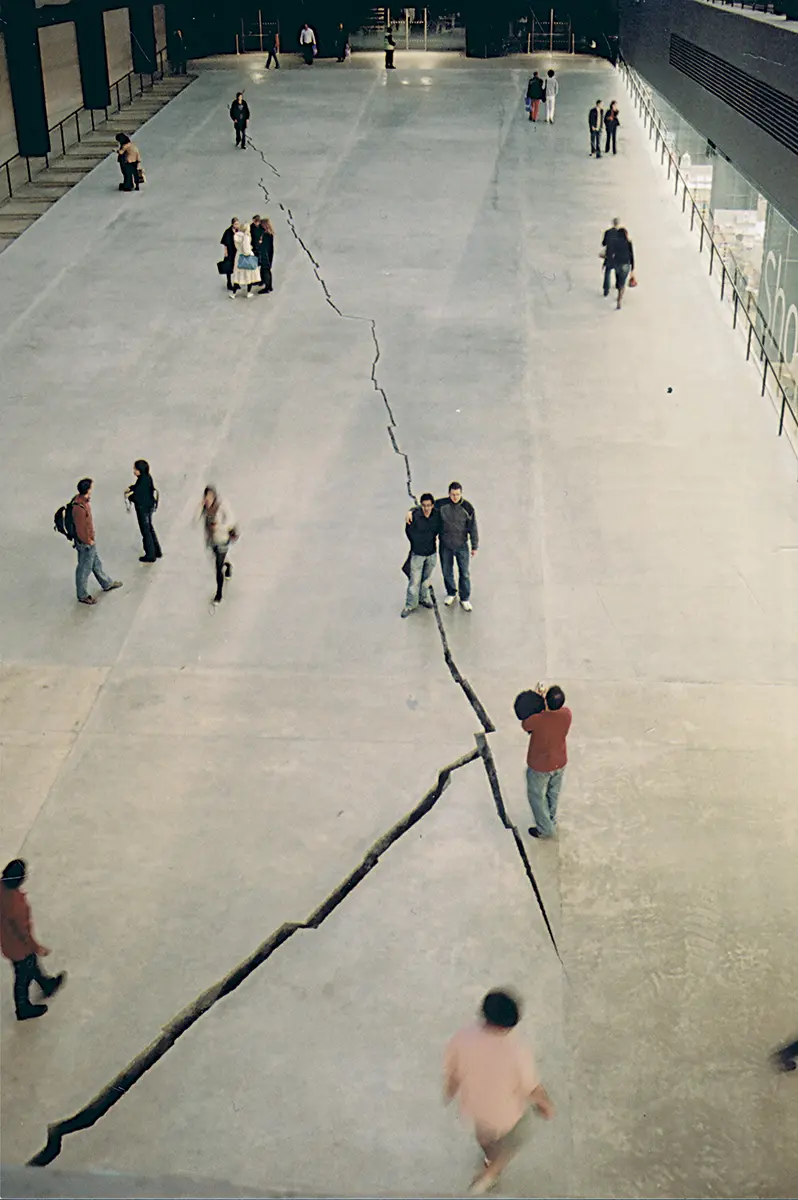
The passage from Judges and Paul Celan’s poem Shibboleth are two sources that allow one to approach the meaning of Doris Salcedo’s work of this title at the Tate Modern in London.2 However, the 167-meter crack in the concrete floor that constituted the work went beyond the mentioned evocations and became the representation of an insurmountable conflict: racial intolerance and segregation.
Doris Salcedo is the first Latin American artist to be invited to create a work in the Turbine Hall of the Tate Modern. In receiving this honor, Salcedo was preceded by Louise Bourgeois, Juan Muñoz, Anish Kapoor, Olafur Eliasson, Bruce Nauman, Rachel Whiteread, and Carsten Höller. Working in this hall, conceived as one of the most emblematic for the viewing of international sculpture, involved a distinctive commitment for Salcedo. She said, “If I was a Third World artist am invited to build one of my works in this space, I must bring them what I am, and the perspective of what I am. I think the space defined by the work is negative space, the space that, ultimately, Third World persons occupy in the First World.”3
The work unveiled a division that many would rather ignore: an abyss between two worlds that do not touch. Racism violates human dignity, and Salcedo asserts that this is not the symptom of a supposed illness afflicting the developed world but rather the illness itself. The European right wing’s racist discourse insists that the presence of immigrants represents the loss of cultural heritage. The latter are the carriers of difference, of lost values, and culture becomes an element of power that justifies an exclusionary ethical system. And, as the artist rightly points out, in order to inhabit a place, one must be welcome in it.4
The history of modernity ambivalently presents a complex relationship between empire and colony; much progress and prosperity were achieved and supported by colonial subjugation. Also, the history of racism runs parallel to the history of modernity since the latter has traditionally been seen as mainly occurring in Europe, where a homogeneous cultural model is presumed, one that promotes institutional models of culture and beauty. Thus, the presence of non-Europeans is perceived as a factor of decay that erodes European identity, leading to a nonnegotiable distance and, therefore, the crack in the floor at the Tate. Salcedo showed the depth and the distance created by segregation; the gap was evidence of our incapacity to traverse differences. But this warning will not end when the sculpture is dismantled. The transgression of cracking the floor open will leave a trace: however, the floor is filled, there will be a scar, which will function as a memorial.
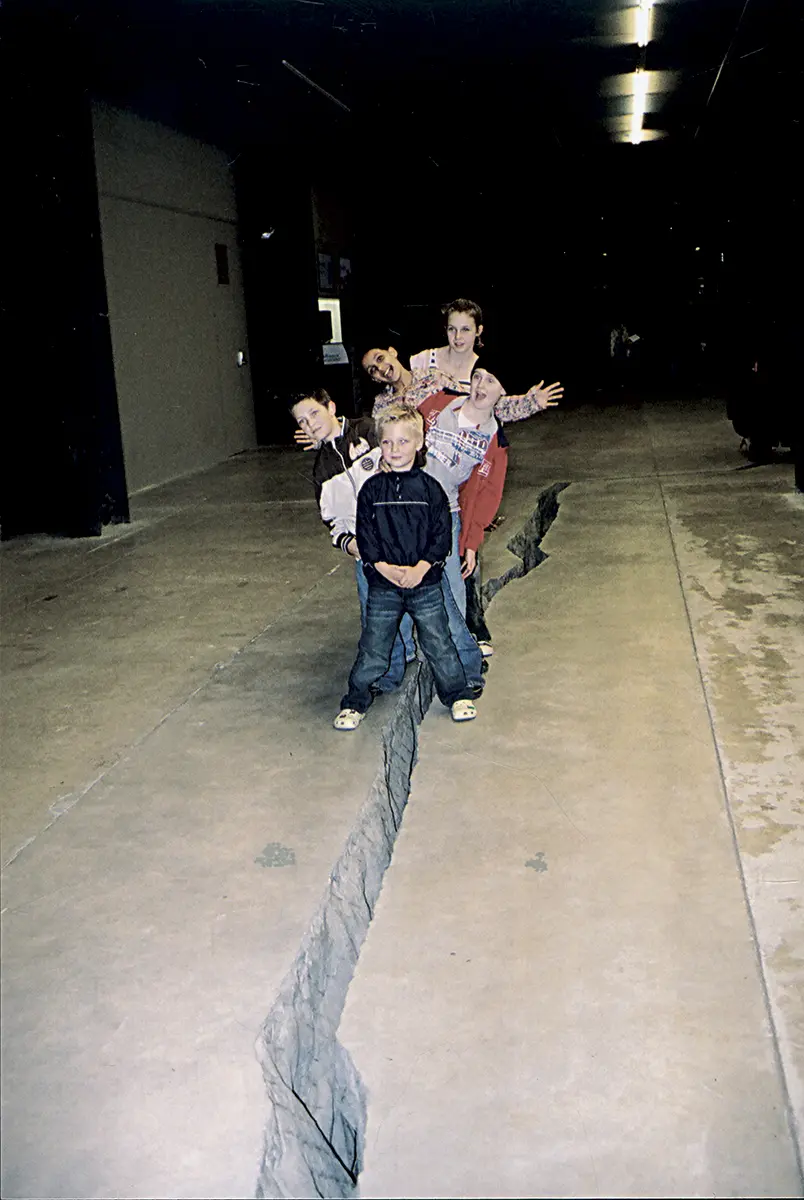
The work did not occupy space: it broke, penetrated, and invaded space. In the otherwise empty gallery, the gap created an abyss with edges that did not meet.5 With this work, Salcedo intervened in an architectural space that, in her judgment, constitutes a symbol of power. She shares this point of view with artists such as Gordon Matta-Cark and Hans Haacke who, in works like Matta-Clark’s cut-up buildings and Haacke’s Germania, questioned architecture’s aspiration to seek monumentality and permanence as expressions of power.6
On the another hand, one of the characteristics of a museum is to be a holder of history. But the preservation of history does not prevent segregation, hence Salcedo’s interest in the intervention of such First World museum spaces. She intends to present the history of those on the margins by relocating their traumatic experiences; these experiences define her work.
As in previous works, Schibboleth was not a narrative. Salcedo’s perpetual concern with memory and suffering doesn’t lead to the telling of stories, and her works demonstrate the value and significance of silence. Salcedo focuses on the evocative power of objects, not on the body, despite the human conflicts, abuses of power, and exclusions that have been at the epicenter of her investigations for more than twenty years of activity.
The resources used to build this work indicate that Salcedo’s technique shifts according to her intent; she employs stone, steel, and personal or domestic objects that create material mixtures not often used in sculpture. The structure that held open Tate’s cavity was produced through a complex and laboriously handcrafted process in Salcedo’s Bogotá studio over a year’s time.
Schibboleth, a work with clearly political content reflected one of the many forms of violence as well as the artist’s characterization of art as a condensed experience, one with profound historical meaning, in which the story of each protagonist of an act of violence mixes with those of other members of the community. Aesthetics and politics join together to develop an ethical conscience that not only operates in the restricted space of the original investigation but also affects survivors of collective suffering. Colombia, of course, doesn’t have a monopoly on the intellectual property of violence.
Salcedo’s sculptures are risky invitations to explore and investigate. For her, inciting memory is a way to open discussion about conflict, acknowledge its existence, and reconstruct history as a present reality.
NOTES
1. Jacques Derrida, Schibboleth pour Paul Celan (París: Ed. Galilée, 1986) 44–45.
2. Paul Celan (born in Romania, 1920–died in Paris, 1970) was a German poet of Romanian Jewish heritage and is recognized by critics as one of the great names in the postwar period. His poetry points toward permanent grief, to the impossibility of recovering lost lives. In one of the stanzas of his poem Shibboleth, he writes: “My Heart, make it known here also, here, in the middle of the marketplace. Make it echo, the shibboleth, alien from the fatherland. February. They will not pass.” The last two sentences allude to the triumph of the Popular Front in Spain, in 1936.
3. Manuel Toledo, “Doris Salcedo contra el racismo,” BBC Mundo (October 9, 2007).
4. From a conversation with the artist, Bogotá, December 2007.
5. Salcedo has explored the notion of the abyss before, such as her intervention in the Turin Triennial, at the Castello di Rivoli, an eighteenth-century building.
6. Doris Salcedo, Proposal for a project for the Turbine Hall, Tate Modern, London, 2007, in Doris Salcedo Schibboleth (The Unilever Series, Tate Publishing, 2007) 64–65.
* Photos: León Birbragher.
IVONNE PINI
Professor at Universidad Nacional de Colombia and Universidad de los Andes.