
In
2004, Dulce Pinzón began her most recent series The Real Story of the Superheroes. These color photographs (ten of
which made up the recent exhibit at the Kunsthaus Gallery in Miami) reveal a
central aspect of Latin-American immigrants in the U.S.: the commitment to a
life of hard work performing jobs that U.S. citizens and residents are
unwilling to do. For these first twenty photographs of the series, Pinzón,
herself an immigrant born in Mexico in 1974, photographed Mexican immigrants in
New York at work in construction, agriculture, cleaning services, skyscraper
maintenance, food service, and other jobs typically performed by immigrants.
The unifying characteristic of these works is that the subjects that Pinzón
photographs all wear superhero costumes inspired by U.S. or Mexican comic book
and movie characters. A restaurant deliveryman rides a bicycle wearing a
Superman outfit while on his way to deliver food; another person cleans windows
clinging to the wall of a skyscraper wall, wearing a Spiderman costume; a
laundromat worker is Wonder Woman; another cleans fish as Aquaman; a
construction worker appears as El Chapulín Colorado (The Red Grasshopper, a
Mexican TV character); a worker loading trucks for a greengrocer is the
Incredible Hulk; and a nanny has become Catwoman.
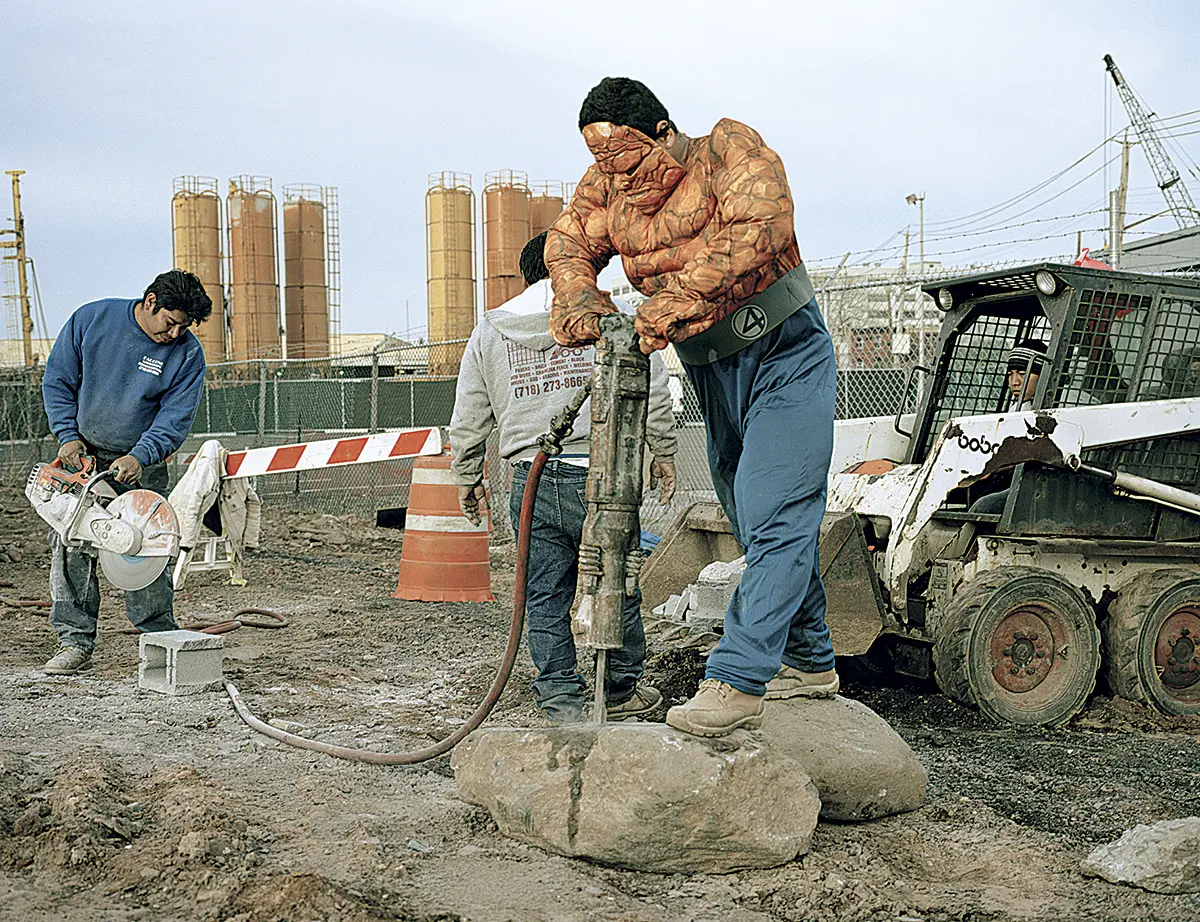
Transforming the subjects’ identities might create some confusion concerning the artist’s intentions; she in fact attempts to establish a link between pop culture icons and the immigrant’s real position as the hero of the family and of the community he/she supports in his/her country of origin. Pinzón clears up this ambiguity by employing a typically conceptualist device: text, which is presented as something falling between the caption of a photograph and a textual commentary on the wall next to each work. Thus, one can learn the true identity of the individuals photographed, hidden under superhero costumes. Spiderman is in fact Bernabé Méndez, who every month sends five hundred U.S. dollars each month to his family in Mexico; the Superman riding a bicycle is Noé Reyes, born in the Mexican state of Puebla, works in Brooklyn and sends five hundred dollars to his family each week; and Wonder Woman is María Luisa Romero, also from Puebla, who weekly sends one hundred fifty dollars to her family. Dressed as Aquaman and from the state of México, Juventino Rosas sends three hundred fifty dollars per week; under the Incredible Hulk costume is Paulino Cardozo, who contributes three hundred dollars weekly to support his family back in his home state of Guerrero, and Minerva Valencia is Catwoman, who sends four hundred dollars per week to her relatives in Puebla.
In this manner, Pinzón’s photo essay suddenly reveals itself as sharp and subtle sociological research on this very important segment of society—this ghostly floating community of undocumented immigrant laborers. But these multi-ethnic workers embody heroism that in many ways transcends the conventions and artifice found in comic books and fantasy films. In her introduction for the series that appears on her website (dulcepinzon.com), the artist states that these are “heroes who sacrifice immeasurable life and labor in their day-to-day lives for the good of others.” And later: “A superhero in the context of pop culture must possess supernatural powers to save and protect others. Translated into everyday life, this concept of supernatural power could apply, for instance, to the capacity to persevere under extreme climate or work conditions.”
These staged photographs by Dulce Pinzón achieve a visual estrangement from the representation of Latin-American subjects, whose identities are suggested under the superhero costumes, and the incongruity of these costumes in the work environments where these people perform daily. This juxtaposition generates irony within the social commentary of the photos in the series. In addition, the strong contrast between the superhero costumes’ kitschy appearance and the dignity and realism of the subjects’ working environments underscores a fact of mutual co-dependence: of a powerful nation and its economy in need of cheap labor and of the immigrants, seeking within a Pantagruelian job market a specific niche and the promise of a better life for themselves and their families back home.
RAFAEL LÓPEZ-RAMOS