
Negro
y blanco, a show of works by the Venezuelan artist Julio Pacheco Rivas, was
presented at D’Museo Gallery last September. It was significant because it
re-valued printmaking as an essential resource and because it allowed viewers
to appreciate the results of a creative project that the artist has developed
over his entire career.
These results were surprising in view of Pacheco Rivas’s prior pictorial work and were significant for their treatment of color, among other things.1 For several years, the artist painted geometrically impeccable architectural spaces and unreal forms conceived in subdued and generally cool colors. These lonely spaces evoked the lack of life; there was no place in them for men or women. Yet amid such apparent austerity, there was a small measure of humanity. This seemingly contradictory assertion has a reason behind it. Among several artists who came onto the scene in the 1970s, Pacheco Rivas reacted to kinetic experimentalism by searching for the human values that had been thought removed by that artistic practice. Some artists created a flexible, amorphous geometry; others produced works filled with symbolic content taken from consumerist mass-media culture. Pacheco Rivas, paradoxically, explored human nature without the need to represent Man in his fictional scenes. Instead, he created unreal, fictional realms, an inherent condition of his style.
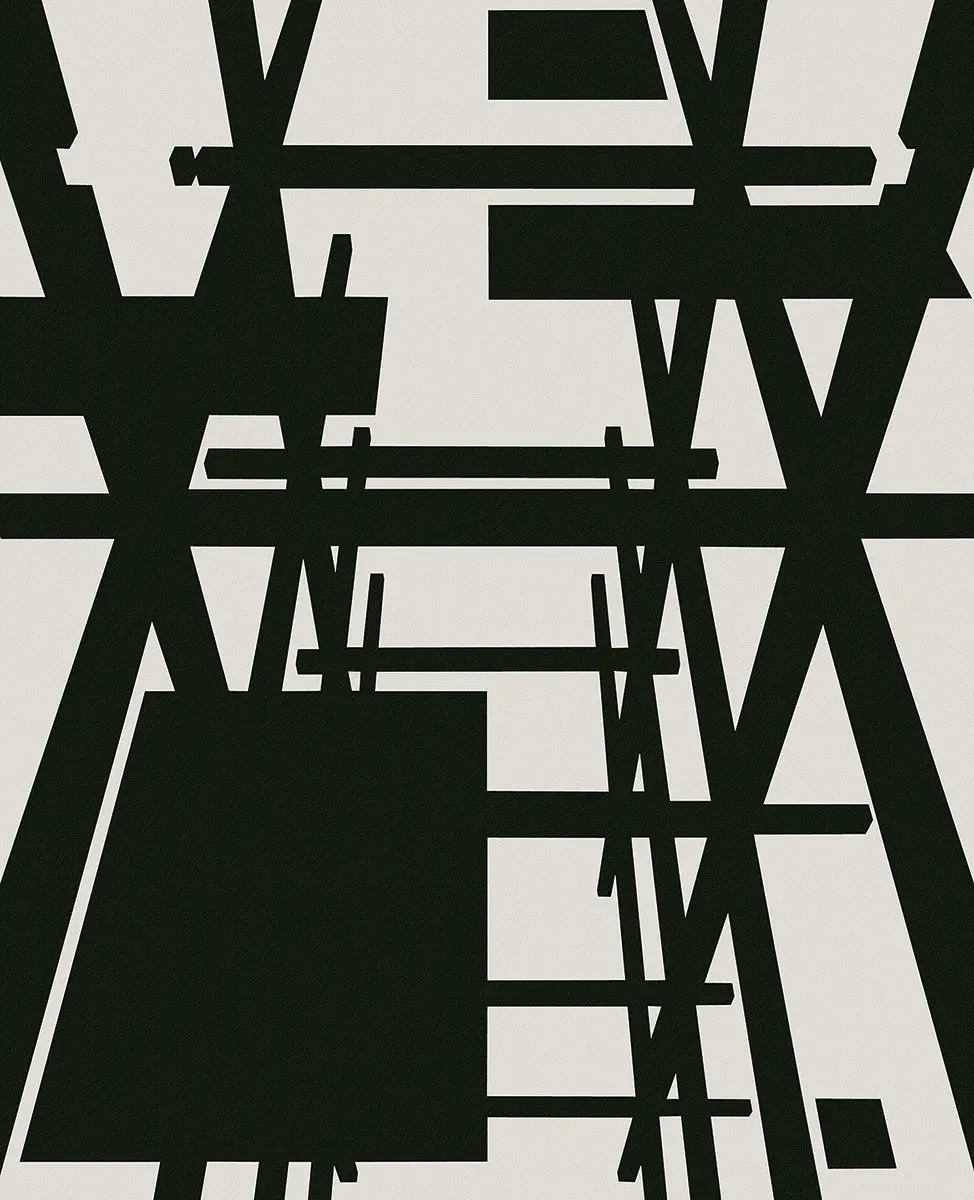
In recent years, color has gradually drained out of Pacheco Rivas’s fictional world. The beginning of this process was seen in “Fugas,” a show presented at the Provincial Foundation in 2000 along with work by the sculptor Sydia Reyes. Here, Pacheco Rivas had already neutralized his palette through the use of grays. At the same time, he began to underscore the importance of everyday objects (a coffeepot, plate, and cup, toothbrush, etc.) by painting them at a large scale against his architectural spaces. His current work incorporates these investigations in form, color, and scale. The palatial spaces, columns, and worlds created as “machines from the future” have disappeared, ceding the protagonist roles to everyday objects—chairs, toothbrushes, ladders, and other utensils—that gain structural and even spatial character as they appear in the foreground, at an out-of-proportion scale.
Another big change with respect to Pacheco Rivas’s previous work is the suppression of the illusion of volume and depth. In 2000, the linear perspective and the tonal shifts in the treatment of grays still generated an illusion of three-dimensionality. Today, those objects are black outlines against white grounds. They are flat shapes created digitally in a repeated and systematic fashion, which allows the artist to make infinite, unexpected compositions. One chair can be combined with others in many different ways. In this compositional process, the reduction of synthesis of figures can result in a multiplicity of images as well as in ambiguous readings about the identification of the object—as in the work Mínimo-mínimo, which makes indistinct allusions to chair legs and lampposts of a minimalist abstract image. Some pieces allude to the representation of three-dimensionality by the novel technique of digital printing, which allows some works to be “installed” on the wall to create false perspectives. As these are essentially linear works, they are entirely integrated into the architecture of the exhibition space. For that purpose, the artist took advantage of angles and corners, as seen recently in the show Extrapictórico and on the walls at D’Museo Gallery.
In sum, it is the object that identifies Man. Pacheco Rivas again avoids human figures in his work yet suggests a human presence with the representation of familiar objects. These objects establish a temporality. While his previous work existed without relation to time, Pacheco Rivas’s new images are timely, belonging clearly to the twentieth and twenty-first centuries. The feeling of contemporariness is associated with design through the representation of utilitarian objects and through the use of new technological and digital means that give a new dimension to contemporary printmaking. The exhibition at D’Museo Gallery comprised serigraphs and aquatints printed at Taller de Artistas Gráficos (TAGA), digital prints made with ultraviolet ink, one work made with a multidirectional router on Plexiglas, and a painted steel-laminate folding screen worked with a computerized hole-puncher. With these works, Julio Pacheco Rivas’s oeuvre gained a newfound impetus, and digital graphics and technology were forcefully inscribed as valid contemporary art media.
NOTE
1. See Federica Palomero’s article in ArtNexus #35, which highlighted the processes of change in the artist’s career between 1972 and 1999.
SUSANA BENKO