
A long-awaited exhibit brought Mathias Goeritz’s presence back to the New York
art scene. An artist of plural talents, a man ahead of his time, and a creator
of ideas more than works, Goeritz was one of the many Europeans who
immigrated to Latin America because of World War II. Those who saw the recent
exhibit at Ramis Barquet (and those who did not) should be aware that Goeritz’s
presence in the New York art world has become stronger in auctions, galleries,
and personal art collections. It was also in New York, nearly a half-century
ago, where Goeritz had to pay a garbage truck to take away some of the work he
was unable to sell because the gallery (Carstairs) was closing its operation
and could not store the pieces, and Goeritz had no way of taking the works with
him. But the recent exhibit in Chelsea offered several confirmations. The
first, in the words of the artist, was: “Only history will decide what art is.”
And two others were: perspective is essential, and investing in art pays off.
Having escaped Nazi Germany, Goeritz lived for some time in Spain, where he grew intellectually and came to know influential people. In contrast to the rigid and solemn education he received while growing up, Goeritz’s experience of the Altamira Caves expanded his already present admiration for human naiveté in the primitive state. While he was part of a circle of progressive Spanish artists, Goeritz began teaching. Later, he met the Mexican architect Ignacio Díaz-Morales, who at the time was in the process of founding a school of architecture in Guadalajara, Mexico, and Goeritz was invited to form part of the faculty there.
This would mark the beginning of his most productive period as an educator, in which he used his own methods to teach the visual arts. Goeritz was most involved with teaching during three periods—in Guadalajara, and at the Ibero-American and the National Autonomous Universities in Mexico City—and he taught the majority of notable architects, visual artists, and designers of his new country, where he would live until his death in 1990. In the recent exhibit, Goeritz’s use of gold, white, and red-orange was present in a brief but important mention of Mexican influence on his works, which balanced the European trends he introduced into Mexican culture.
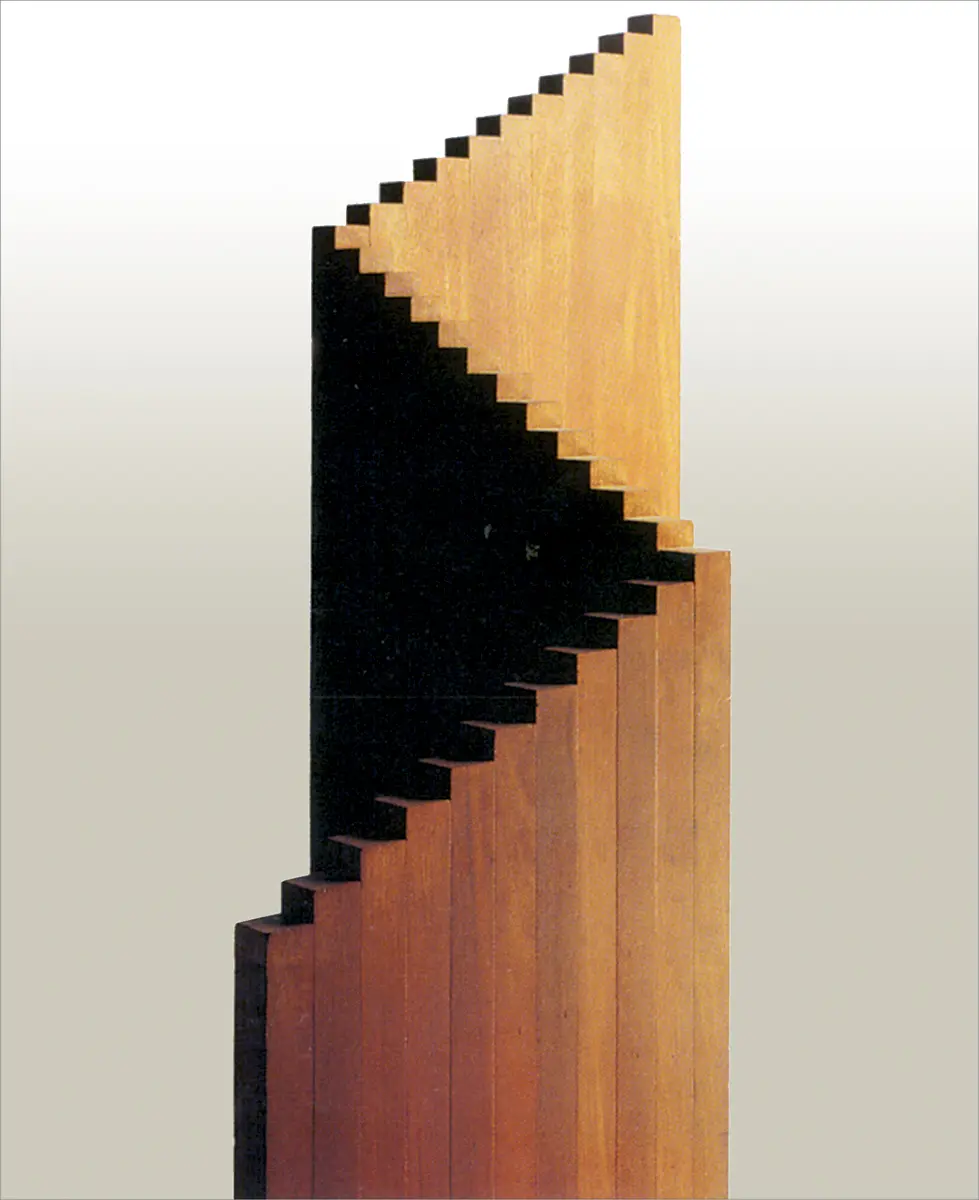
Goeritz was a visual artist who also worked as an editor and art critic of an important Mexican architecture periodical. He organized numerous events, conferences, and projects; he was the creator and director of the Cultural Programme for the 1968 Olympic Games. Although Goetritz was a painter when he arrived in Mexico, the works included in the recent show exhibit were mainly sculptures; he was required to create sculptures in his newly adopted land. Goeritz always acknowledged the teachers and artisans who taught and supported him, and several sculptures and architectural models in the exhibition—El Carnicero (The Butcher), Ciudad sin Fin (Never-Ending City), Sculpture for AMT and its negative version, El Laberinto de Jerusalém (The Jerusalem Labyrinth), and Automex Towers—reminded the viewer of Goeritz’s diversity.
As previously mentioned, the exhibit illustrated the artist’s multifaceted approach and his early lack of professional recognition. Even then, an artist’s work was defined by his treatment of contextual themes, his palette, and his adherence to one or several movements. For instance, Goeritz was labeled an Expressionist in the early part of his career and later as a Geometric artist. Presently, an artist survives not only in one or two artistic movements but takes on anything of interest. He changes formats, materials, and supports; works in several disciplines simultaneously, and does not create with the durability of the work in mind. He questions and critiques ascribe to marketing rules or rebels against them; he defies them, he defies herself, and he defies us. Goeritz did all of this. Viewers saw it in his woodcarving Salvador de Auschwitz (Savior of Auschwitz). Goeritz created countless works for several religions, as seen in Salvador, Custoria (Guardianship), Los Mensajes (The Messages), Modelo para una Capilla Exterior (Scale Model for an Exterior Chapel), and in artistic works for synagogues.
In his determination to break from the solemnity and in his profound admiration for the photographic media, Mathias Goeritz was aesthetically ahead of his time. Although many of the exhibition’s forty-five works that dated from 1958 to 1998 were scale models, this selection allowed the viewer to understand that Goeritz created a vast number of urban and monumental works, artistic expressions in which he also participated as an international organizer and juror. In addition, he created minimalist works prior to the initiation of Minimalism as well as concrete poetry, installations, performances, and interventions.
GRACIELA KARTOFEL