
Reader and cryptic are two words I do not use as labels for anyone, much less the eight Colombian artists who participated in the fourth edition of the Luis Caballero Award exhibition. These artists are very different from one another, and they are unclassifiable. I use those two words because they help me to see, and I trust they will help me to write.
I understand “reader” artists as those who are interested in the news of the world and of Colombia, even if that sounds like a bad omen. These artists are interested in language and, by wondering about its structure, critically express situations of everyday life: the language of news, the sounds of a living room colonized by a TV set, or the paradoxical phrases found in graffiti or uttered by those who exercise their right not to commit, such as the phrase above, taken from Humberto Junca’s work. Language-based work explores situations that are denied even when they are in plain sight. Thus, the exhibition affected me as a good book would, and I left with new ideas about what it means to live in Colombia.
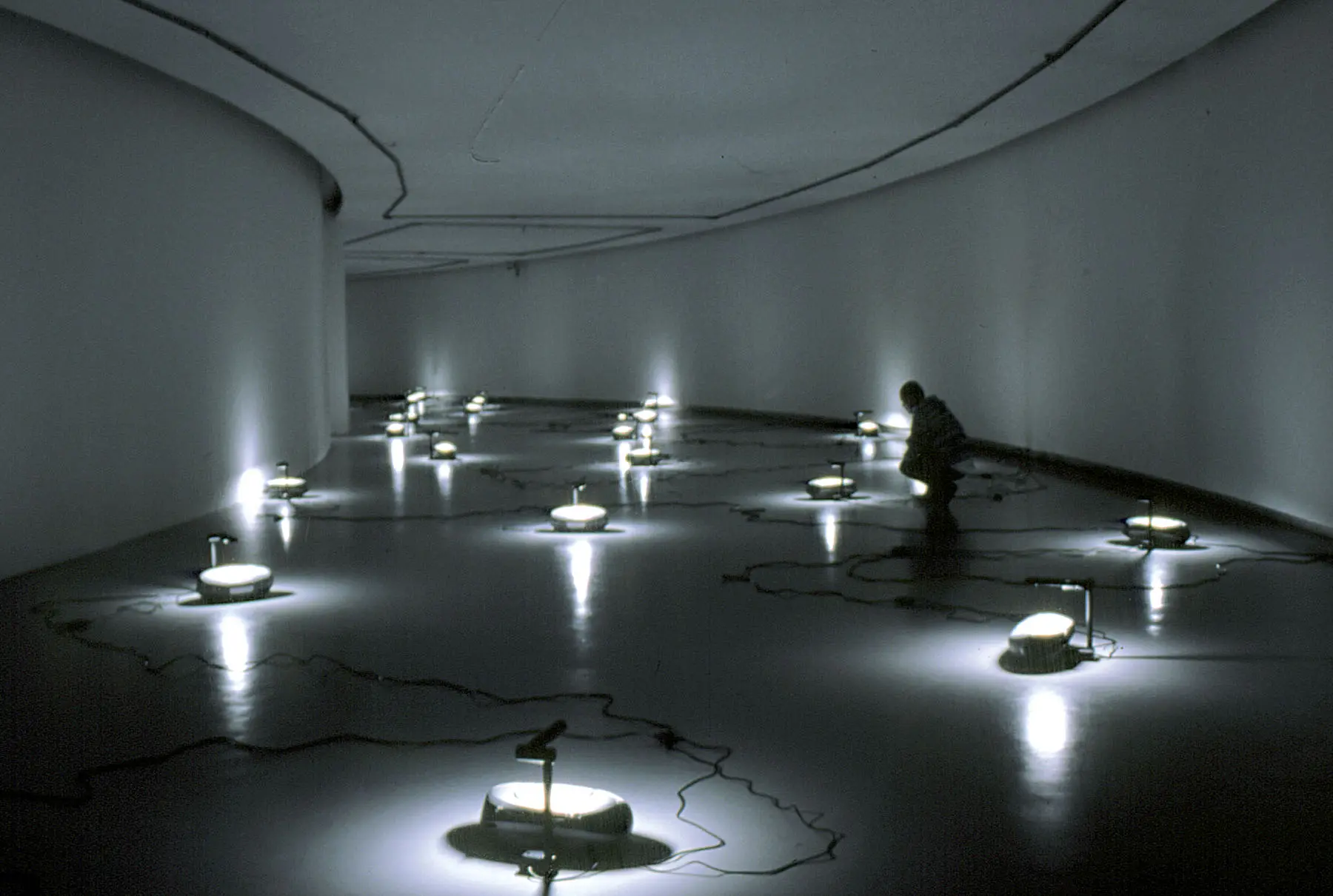
The work of Fernando Uhía (born in 1967, Bogotá) is my first example of the reader category of artist. His work began when he saw people who are close to him hypnotized in front of the television. The sound perceived by Uhía in this situation was a mixture of rapid gunfire, explosions, and shouts—the sounds of most movies seen on cable TV. Uhía transformed that noise into mass. He said:
For physicists, the phrase 'critical mass' indicates the minimal amount of fissionable matter needed for a nuclear chain reaction. In the case of the sound installation Masa Crítica, a relationship is established between the minimum amount of mass-media sound matter and what is needed to create in the viewer’s imagination the appearance of that sound matter’s visual referent.2
Critical mass is a hypothesis developed by ethicists and economists to say that individual behaviors shift, sometimes unconsciously, and adhere to that of a group of a certain size. “The hundredth monkey” is a phrase that means one more individual adopting a certain behavior will finally tip the scale and effect a change of attitude. But is it a favorable or unfavorable change? That depends. Uhía’s work suggested that we join, without awareness, a critical mass:
"We adhere: to the sound of televised diversions in the action genre, which must be understood as part of a conspiracy that forces us to lazily consume globalizing ideologies through the use of the sound of its tragic-violent events—that is, through the exacerbation of the senses by the globalizing ideological apparatus."3
What is key to this work is the fact that Uhía entirely modified the space and did so in a painterly manner. That is, the spatial, material, and color issues occupied the space comfortably. Uhía placed on the floor thirty-two CD players that emitted the sound mass. Like any good painter, he carefully chose the gray-colored units, installed them with their cables in view, and lit them with a small white lamp. In this way, he eliminated the viewer’s awareness of the walls and the floor; an in-between space appeared, like an uncertain, gray-misted planet, a planet of useless sounds.
Uhía’s sound installation, Masa crítica, won the prize, the Luis Caballero Award. This is a competition for Colombian artists who are thirty-five years of age or older. The process is this: a jury selects eight projects, and these are exhibited in Bogotá’s Santa Fe Gallery for an entire year. The curving, complex exhibition space, in the end, becomes an implacable juror. The ring-like space has two curved walls; the light can be pitilessly intense when the doors are opened to the garden, or the gallery can be transformed into a frightful labyrinth. The gallery is located in the Planetarium in a park with historical traces and native spaces, in the middle of the noise of downtown Bogotá; all of these variables, in the end, affect the result of the competition.
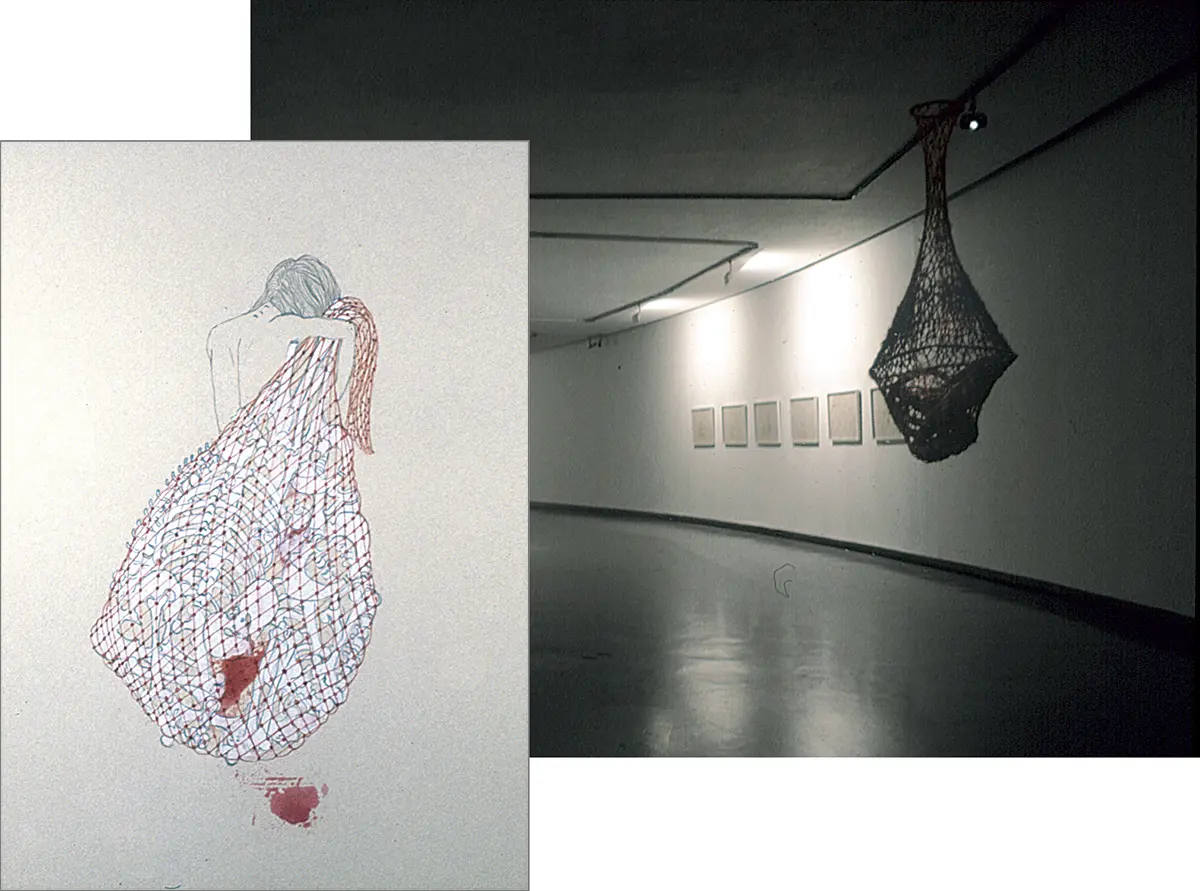
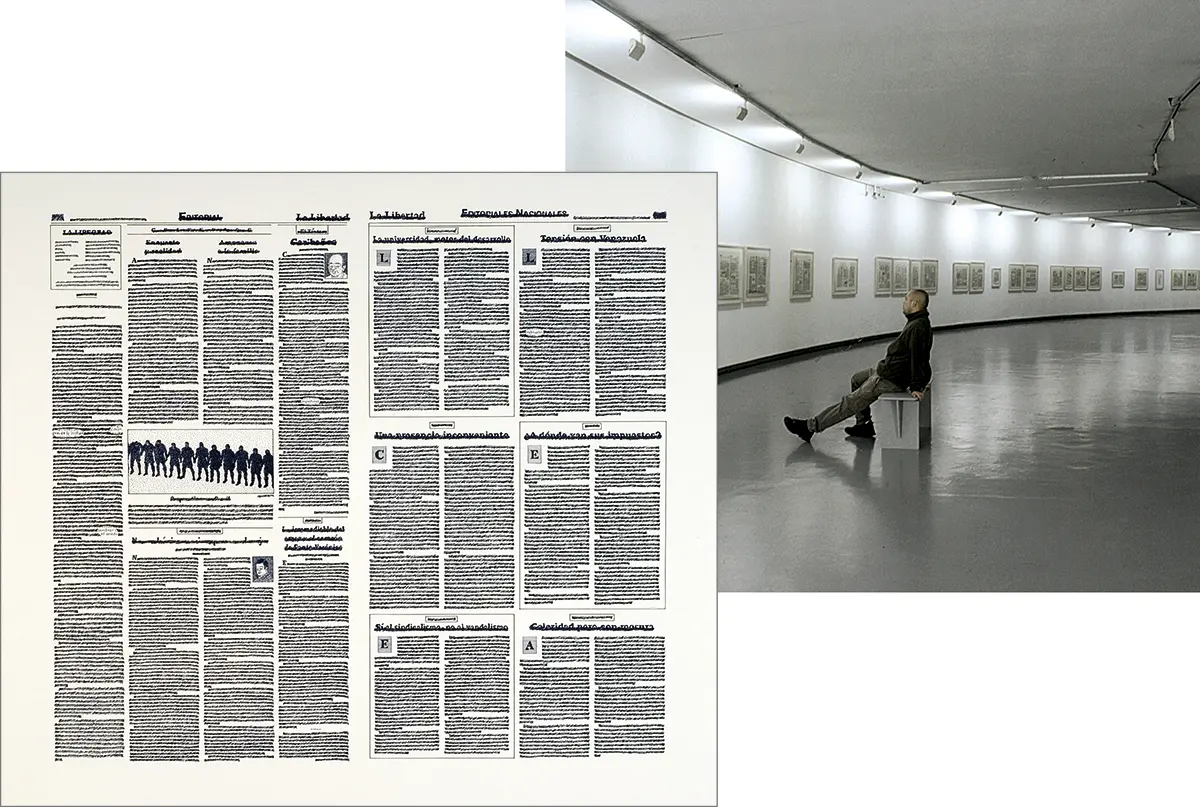
Another reader artist in the exhibition was Johanna Calle (born 1965, Bogotá). Her work Lacónia began with a text on the wall:
"To be able to adjust to shifts in events, words had to change their usual meanings... any idea of moderation was just an attempt to disguise a soft character; an ability to examine any issue from every angle meant that one was completely useless for action... Whoever wielded violent opinions gained trust, and whoever objected to them was seen with suspicion ...Society was divided into territories where no man trusted his neighbor." (Thucydides)
This preamble was followed by a series of drawings in
ink, separated by phrases written on the wall. El laconista, for example, was a set of ink drawings with blocks of
texts and images that imitated a newspaper. The news was taken from dailies
from across the nation. Most of the sentences were crossed out, but some were
readable: Opinion, CLOSE UP, TRAGEDY. At times, the ink drawings were
like points of dust, disintegration, and chaos. The well-chosen phrases on the
wall reminded viewers of the urgency of individually seizing power over
language heard and spoken. Unfortunately, in Colombia, words are used to
dominate and hide. In my view, the words of those in power only assign blame,
make generalizations, and silence other voices, and they are echoed by those
who don’t know or don’t contradict. One of the chosen phrases was by the
Colombian writer Enrique Serrano: “There are no cataclysms but the gripping calm
of those who are silent.” Calle’s presentation included notebooks of apparently
judicious content, but they became progressively rarefied to the point of being
unreadable. And on the wall, the viewer read: “In his books, words eat away at
the pages like worms” (Sylvia Plath). It was as though those rarefied pages
also demanded free drawing: “Times of rare happiness in which it is licit to
understand things as one pleases, and to state them as they are understood”
(Tacitus).
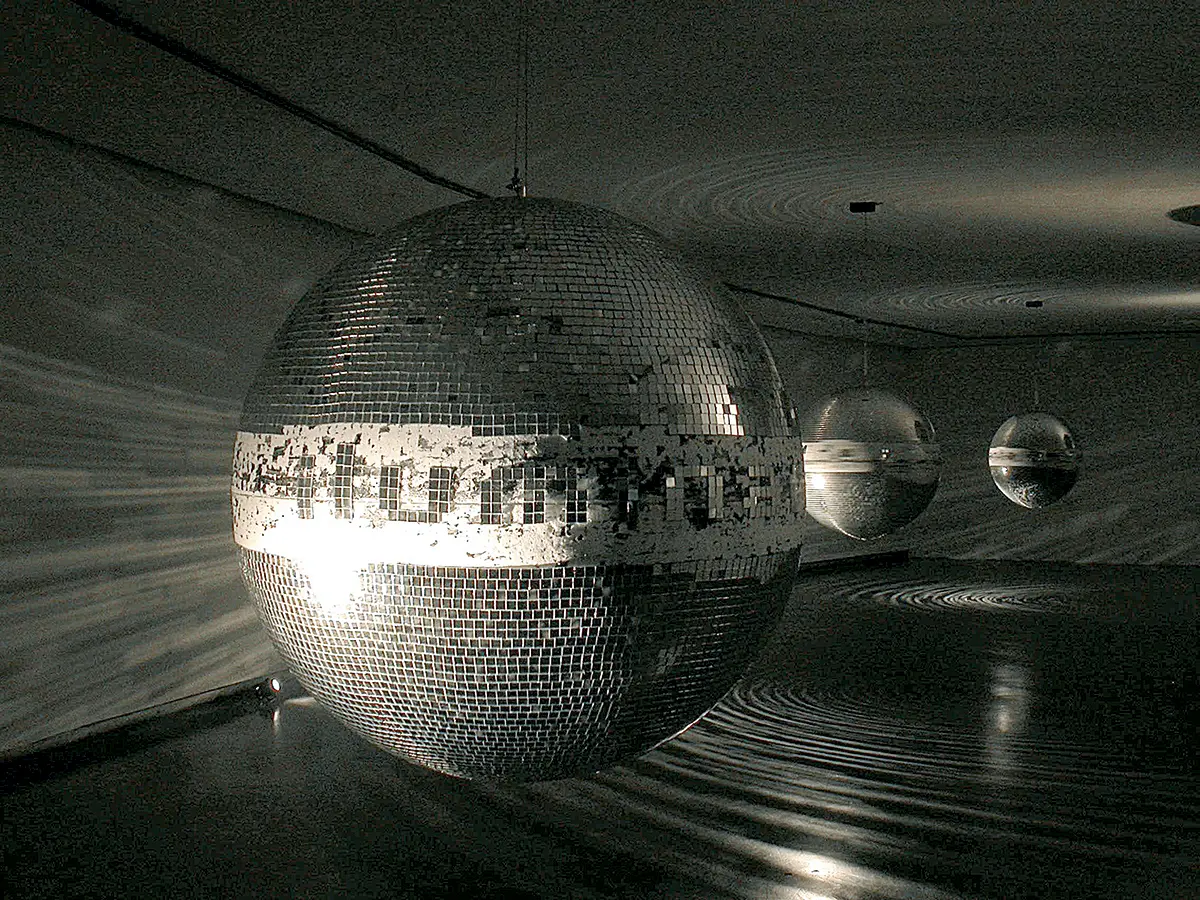
The work of Humberto Junca (born 1968, Bogotá) was titled Acto Reflejo. The artist hung large, mirrored disco balls from the gallery ceiling, with phrases that struck me as the thoughts of individuals who aren’t compromised by institutions they do not believe in and refuse to participate in a diagnosis of what occurs. They reminded me of Marcel Duchamp’s ready-mades, such as his 1915 snow shovel with a shadow that appeared as a broken arm on the wall. The earliest ready-mades were created in the midst of war, and Duchamp commented that at parties, he and his friends mocked everything—including their own works, power, the king, and the queen—and then ended the night in tears.4
In the catalog, Humberto Junca said:
A couple of years ago I came crashing down. In the midst of my melancholia, I made a rough sketch for the Luis Caballero Award, a reflection of the despair that grows and swallows everything. If they invited me to parties, I suspected a trap, a mirage. So much fun and so much laughter struck me as unfair. An old graffito was lodged in my brain: “The world is crumbling down and we are out partying."5
Junca described the process and the origin of the phrases:
Finding a phrase for each ball was complicated. From the original project, I only kept one, which I had taken from the Brazilian artist Helio Oiticica’s Parangolé: “We live on adversity.” The other five had to have the same bittersweet flavor. In a newspaper interview with the Mexican film director Arturo Ripstein, I found the second one: “to persevere without hope.” The third one was given to me by a friend, who quoted Cesar Pagano: “optimism in the face of the abyss.” (I don’t know if the quote is accurate, but it fits.) Toward the end of 2006, my collection of phrases and sentences and my team of collaborators grew. Most of the phrases recommended to me were charged with too much cynicism (damn you, Cioran!) and did not advise a courageous and absurd behavior in the face of an equally absurd and adverse reality. I had no other option but to put together the other three phrases as a reflection of those I already had, pointing out elements present in the exhibition in order to underscore for the viewer the urgency of the “here and now.” These phrases were: “Let’s celebrate the mirage,” “Illuminate failure,” and “Grace in the face of disgrace."6
I greatly enjoyed the presentations of these three artists. On the one hand, they worked with language, which contributed to raising the awareness of any casual visitor to the gallery. On the other, they brought back the pleasure of playing with textual elements and weren’t overtaken by a documentary nature. They made it possible to once again employ media already within the art canon, such as painting, drawing, and the ready-made. Perhaps that allowed them to transform complexity into a more synthesized experience.
Those artists that I call “cryptic” are reflexive, to be sure, with works that revealed only the tip of their investigations. As I visited their presentations, I felt as if I was inside a crypt where the rules of the game were hidden, at least from me, and needed to be deciphered. I always celebrate artists who work with language, but I also respect the cryptic. After encountering their works, I can offer impressionistic traces of my experience and some texts by the artists, published in the individual catalogs.
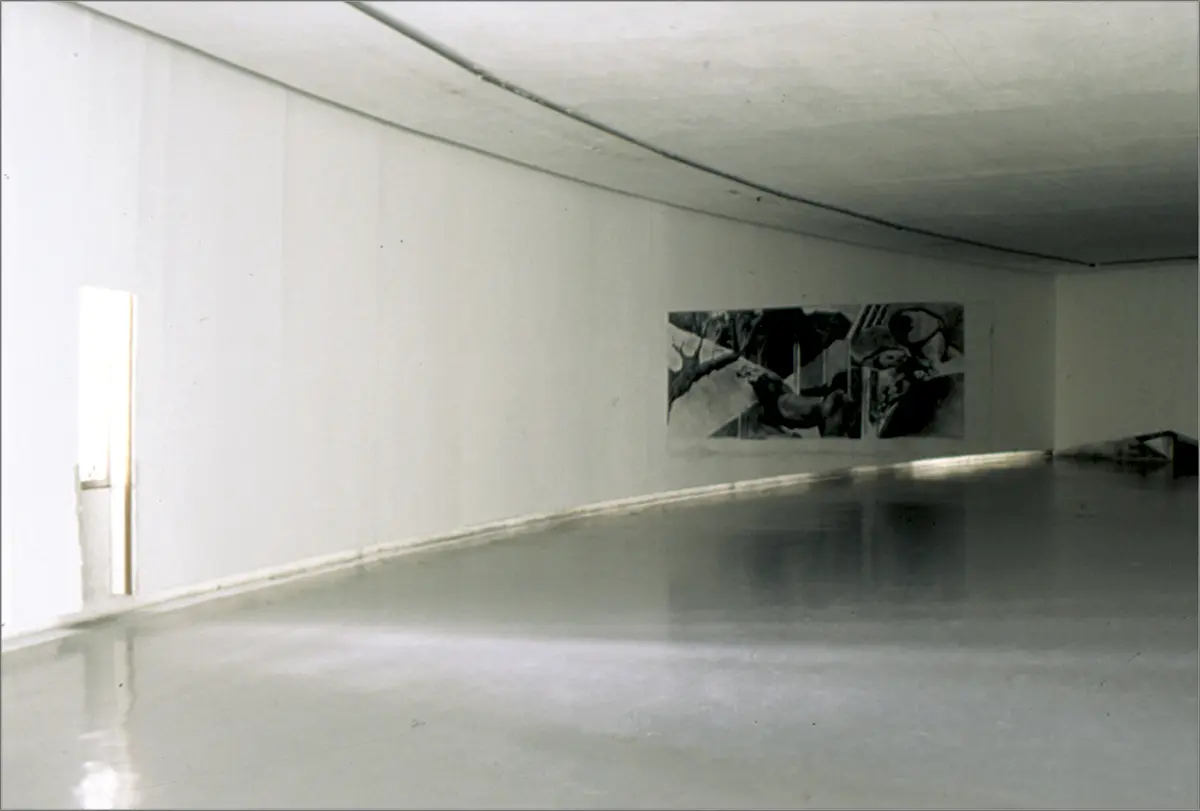
In the case of Ámbitos, by Miguel Huertas (born 1959, Bogotá), the gallery, devoid of any artificial light, was shrouded in a semi-darkness that was broken only by the whiteness of the drawings. These opened virtual holes in the wall as if connecting the gallery and the outside world. At times, the afternoon light entered through small cracks in the panels that covered windows that normally look onto the park. It was an installation designed not to reveal and yet to make visible what was left out: works by art students gathered by Huertas, and whose experiences at the site were shown on the internet; the trees and the carousel in the park, and childhood experiences that must be guarded from an art world that often is predatory. But in the exhibition catalog, they evoked a Bogotá that belongs to all of us.
Huertas described his inspiration:
The light was normally cold, like the air. The cold was an indication that it was still early; the sun only came out when we were already lining up at school and was not part of our daily repertoire until we were out on vacation. While having breakfast, the lights were on; in fact, it seemed that the workday started by slowly condemning the signals from the previous night from the small terror of the night, all that was left was a handful of rags. Staying awake was difficult: that familiar sensation of a grain of sand behind one’s eyelids.7
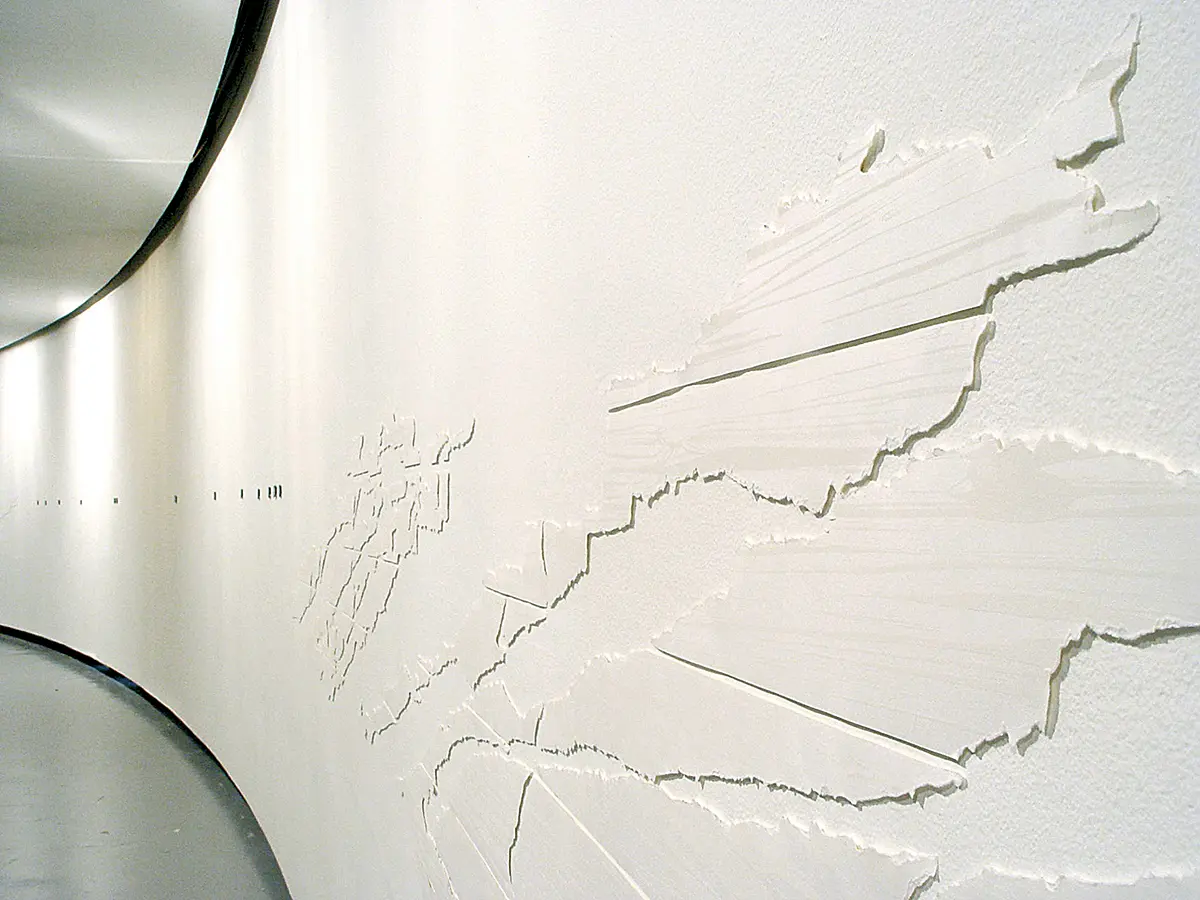
In her work, Beatriz Eugenia Díaz (born 1965, Bogotá) wanted to freeze Bogotá’s chaos and motion at a fixed point, the north star that guides all navigators: Polaris. The shape of the gallery, like a ring around the Planetarium, helped Díaz make this metaphor concrete. The city’s twenty localities were represented by pieces of ripped white paper that were strained by contradictory movements. On the one hand, Diaz evoked a globalized city that separated and dissolved its parts and, on the other, a city that was described from a single point, which paradoxically was also fragmentary and illusory:
"For many, Bogotá becomes the North Pole. People move toward the direction of that point, whose relative position remains constant. And they situate themselves. They come from uprootedness and chaos. From confrontation, confusion, loss. And they arrive in Bogotá, space where everything unfolds: fragmentation, repercussion, drama, crisis, preoccupation, conflict, differences, necessity, fright, alteration, violence, destruction, pain, resentment, aggression, impact, renunciation, rupture, absence, oblivion, silence, displacement, novelty, high-plains, mountains."8
The map of the city, transformed into fragments that seemed to be made of ice, was submerged by the noises from the twenty districts that Díaz recorded and made into white noise. At times the song of the copetones, the city’s characteristic bird, was heard.
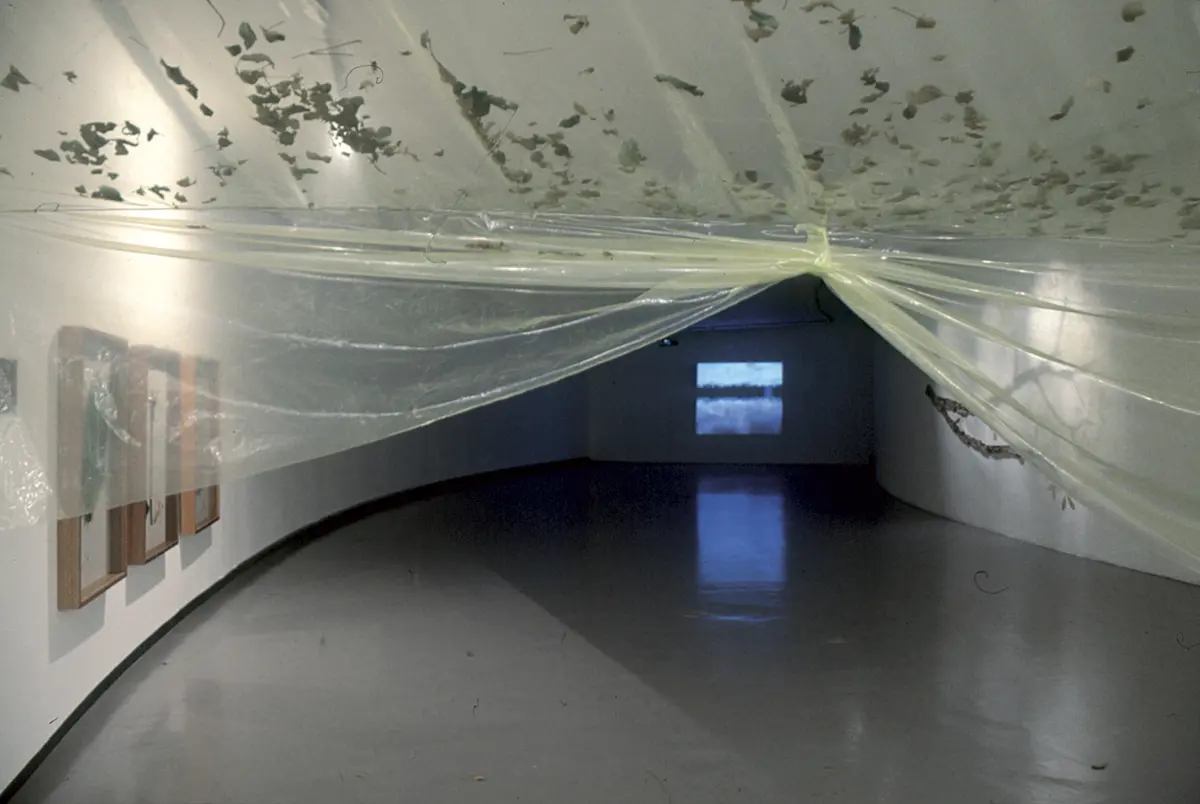
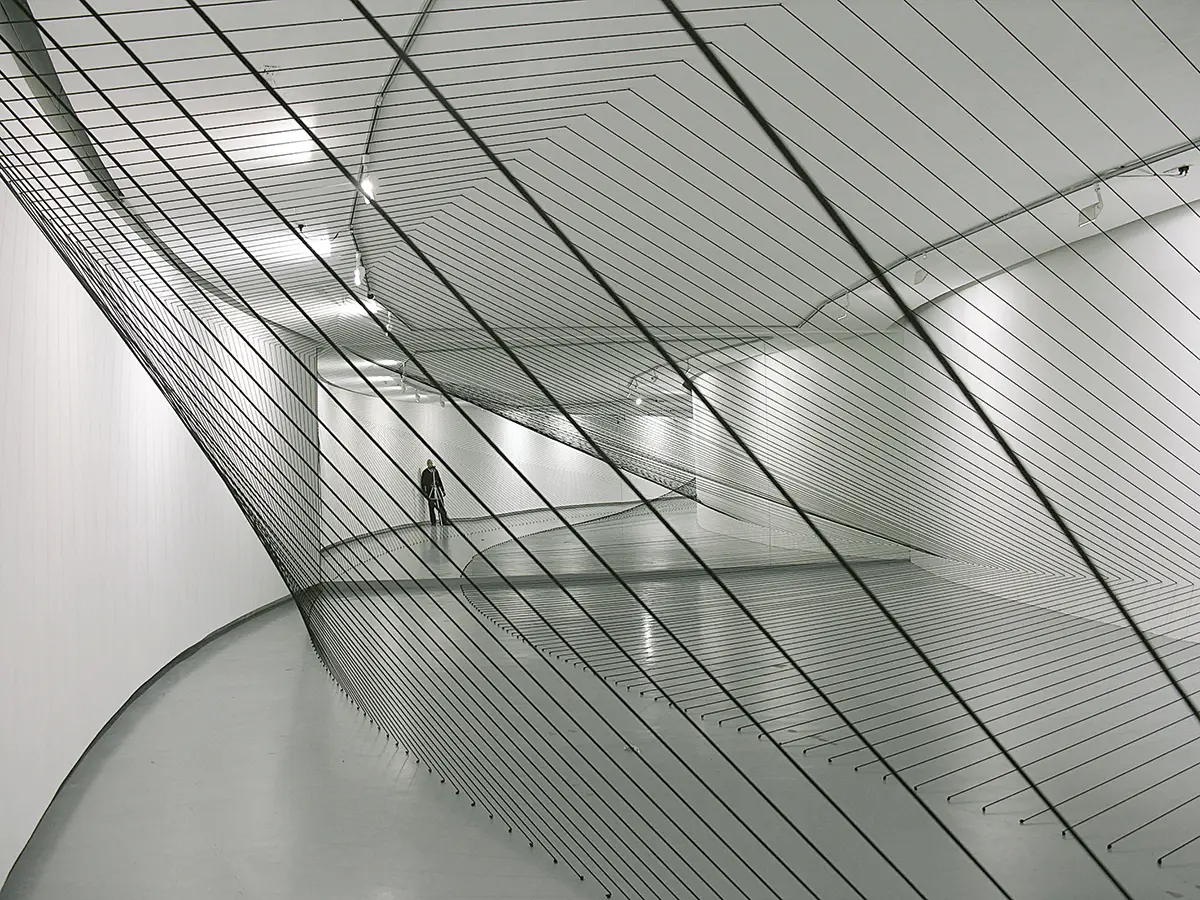
Three presentations, more than being cryptic, were inhibited by different circumstances. De tripas Corazón, by Luz Ángela Lizarazo (born 1966, Bogotá), was made with the conviction that the viewer could understand the body transferred to the canvas, in drawing, or clay. But it seemed that the materials created an imaginary protective barrier rather than a map of the inner body. Expedición, by Alberto Baraya (born 1968, Bogotá) attempted to present his experiences as an explorer: his collection of artificial plants, his journey along the Amazon on a gunboat, and his observation of shifting rites on its margins. All of this was wrapped in plastic, resembling the greenhouses used to cultivate flowers on the Bogotá savanna. Perhaps the exhibition space, which was somewhat labyrinthine, didn’t favor the visualization of such dissimilar items and experiences, interesting as they were. The installation presented by Edgar Guzmán-Ruiz (born 1969, Bogotá), Circundante, made me feel as if I was walking inside a sculpture by Pevsner. Nylon chords, like rays tensed from the floor to the wall and from the wall to the ceiling, changed the tilt of the space. A corridor was created at the center through which viewers were able to walk. At each end, the walls were covered in mirrors. It was an installation island, where the viewer drifted inside a drawing in space, and it was impeccably put together. I visited it along with school children, older ladies, college students; although this was not the artist’s intent, the work seemed to reflect people’s movements in a space of modernity that is less simplistic than we sometimes think.
The Luis Caballero Award is an event that remains relevant because of its experimentalism and independence from commercial pressures. The award exhibition creates space to think about what we can call art and is indicative of shifts in sensibility: the readers, languages, protected spaces, returning abstract pulses, and expeditions.
NOTES
1. Humberto Junca, Acto Reflejo, Catalog #6, Fourth Luis Caballero Award (Office of the Mayor of Bogotá, Culture and Tourism Directorate: March 2007).
2. Fernando Uhía, Preliminary proposals for the Luis Caballero Award, 2006.
3. Ibid.
4. Arturo Schwarz, The Complete Works of Marcel Duchamp (London: Thames and Hudson, 1969).
5. Humberto Junca, Acto Reflejo, Catalog #6, Fourth Luis Caballero Award (Office of the Mayor of Bogotá, Culture and Tourism Directorate: March 2007).
6. Ibid.
7. Miguel Huertas, Ámbitos, Catalog #4, Fourth Luis Caballero Award (Office of the Mayor of Bogotá, Culture and Tourism Directorate: October 2006).
8.Beatriz Eugenia Díaz, Polaris, Catalog #7, Fourth Luis Caballero Award. (Office of the Mayor of Bogotá, Culture and Tourism Directorate: April 2007).
NATALIA GUTIÉRREZ
Proffesor at Universidad Nacional de Colombia.