
Violence
is a part of our lives, whether mainly through the media or real life. The
second situation is routine in the Third World. It is no surprise that violence
is so vividly reflected in the art produced in these countries. A good example
is Ronald Moran’s work, which deals with the violent reality of El Salvador, a
country plagued by the effects of an extended and crude civil war.
Moran is mostly known for objects wrapped in white cotton that collectively compose an image. Traditionally, the color white is associated with purity and innocence; Moran employs this symbolism to trigger interest in the work. He uses the material of white cotton as a cushion for his theme, the ever-escalating violence in El Salvador.
Moran’s career is taking off at a steady pace. The artist represented El Salvador in the most recent Venice Biennial, where he exhibited an installation and a video. In Miami, his work can be found in several private collections, including the prestigious Margulies Collection.
Blanco Intenso (Intense white) is the title of Moran’s most recent solo exhibition at the Kevin Bruk Gallery. The exhibition consisted of a selection of paintings, photographs, installations, objects, and a video. This was a change from the artist’s usual presentations, which have mostly included objects and photographs. Nevertheless, one could see the connection among all the works despite the differences in media.
Moran treated his paintings with similar imagery as his photographs and objects. Continuing the idea of the objects wrapped in white fibers, Moran created the same effect in his three canvases. The striking paintings featured a neutral palette of predominantly grey colors and resulted in a nebulous effect. The compositions were structured from the intentionally visible brushstrokes; these seemed to imitate the fibers that wrap Moran’s objects.
The video Terapia para un dulce sueño (Therapy for a sweet dream) was presented as an installation. Moran placed a pillow against the wall and projected the image on top, where a head would rest. This work referred to the traditional insomnia remedy of counting sheep; instead of sheep, the video depicted Maras Salvatruchas gang members jumping over fences. What had been a relaxing technique to induce sleep and dreams became a nightmare. The black-and-white images helped to reinforce the idea of a dreamlike trance.
Mi dulce niñez I and Mi dulce niñez II (My sweet childhood) were two groupings of Moran’s traditional white objects. Wrapped toy guns were displayed on shelves, almost like fetishes. Moran used these toys and associated “innocent” childhood war games to illustrate the familiarity and instigation of violence from an early age.
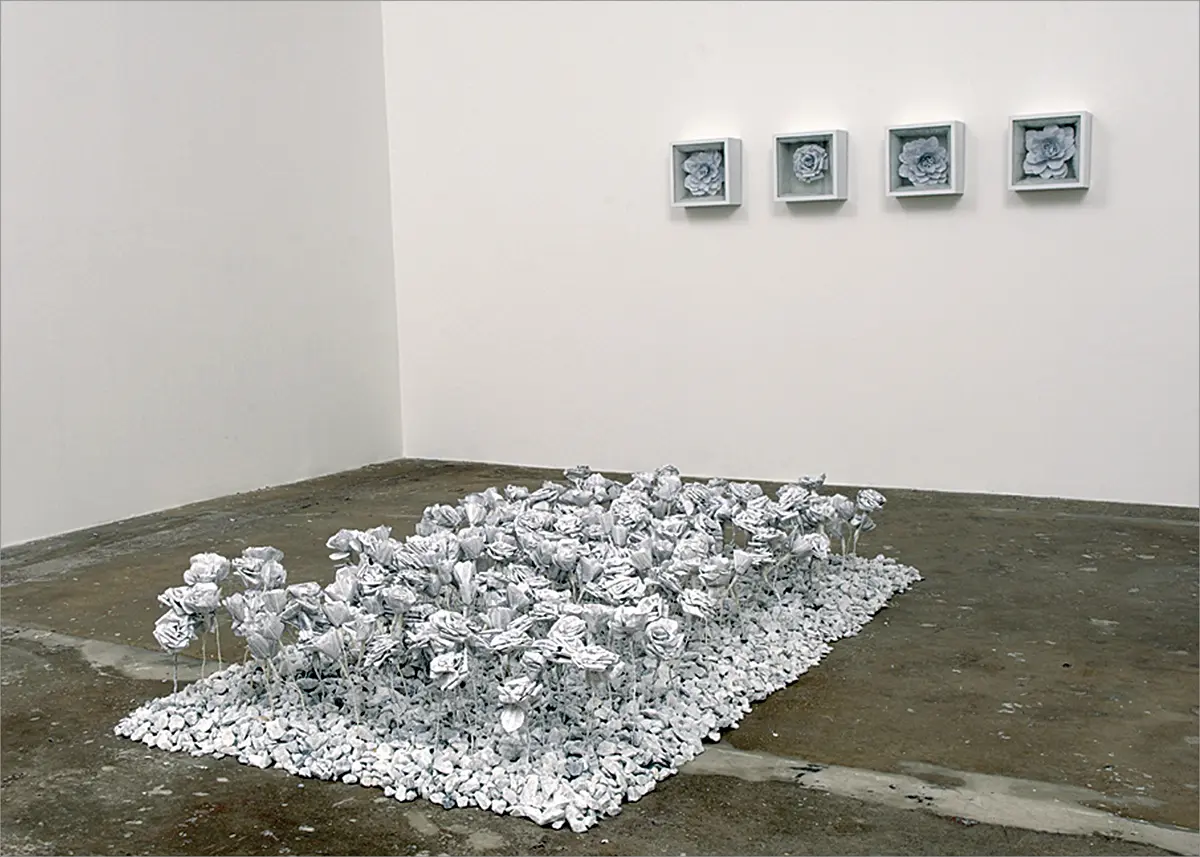
One of the installations, Entre las flores (Among the flowers) featured a garden of paper flowers emerging from a bed of stones. The work was Moran’s tribute to the indigenous group massacred in Rabinal, Guatemala, in 1982. The flowers were made of documents and books printed with the testimonies of the survivors. By using the words as the material, the work suggested that the suffering hasn’t gone away but is still very present.
Four boxes formed another piece with this theme, titled Indigenas (Indigenous). The central motif of the boxes was also flowers also made of paper. In this instance, the writing on the flowers was from the testimonies that Moran collected from the families of the victims. Each box was named after one of the victims, removing the anonymity of the massacre. The atrocity of these acts is impossible to convey, much less in an artwork. Nevertheless, Moran conveyed emotions in these works and referred to the fragility of life and its preciousness at the same time. The work questioned why something like this happened and why it occurred with impunity.
Ronald Moran uses fragments from his reality to make a statement. He talks about violence and how it has become part of the daily life of El Salvador: violence that has reached all levels and places of his country, from domestic environments to public spaces, from childhood to adulthood, all the while demonstrating a perpetual lack of safety. This is what Moran conveys in his work. Disguising an object under a soft white mantle of cotton is the same trick seen every day: people hiding their fear under the pretenses of false normality.
IRINA LEYVA