
Literary
references have been common in the work of Rubén Torres Llorca since the late
1980s, when he used a memorable verse by Pere Gimferrer to title one of his
works with: were I to lose my memory,
what purity. Last July, Torres Llorca and Liliam Domínguez opened at
Miami’s Centro Cultural Español the show Un
cuento para niños basado en un crimen real, which is “a narrative work,
part thriller, part intervention, a part three-dimensional fairy tale. It
narrates two parallel stories, one male and the other female, that are at times
dissonant and at times harmonious, and which at a certain point are the same
story."
The project is the staging of some fairy tales —or all of them, which are, in essence, one and the same—, a topic that Torres Llorca has explored often in his most recent work, emphasizing their quality of being a reserve of the collective soul, useful for centuries for the transmission of knowledge from generation to generation, through images that survive longer than their mere conceptual repetition would have. To this power of myth and metaphor Torres Llorca now adds, in his dual role as artist and curator, a much more personal meaning, derived from the dialog established with the work of Liliam Domínguez, in turn, derived from a close personal and professional relationship between the two artists who have frequently analyzed their respective poetics and collaborated in the creation of works —one of them now in the Bass Museum’s permanent collection, in Miami.
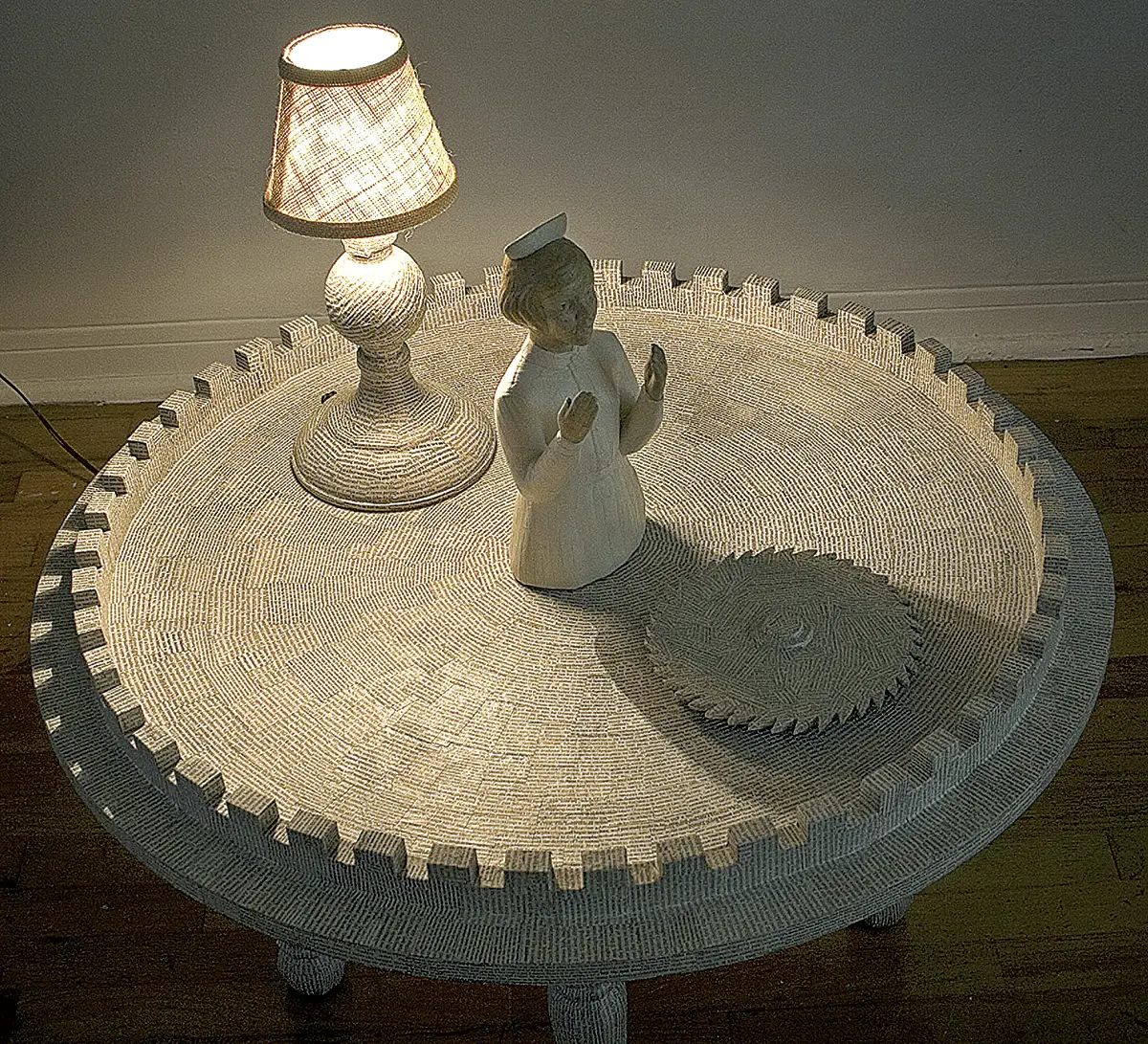
This dialog between the work of the two artists takes place under an unorthodox half-light that evokes the atmosphere in which these fairy tales are read or told to children, right before bed. In this mysterious, intimate environment, Torres Llorca’s and Domínguez’s works converse sotto voce, and in fact are able to displace our condition of observers into that of voyeurs, making us feel as if we were violating a private space were issues that are none of our business are aired —issues that are, nonetheless, highly attractive to us. Five wall captions guide our viewing and acquire a certain Borges-like character when we learn that, except for one, they are all apocryphal —another turn of the literary screw.
The text that is supposedly signed by Clarice Lispector warns us that “it is in the darkness where we must look,” contributing one clue abbot the point in which the perspectives of both artists intersect to produce the coincidence of the lights and shadows captured by photography and the lights and shadows projected by the night lamps resting next to the three-dimensional works, some of which have yet an additional shadow painted on the floor. Similarly, the beauty of contemporary entropy, which Liliam fuses harmoniously to images of a certain classical nostalgia in the essentially visual discourse of her digital photographs, also connect with Rubén’s iconic, archetypical objects, which rest on —or are covered by— a word tapestry that at times adopt the shape of a net, a spider web,, or a mosaic underscoring the place of texts in Western culture.
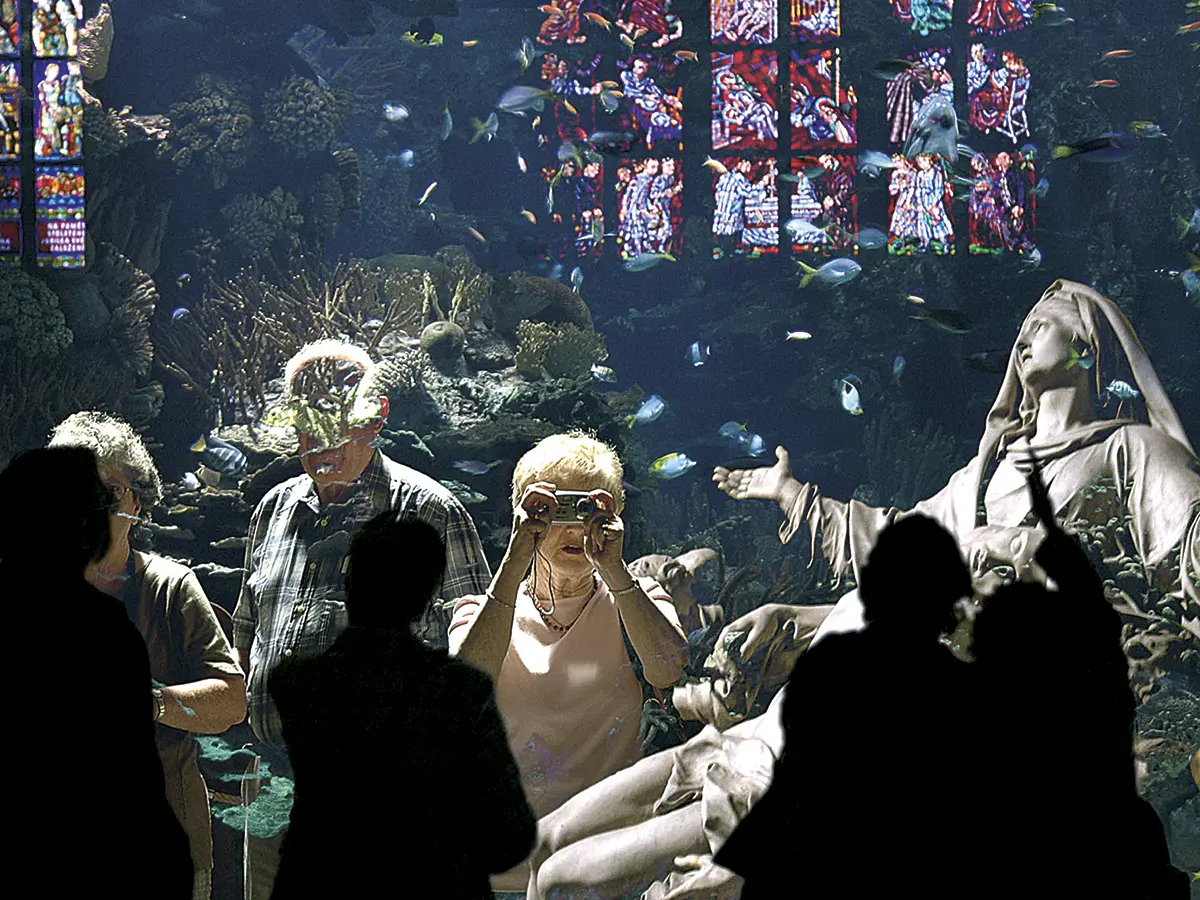
A man lost in the labyrinth could be Theseus searching for the Minotaur; but, as all men, he is at once Theseus and the Minotaur. In the adjacent wall, the sole non-apocryphal text, signed by Enrique Vila-Matas, suggests that Dante wrote the Commedia only to be able to include scenes of his encounter with the irrecoverable Beatrice. Another important fable in the show is the Beauty and the Beast, which emerges in yet another wall text, attributed to Rene Clement, that says that Jean Cocteau had an alternate script for his film, where Beauty not only changes the Beast but also herself, losing her purity and abandoning her unfinished mission. The Beast doesn’t know how to deal with his newfound humanity, and both cease to be archetypes of good and evil. At the foot of this text, an installation shows a man carrying a heavy load and a young girl, represented at a larger scale, at the other end of a kind of bridge formed by seven small blackboards filled with schematic, pedagogical drawings in chalk.
This is definitely more than an art show. Besides being an excellent curatorial project, it is also, or above all, a therapeutic work, curative in the best tradition of anthropological art in the 1980s in Cuba, as well as the sublimation of a desire and the aestheticization of a feeling, by means of the citation of a handful of fairy tales in order to evoke all of their archetypes at once.
RAFAEL LÓPEZ RAMOS