
Santiago
Rodríguez Olazábal is an impressive artist because he is persuasive. He
demonstrated this skill once again in the exhibit Pequeñas Cosas (Little
things), which opened on November 16
at the Casona Gallery. Olazábal’s capacity to convince derives from his
erudition and the expressive ability he developed while living with his unified
religiosity and creativity. His beginnings in religious matters, specifically
in the cult of Ifá, occurred thirty years ago when Olazábal became a Babaláwo
at a young age.
In the recent exhibit, the artist underscored his drawing talent with twenty-one medium-format poster boards created with mixed techniques. He also included an installation conceived as an offering to the Earth. The thesis of this work circles around Ebó (the son of Orúnmílá and Aiyé, a gift from Olodùmarè to resolve the problems on Earth), whose name means “sacrifice” in the Yoruba language. It is Olazábal’s view that humankind can reach a resolution to conflicts through the “little things” that seem insignificant to many people.
The quality of the drawing was the heart of the exhibit. According to the artist, drawing is a more rational and less emotional medium than painting due to its nature; as such, it aids him in achieving the desired effect. Olazábal is interested in touching on specific human issues without indulging in visual effects that deviate from his main message: calling attention to the need for nurturing the will. What is most attractive about this artist is his energy. On this occasion, Olazábal eloquently conveyed this energy with a degree of synthesis that only an artist at the top of his game could master.
Olazábal’s artistic career was first noticed during the 1980s, a renaissance in Cuban visual arts when the Afro-Cuban tradition adopted a new function through discourses that combined the occult with the popular. To Olazábal, religion is a way of life; the artist was raised under its influence from the time his parents were initiated in the cult of Ifá. Thus, he possesses a profound understanding of the tradition. He addresses the fate of the founders of these religious practices when they were violently forced out of their native lands. He comments on his ancestors with a combination of melancholy for the shadow of colonization and nonconformity for not being happy about the way many of the priests manage the cult. Each work conducts a dialogue with the pronouncements at the Ifá Oracle. Recurrent in all of Olazábal’s works is the presence of points that symbolize concentrations of energy. For instance, when the artist draws these points near a mouth, they are associated with words that cast the spell.
Olazábal’s temperate use of color and formal economy in Pequeñas Cosas enabled the exhibit to move the discourse into the forefront. Although the majority of the artist’s works were resolved with two or three compositional elements, including the ever-present human figure, they nevertheless achieved a visual and thoughtful impact that brought to light attitudes toward fellow human beings. In La Fuerza del Hacha (The Strength of the Hatchet), which depicts a Black man bent over with a hatchet next to him that makes him look smaller, the artist played with the representation of power. The instrument turned into an ambivalent element: it can be used as both a tool for work and for combat. The artist’s perspective made one rethink everyday occurrences and situations. In Esta no Puede Ser la Única Forma de Partir la Diferencia (This Can Not Be the Only Way to Split the Difference), he addressed domestic violence. Here, the character carried a knife in his hand because he lost control over his emotions.
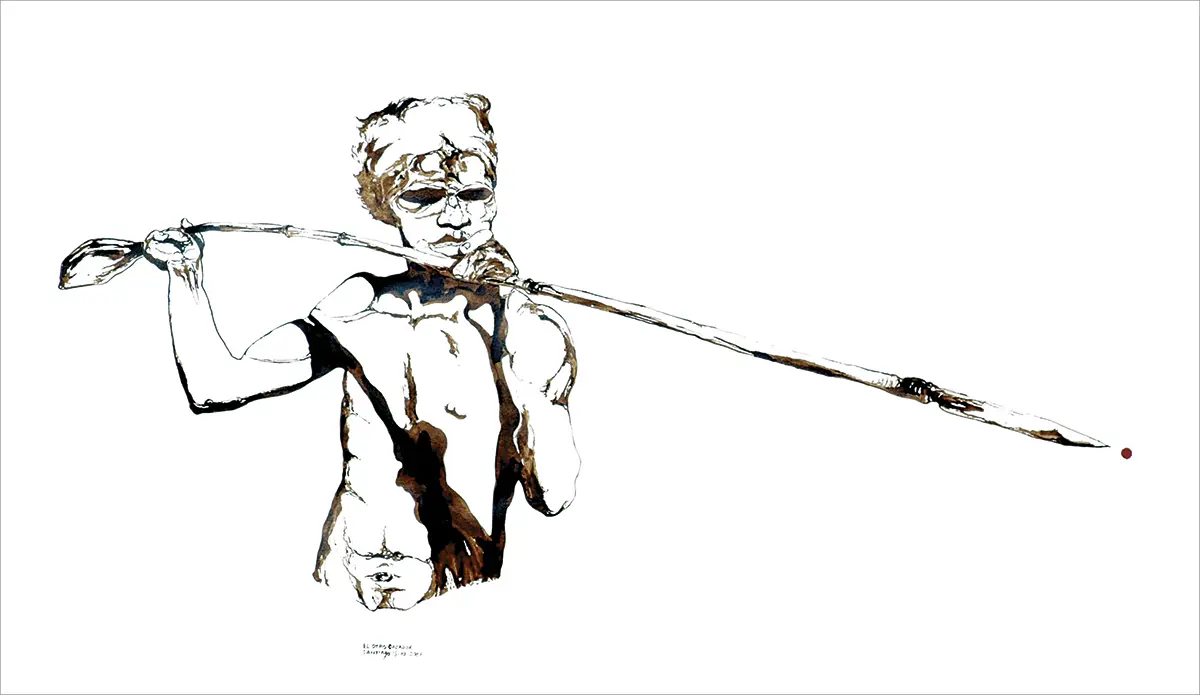
En Otra Cuerda está el Otro Cazador (The Other Hunter is On Another Cord) was a work that transported the viewer into a state of calm. Here, the human figure appeared as if it possessed a divine halo, engaged in a creative stillness (to borrow a term from Indian philosophy). A man with an absorbed gaze aimed his spear toward a point of energy in this image, one of the most mystically charged in the exhibit.
One of Olazábal’s works proclaimed the following: “Every young person must venerate old people, for they are the carriers of wisdom; nevertheless, it is oftentimes the case that they are not appreciated. No headcloth can be wider than those used by the old people of the night.” Here, the artist paid tribute to the wisdom of elders. Such reflection is significant within Cuba, where older people are often treated with disrespect.
In this exhibit, Olazábal highlighted the attitudes that exist both inside and outside his professed cult. In the end, humans are the same everywhere notwithstanding their origins, and our miseries blanket the entire planet. The solutions to our problems are dependent to a great extent on the sacrifices we are willing to make: Ebó on Ebó ad infinitum?
AMALINA BOMNÍN