
Heisenberg’s uncertainty principle is relatively easy to understand: in order to learn the state,
velocity, and position of a given particle, one first needs to shine a light on
it; the light, however, will affect the particle, modifying its velocity and,
in consequence, its structural position in the atom. One can apply this
principle to a social situation: if I want to meet a woman sitting at the next
table, I must approach her and ask her something, listen attentively, and
continue the conversation according to her answers; but my interruption of her
privacy, my questions, and my concentrated attention will disturb the woman’s
natural state, which means that I will only know her in relation to me. Perhaps
my example is inexact; a woman is much more unstable than any particle. But to
defend my example, I quote Stephen Hawking: “Heisenberg’s uncertainty principle
is a fundamental, inescapable property of the world.” Given the uncertainty
principle, it follows that science is not, after all, all that sure—that its
objectivity is shaky and that reality cannot be known, much less predicted.
Reality is unstable, which is a rather unsettling conclusion when you take into
account that, in our belief system, the reality is all that there is.
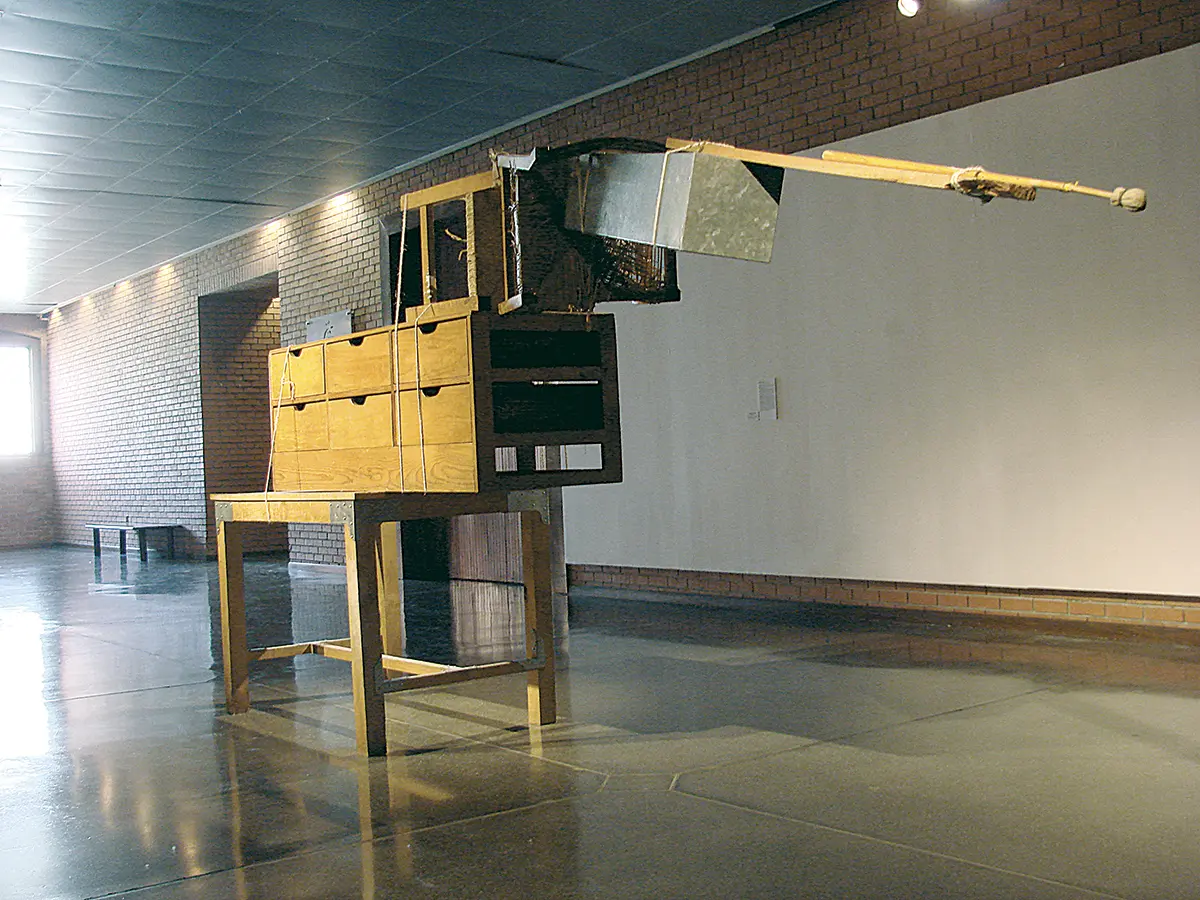
Titled Principio de incertidumbre (Uncertainty principle) and sharing the premises of this reference, a group exhibition was presented at the Centro de las Artes of Nuevo León as part of the Universal Cultures Forum. The exhibition was curated by Fernando Delmar and included works by Francis Alÿs, Pablo Rasgado, Nathalie Regard, Pedro Reyes, Manuel Rocha, Marco Arce, Andrea Di Castro, Demián Flores, Adriana Calatayud, Pablo Vargas Lugo, Damián Ortega, Torolab, and Ana de la Cueva, among others. The exhibit attempted to present chaos theory and interdisciplinary procedures.
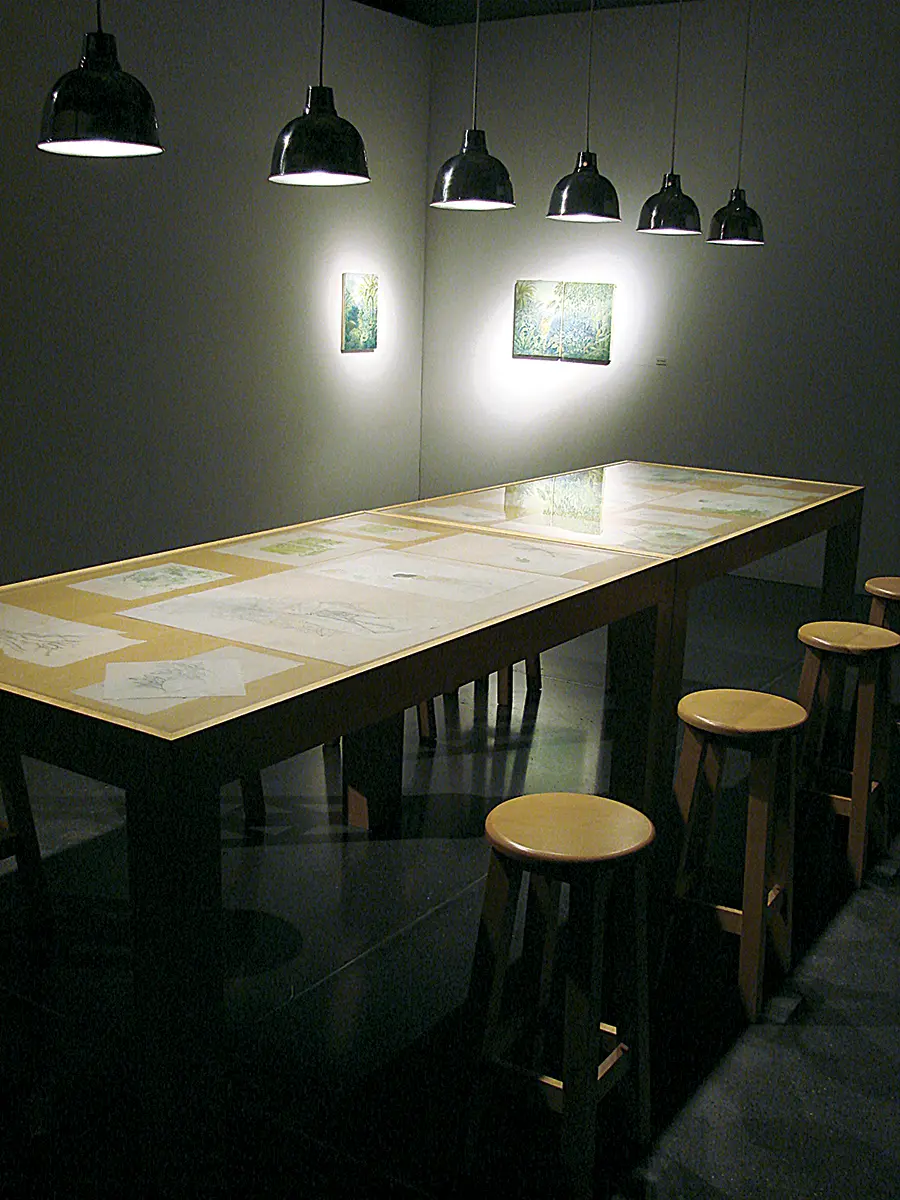
Among the participants, Francis Alÿs and Pablo Rasgado are the artists whose works more closely subscribed to these precepts. Alÿs’s work included a painting triptych on the somewhat eccentric topic of the jungle; it also comprised a workbench displaying sketches and watercolors, the trials and directional shifts that ultimately were resolved in the triptych. Why is it so fascinating for us to know the process behind a product? Because, in terms of meaning, the path followed and the final product do not have any formal connection. The resulting painting is of limited interest when compared with the several moments that preceded it. Like Alÿs’s works often are, this display was amiable. Who doesn’t like sketches, with their lack of definition and the expressive freedom of the inconclusive? Trial and error: what art and science have always had in common.
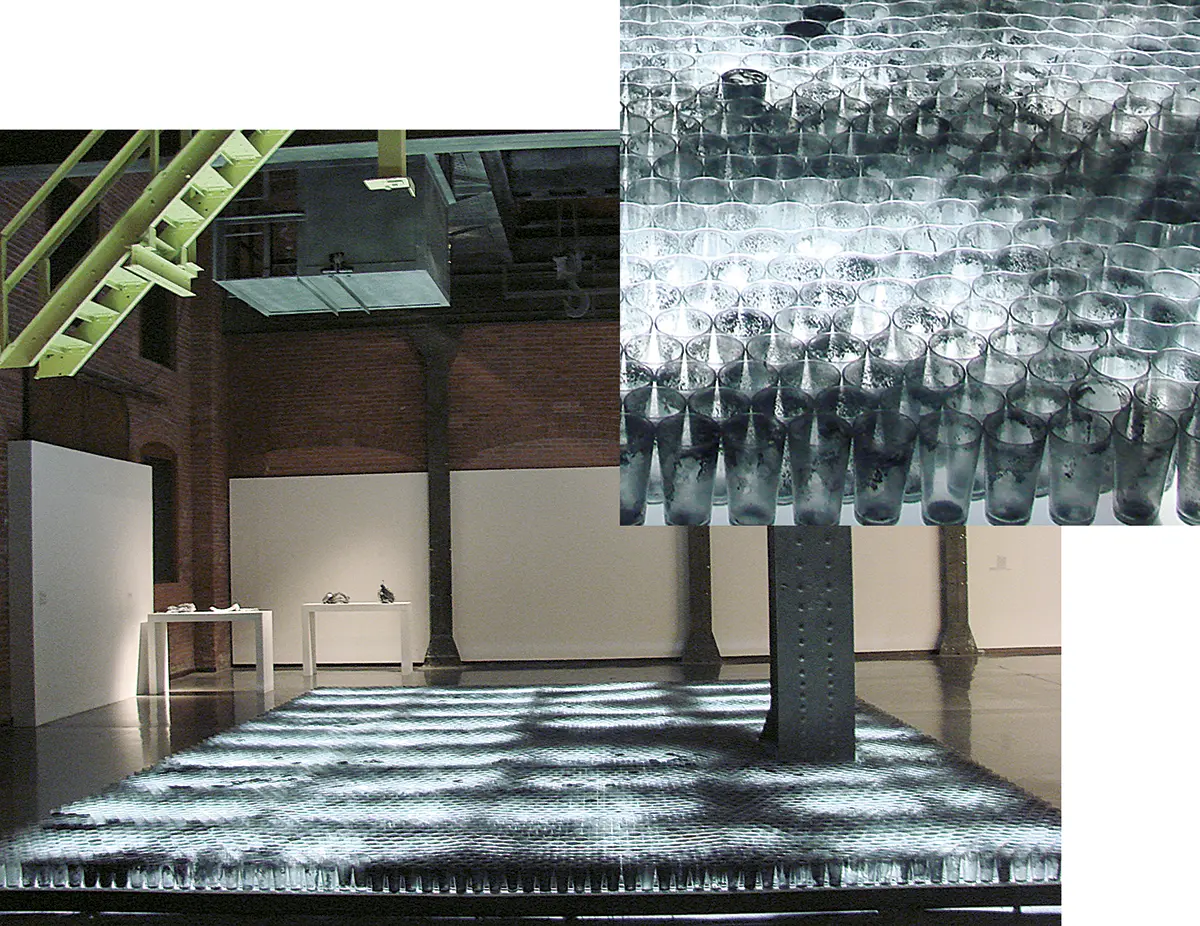
Pablo Rasgado’s works were outstanding. One documented a physical change. On a platform lit with bulbs of different intensities, ten thousand glasses had been filled with water and ink; when the water evaporated, the ink left irregular marks on the glass. The experiment’s minimal variations caused differences in the records of evaporation. Rasgado’s other works were the result of melted lead poured on cold water. His procedures follow all the mechanics of a scientific experiment—trial and repetition—and the products have the appearance of an experienced artist shifting the usual meaning of a given object. Seeing these objects is enough to imagine the processes and what they might mean. In contrast, much conceptual art often fails to achieve a viewer’s enjoyment without an explanation—to communicate that science, and perhaps art is fun.
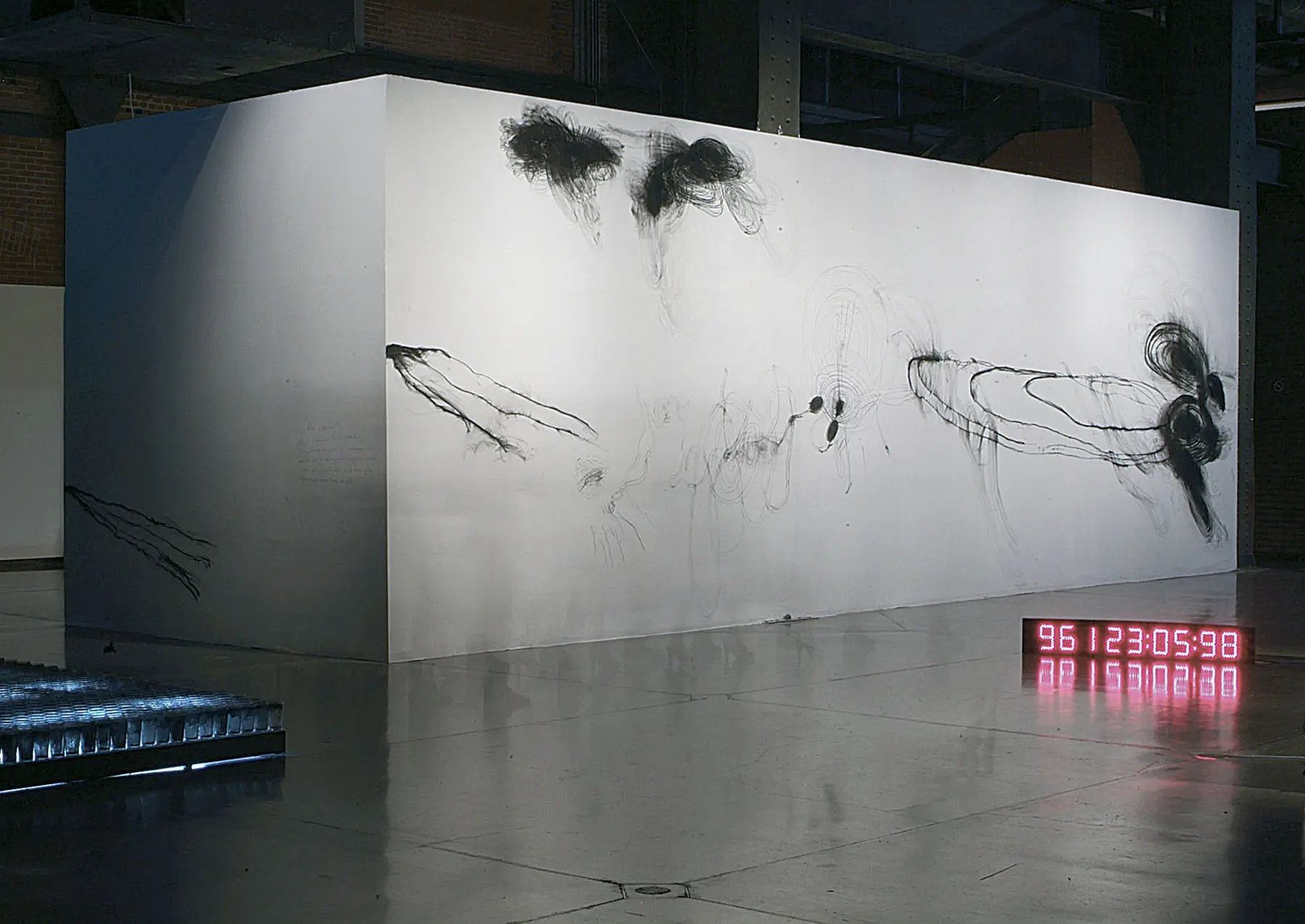
In part due to a large number of participants in the forum, the exhibition was satisfactorily faithful to the principle invoked by the title. Many of the works received unexpected modifications. Magali Lara’s charcoal drawing on the wall, which alluded to the random nature of a person afflicted with Alzheimer’s, was repeatedly touched by visitors; the linear expansions and newly generated designs were not intended by the artist and couldn’t be prevented by the gallery guards. In Gabriel Orozco’s Kiss the Egg, the egg that symbolized the union of lovers broke several times (probably to the lovers’ misfortunes); the Centro was cautious enough to substitute a chicken egg for the original marble one.
ERICK VÁZQUEZ