
The
Brazilian painter Walter Goldfarb’s first solo museum exhibition in the United
States, Walter Goldfarb: D + Lirium, demonstrates the self-taught artist’s
mastery of a variety of inventive painterly techniques. The guest curator
Agustin Arteaga, director of the Ponce Art Museum in Puerto Rico, included
selections from three bodies of work produced since the mid-nineties—the Black Series, the White Series, and the multi-chromatic Lysergic Garden—each distinguished by a particular palette and
finish.
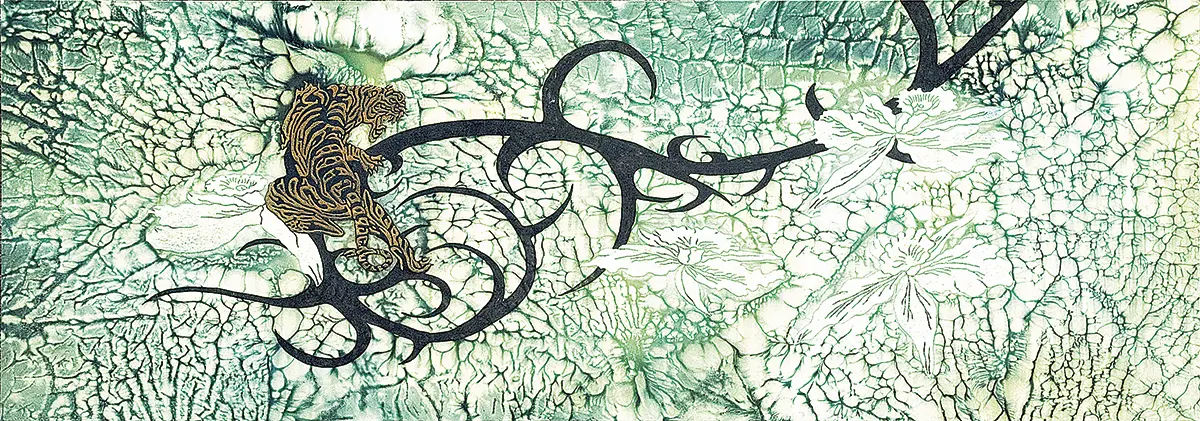
Alluding to the visual effects induced by psychedelic drugs, the Lysergic Garden paintings are characterized by contrasting textures and colors. In A Passion in the Lysergic Garden III (2007), graphically rendered shiny, lacquered figures adorn a raw canvas stained in a tie-dye-like pattern. The orange tigers, white flowers, and black “tribal” forms (sinuous and angular linear patterns), which are apparently Rio de Janeiro’s most popular tattoo designs, float atop a blotchy sea of green and white, creating a strange brew of patterns and pigments. While unique in its style and material, the eighteen-feet-wide painting relies heavily on spectacle to seduce the viewer. This tendency toward sensationalism is also evident in the prodigious ten-by-twenty-feet grid installation of six paintings of roses. Simultaneously lurid and delectable, each monochromatic painting depicts a single white lacquered flower hovering over an intensely pigmented canvas in an array of colors: blue, red (Lysergic Moroccan Rose from 2007), purple, fuchsia, and green. Because of their somewhat abstracted content, the strength of Goldfarb’s practice—his striking optical effects—is fully expressed without obscure symbolism or narrative getting in the way.
The Black Series paintings, which draw on canonical images from the history of Western painting, are plagued by the problem of enigmatic content and murky allusions. No Sin Beneath the Equator after Cornelius van Haarlem (2000) reinterprets a scene of carnage originally portrayed by the sixteenth-century Dutch master. Evoking a baroque sensibility, Goldfarb’s technique—which involved drawing dense groups of bodies on an unprimed canvas with copious amounts of charcoal, drenching the surface with a chemical wash to mute and bleed the charcoal, and further adorning the composition with additional ghostly figures picked out in embroidery thread—is alluring and distinctive, yet Goldfarb’s subject matter (a reproduction of a well-known image from Western art history) seems arbitrary. Perhaps this image of a massacre, known to represent the cruelty of state power, refers to the oppressive Brazilian dictatorship of earlier decades? Rapunzel and the Manipulator’s Milk after Vermeer and Cornelis van Haarlem (2004) employs a similar strategy of appropriation: the artist reproduced a portrait of military men by van Haarlem on one side of the canvas along with a version of the milkmaid once painted by Vermeer on the other. In a collapsing of Grimm’s fairytale of Rapunzel and Vermeer’s maid, the milk flowing out of the jug becomes a thick rope that extends out from the canvas onto the floor like a long braid of hair. Employing postmodern strategies of juxtaposition and appropriation of various moments in art history and popular culture, Goldfarb creates a perplexing network of arguably capricious references. The artist claims that the works in this series represent the embattled field of power relations between men and women in modern society, but it is unclear how Rapunzel contributes meaningfully to this debate.
Some paintings in the White Series borrow from iconic historical paintings as well, but the central concerns of these works are the Holocaust and Jewish relations with Christianity. Rather than the densely crowded compositions of the Black Series, or the brightly colored canvases of the Lysergic Garden series, the White Series paintings revel in empty white space. Kal Nidre (1998) depicts a map of Europe with the names of Nazi concentration camps burned into the canvas, flanked by painted portraits of Pope Pius XII, who was publicly indifferent to the plight of the Jews during World War II, and Pope John Paul II, who half a century later denounced the Holocaust and asked for forgiveness for the Church’s wartime conduct. Perhaps Goldfarb’s residence in heavily Catholic Brazil compelled the artist to consider the Holocaust as framed by the papal rulers. While the burning of the names echo the branding of Jewish prisoners in a rather literal and facile manner, the stark composition, and expert surface finish create an ethereal and even chilling result.
Goldfarb is no doubt talented and skilled in various painterly techniques. His use of massive scale, elaborate finishes, and iconic images result in sensationalist works in which the content pales in comparison to the inventiveness of the form.
LETA MING