
In
the midst of the expectation generated by the great catwalk of contemporary art
(each awaited “moment of success in the career of established artists or of the
individual himself,”) Wilfredo Prieto presents —in his second individual show
at the Nogueras Blanchard Gallery— a long
red carpet extended in a straight line along with the entire space. On the
immaculate white we feel the impact of the large red band, raised in one of its
ends to subtly invite us to discover what lies underneath.
A work of art that suddenly opens up to the viewer from its own contradiction, from the series of ambivalences and ambiguities it generates. How to react to the frustrating or revealing event of finding a long carpet in the middle of an art gallery? ¿To the attempt to find art where it is not seen?
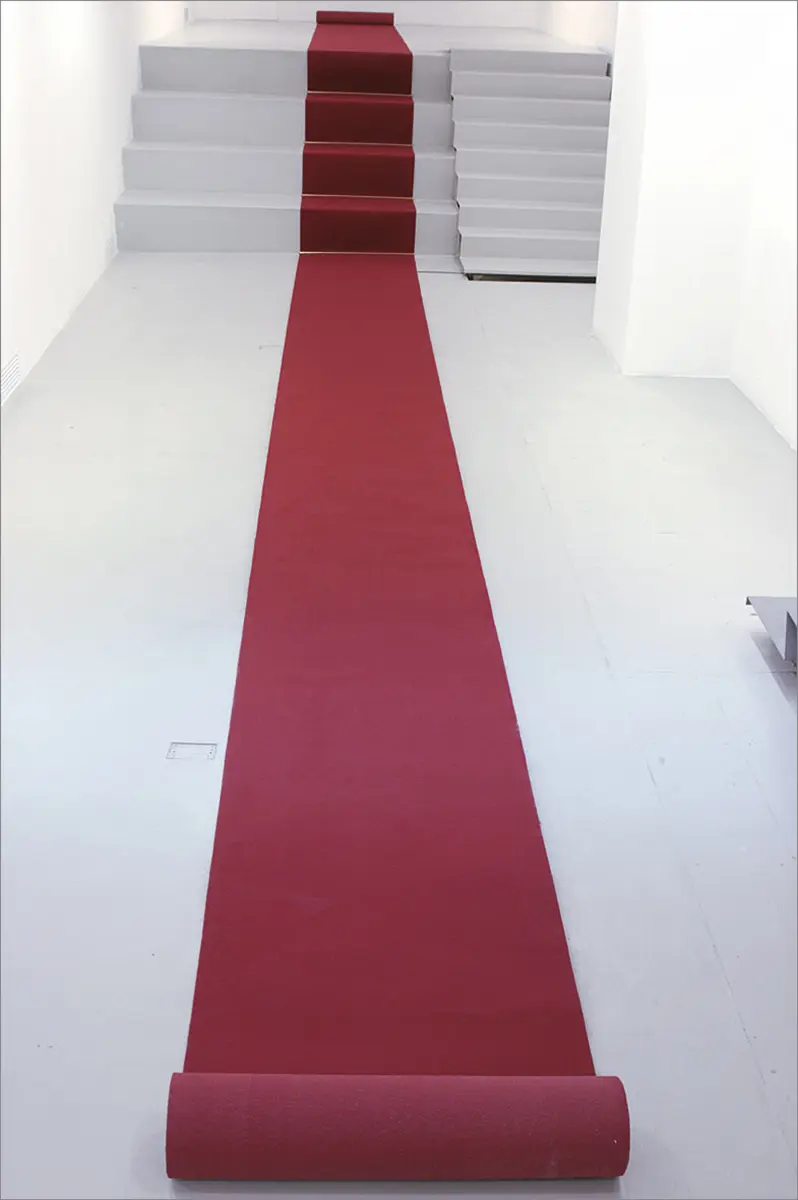
Once again the work’s visual impact is a path towards the activation of the viewer’s senses. In one of his best “perverse minimalist” gestures, the artist presents us with one of the moments in which he has most successfully approached the very contradictions and preoccupations that drive his work. Inscribed in the line of the poetics of the unpredictable,1 alfombra roja reaffirms the artist’s special vocation for “the work of camouflage, the found-art work” as the sole possible trigger for his audacious (and irrepressible) investigation of the meaning of art and life itself.”
While Prieto’s work belongs to the same line as a certain sector among the new generations of contemporary Cuban artists, who tend towards postminimalist practices while retaining a critical intent, the artist has increasingly asserted the gesturality he developed “without biographical precedents,” differentiated from the visual sensibility of artists like Félix Gonzáles Torres, Gabriel Orozco, Wim Delvoye, or Jeff Koons, among others with whom his work has been associated.
With minimal, simple movements that evince or establish hierarchies for the content of objects —a kind of “symbolic minimalism”2— he adds here, to the “staging of uselessness” that was present in previous works like Mucho ruido y pocas nueces (2003); Grasa, jabón y plátano (2006); or Masa boba (2007, a large mass of inert bread dough taking over, uselessly, the entire gallery floor,) the ironic “staging” of the very situation of art, of culture, and of the entertainment industries that inundate an individual’s life, as a symbolic resource also referred to power, economics, and politics, ultimately encompassed in the menacing “manipulative crudeness of the present.”3
As Rosa Olivares recently pointed out, “if art is no longer defined by the art object, the final product of the entire creative process, but for the ideas that generate it, then there are no more boundaries: everything can be art, and in consequence, nothing is art.” Perhaps that feeling of an absolute lack of certainty, the possible starting point for the reproduction of a situation that escapes us,4 is the essential trigger for the inscription of works based on the projection of their own conflictive space, work that “end up as contradictions in themselves.” Unsettling paradoxes, apparent counter-intuitions by means of which the artist is able to activate the viewer’s attention.
To speak of emptiness from a position of fullness (Biblioteca Blanca, 2004,) of the essence from the appearance, of politics from the apolitical (Apolítico, 2001); to insist on the profound from the standpoint of the banal; to launch comments about “what is expected and what is unexpected in the exhibition spaces and the current art-world machinery,” all of this is a way of removing the foundations of the art world and the social world. Alfombra roja includes a satire of the “conflictive space of an art that recognizes its affirmation as a life-space” and about the way in which subversive, probing proposals are co-opted by the art institution, in the middle of polemics and disquisitions about the consolidation of the museum as spectacle.
In a way that connects with the enormous gap caused by “the last of the museum spectacles” (Colombian artist Doris Salcedo’s intervention on the floor of the Turbine Hall at the Tate,) Wilfredo Prieto’s extensive red band dissects and traverses the space of the gallery, insistently unveiling the debris, the dust, the cracks, the scars that lie underneath: the catastrophe that has already occurred. Both “minimalist breaks” exercise a profoundly critical and seductive mechanism, expressing the need to alter historical conventions5 —inversion of hegemonic cartographies and dispositions— through the controversial but effective placement of the spectacular, of the sensationalistic hook.
With this red carpet, evocative of award shows, presentations, and electoral contests as well as of the art fair the phenomenon, where luxury and opulence decorate what would appear to be a “perfect world,” Wilfredo Prieto achieves one of his most forceful and effective creations, demonstrating that “artists must be the ones who contribute something new, different, personal, to what has already been created and what has already been saying.” From his “non-intervention” position, and beyond the dust hidden behind the immaculate “glamour,” he privileges, at any rate, the viewer’s participation, and the viewer’s word, laying down a vast carpet for all.
NOTES
1. Héctor Antón Castillo. “Wilfredo Prieto,” ArtNexus 58, vol. 4, 2005, p. 130.
2. Wilfredo Prieto. “Me interesan las obras de lectura instantánea y digestión lenta.” In: ABCD las artes y las letras, 820, October 20-26, 2007.
3. Héctor Antón Castillo: “Del cinismo virtual y otras lindezas.” In: http://salonkritik.net/, November 14th, 2007
4. Rosa Olivares: “El artista,” In: Exit express. Revista de información y debate sobre arte actual, November 2007, p. 5.
5. Héctor Antón Castillo. “Wilfredo Prieto.” In: ArtNexus, Nº 58 Vol.4, 2005, p. 130.
WENDY NAVARRO