
War
as a fashion statement. The military only if it is a snob show. Soldiers dancing
the hula and the manneristic, feminine camouflage. Flowers rather than bombs.
Tragedy transformed into a circus, into a spectacle. All is glamour, converting
violence into pleasure, delectation. This is the path Flores’ most recent works
have taken, as evident in his latest personal exhibit entitled Carne de Cañon (Cannon Fodder) at the
Havana Gallery. Adonis Flores immerses himself in the military world to subvert
its cannons, its paradigms; its central mechanisms for self-sublimation (the
phallic center, among those). On seeing his work, we are invaded by an
estrangement-like effect that subtracts any solemnity before the event
witnessed. Thus, aesthetic perception does not proceed beyond being
entertained, an unflappable dehumanized hobby. No catharsis when face-to-face
the image, but rather stoicism, fearlessness, indifference. Our gaze turns
impassive, exactly like what takes place with mass-media warfare feeds. This
occurs because Adonis Flores’ pieces are just that: a signal testimony erected
on metaphors by the contemporary subject’s perceptual determinants in relation
to his surroundings. Even the probably most grotesque piece of them all, Carne de Cañon, is beautiful,
monstrously beautiful; aestheticized until rendering irrelevant its possible
repulsive dimension. I am very pleased that once again Cuban art surprises me
with another creator in the search for universality, eschewing localisms - that
“self-defining neurosis”—fighting the political demons. It is time to toss away
the banners and globalized ourselves once and for all.
All the pieces at the exhibit demonstrate the artist’s irreverent and sacrilegious posture. In Aliento (Breath), for instance, a piece showing a dead soldier with lush and intensely green vegetation growing from his mouth. The dying of this young soldier implies here a nearly spring-like rebirth; the extinction of human life, in this case, leads to the birth of another kind. Similarly, in the video entitled Honras Funebres (Funeral Pomp) a soldier morbidly plays with death, oblivious to concern or anxiety (“The fear of death that surrounded me constantly, even to when I was 18, lead me as time went on to make fun of its solemnity”1, Adonis Flores admits). The artist presents to our death with a self-confidence that defies contention, as he sarcastically ridicules it. He appears to have concluded that fearing death is no more than a cultural construction and that our paranoia in considering the finiteness of our existence has no basis, is empty. On the other hand, Lenguaje (Language) speak to us of the camouflage or pretense in military dialogue, of orally transmitted information. Similarly, another extremely revealing piece, Oratoria (Oratory), refers to the consubstantial demagogy and hypocrisy inherent in every discourse delivered from the nucleus or hegemonic institutions, while at the same time dispatching us to that popular refrain: flowery words, a figure of speech that in this military context becomes extremely provocative and insidious.
In the instance of Maleza (Brush), a connection is once again established between the human-warrior and the realm of inanimate vegetation. Except for this time, it does not originate in the individual but in the masses, the collectivity that depersonalizes invalidates and desecrates individual free will. Thus, we observe that huge uniformed multitude dragging their feet to combat, while the title indicates to us how destructive the troops can become: The artist reminds us that in “En la Unidad esta la Fuerza” (Strength in Unity), the latter forms the basis of strength, but also leads to destruction, injury, and insanity.
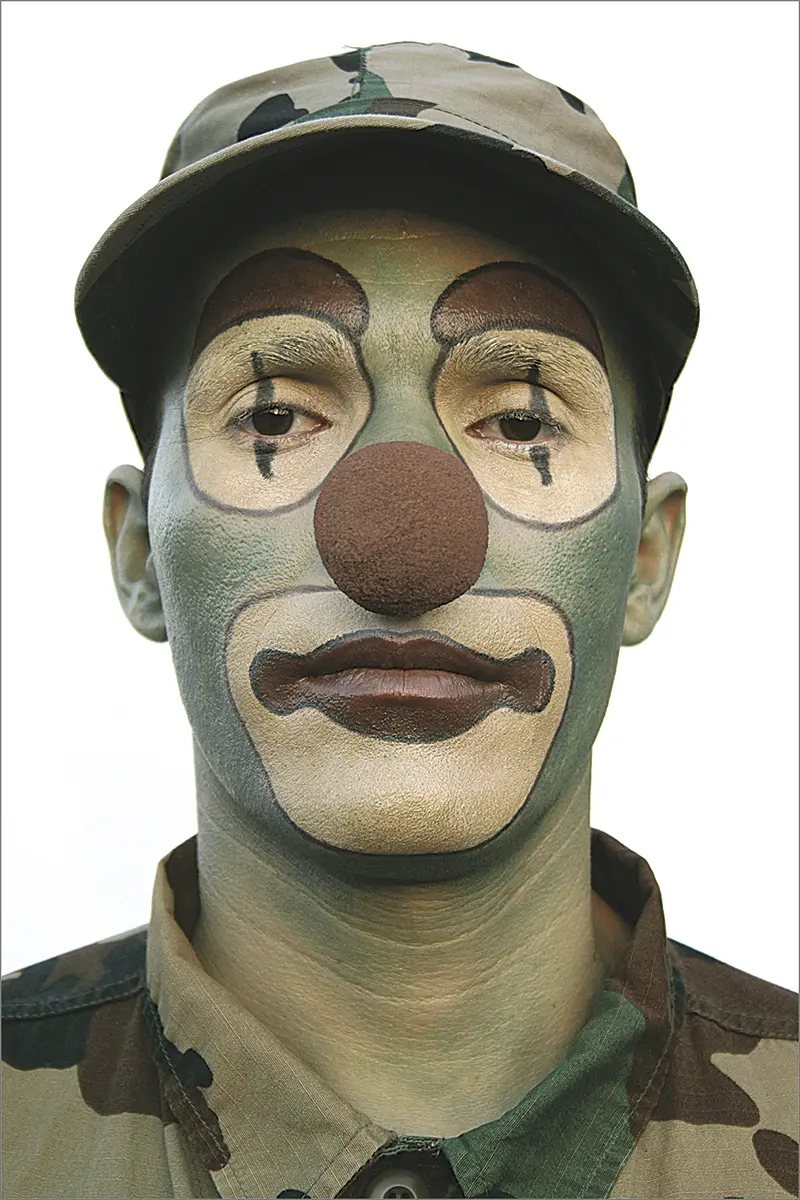
Undoubtedly, one of the most subversive pieces in the show is Mascarada (Masquerade). This iconographic representation pictures the face of a soldier covered with makeup that transforms him into a “clown”, and entertainer whose central mission is to amuse others. Here, the irony explodes into paroxysmal limits: the war correspondent is ballooned with buffoonesque nostrils; a carnival rendering that reveals in the soldier’s gaze the desolation, dissatisfaction, and weariness betraying his commitment to warmongering.
Self-preferentiality is a central premise in understanding Adonis Flores’ poetics. Primarily, the artist utilizes himself as the model for his works. Further, the fact that he participated in the war in Angola in 1989 comprised for him a transcendental event that from then on would mark the course of his life and the paths he would come to choose as a visual artist. Therefore, he selects this particular imagery as the point of departure for presenting his proposals. The artist himself has explicitly expressed this. “In questioning the human condition with themes such as fragility, violence, insecurity, power, irrationality, and death, I resort to my experiences in army life and in my participation in Angola in 1989, but mainly draw my vision from the current climate of war and terrorism”2.
NOTES
1. Conversations with the artist in November 2007 in Havana.
2. Ibid.
PÍTER ORTEGA-NÚÑEZ