
At first, it may seem hard to place
Antonio Manuel’s recent paintings within the wider context of his oeuvre.
Although the paintings sometimes carry certain symbols, even figures, their
geometric nature is clearly more indebted to Mondrian than to the overt references
to mass media, and to the newspaper, in particular, that characterizes his early
production. Moreover, while his work of the late 1960s was charged by a
youthful irreverence and earned the artist a rebellious reputation, one of
being politically engaged, today his work has a more poetic than inflammatory
nature. In this sense, his recent paintings and installations tempt the viewer
into believing that they constitute new and distinct lines of inquiry. However,
the artist’s mature work portrays a creative process that in hindsight is
entirely coherent with his overall oeuvre.
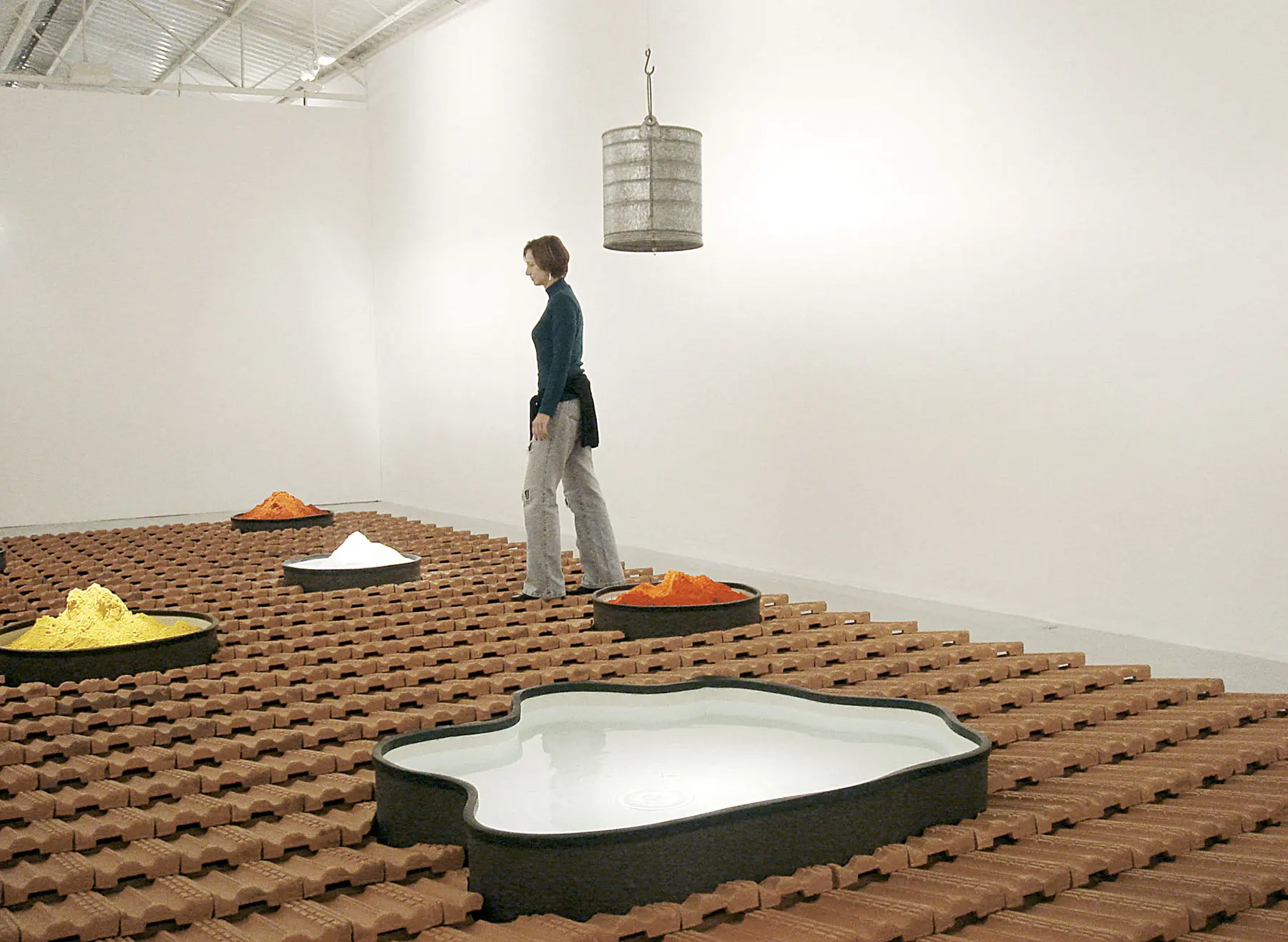
Antonio Manuel’s recent exhibition at Gabinete de Arte Raquel Arnaud (from September 22 to November 11, 2006) was important, for it not only juxtaposed a major installation with the artist’s recent paintings, but it also offered a web of interconnections in which individual works referred to one another and sometimes to works beyond the exhibition itself. These associations were set in place through different means, via titles, formal properties, and processes of production. For instance, one of the paintings (Círculo Vasado Branco, 2006) possessed a corrugated cardboard surface that echoed the undulation of the clay roof tiles in an adjacent installation (Sucessão de Fatos, 2003–06). In addition to mirroring another painting in the exhibition (Buffer Zone, 2006), the painting’s perforated surface also recalled the containers that “interrupt” the installation’s tiled area.
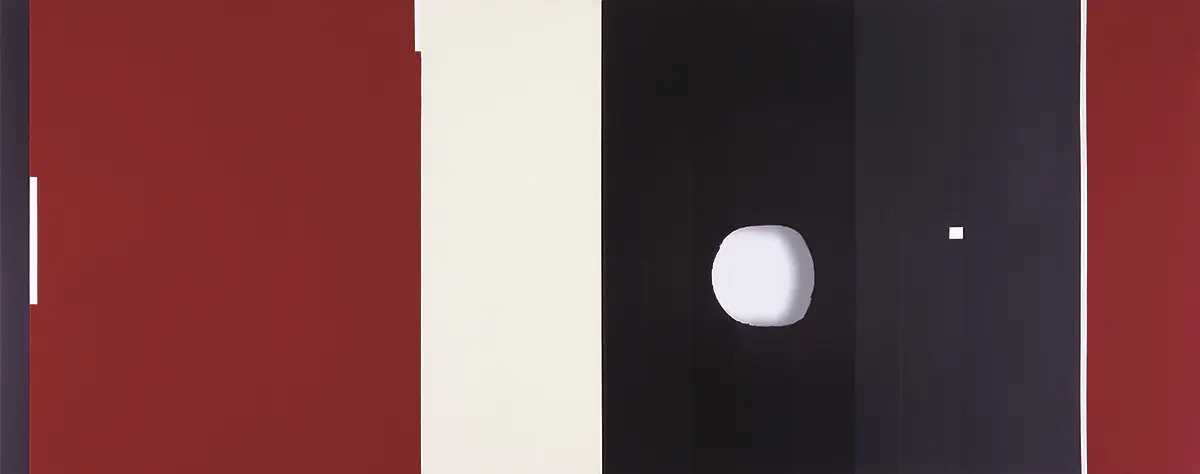
The titles of two paintings, Campo and Lavoro (both 2006), suggested aerial views and thus invited another association with the floor-based installation (Sucessão de Fatos). Other paintings were related through their processes of construction, such as Forma e Conteúdo (2006) and Na Palma da Mão (2006). The surface of the former was perforated, and the resulting hole was covered with black canvas pasted onto the back of the painting. The area of canvas removed from the former was then pasted onto the latter. The artist’s account of such relationships suggests more than a simple self-referential desire:
"There exists a poetic line of communication amongst these works that are a product of a way of thinking. This does not mean that when producing such works I am consciously thinking of previous works. On the contrary, I am interested in the new... Only when the work is finished, is it possible to detect such relations. An example of this is the relation between Frutos do Espaço [1980] and the Jornais and Flans [produced between the late 60s and early 70s]."1
It is nevertheless important to distinguish this auto-referentiality from the idea of autonomy in art, which is so entwined with the history of abstraction. Antonio Manuel’s recent paintings disrupt the non-representational doctrine that we have grown to associate with abstract geometric art. In fact, a more appropriate term would be post-concrete art, since it is from this context that the artist emerged. It is the ambivalent denial and affirmation of the objecthood of painting, of its “concrete” presence in the world, that is at the core of Antonio Manuel’s current creative maneuvers and that connect these to his “historic” works. Throughout his career, his intuitive approach to geometry has earned him the appropriate title of a “romantic/constructivist” artist. He recalls, for instance, the first time he saw a painting by Mondrian “in the flesh,” after being so familiar with the artist’s work via reproductions:
"In the eighties, I had the opportunity to see many of [Mondrian’s] paintings and I was pleasantly surprised to find out that they were badly finished, with badly executed strokes and staples showing on the sides. He wasn’t concerned about this. That is to say, that constructive rigor had its reverse." (Cyprus, p. 121)
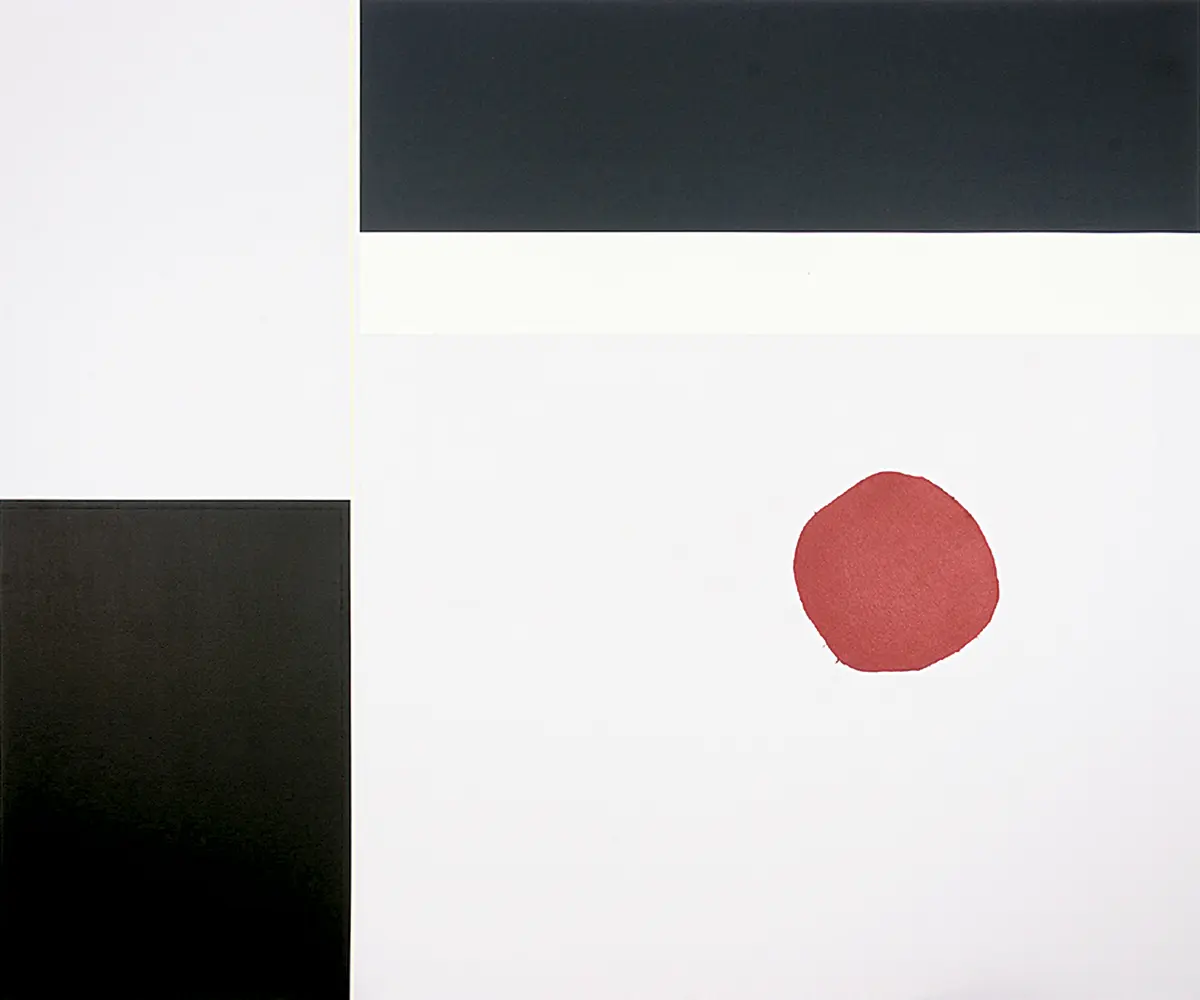
I shall return to the issue of the “reversal” of the constructive rigor within Antonio Manuel’s work. For the moment, I wish to look at the resonance between his comments and an article by Peter Reyner Banham.2 According to Banham, Mondrian could only be described as a classicist to the extent that theories of geometric abstract art have their origins within the beaux-arts tradition and that Mondrian’s use of simple abstract forms to symbolize deity can be compared to similar activities in Renaissance humanism. However, if we are to consider Classical design in terms of modular mathematics, then the term “classicist” is not applicable to Mondrian’s method, for he was an intuitive process, based on trial and error. Mondrian is seen by Banham as possessing his own logic, yet it is a logic that is subjective rather than objective. It is based on geometric relationships between theosophy and the artist’s own intuition. The conclusion is that although his work has been very influential aesthetically within architecture, it would be misleading to assume this influence is related specifically to Mondrian’s philosophy. Although Manuel’s work draws on quite a distinct subject matter that largely relates to his own life experience, it operates at a symbolic level in a similar manner.
Banham wrote the article on Mondrian in 1957. At that time in Brazil, a productive debate had emerged in the wake of the National Exhibition of Concrete Art in 1956.3 Akin to Banham’s argument, it questioned the extent to which intuition and subjectivity were possible, perhaps permissible, within concrete art. The São Paulo group Ruptura, more aligned with the premises of Max Bill, could not admit the emphasis on expression and intuition that the Grupo Frente of Rio de Janeiro demanded.4 The debate would eventually lead to the formation of the Neo-Concrete group in Rio de Janeiro in 1959, but perhaps more importantly it also served to establish an unprecedented critical autonomy within the Brazilian cultural context. The published manifestos and the rapid exchanges of articles in the press generated a sense of cultural emancipation that had profound effects on subsequent national production. For instance, Ferreira Gullar’s notion of the “non-object” has recently begun to be recognized internationally for its historical significance.5 Antonio Manuel was one of a number of indirect beneficiaries of such cultural fermentation, having been trained in the mid-sixties by Ivan Serpa, who had led Grupo Frente during the previous decade. However, the conditions of creative production during the 1960s were quite distinct from the prevalent optimism of the 1950s. Great upheavals in the political and consequently cultural domains brought the demise of the constructivist avant-gardes, since they were dependent on a positivist ideal of their role within society at large. The impasse that faced Manuel’s generation following the military coup of 1964 and the advent of Pop Art at an international level made it no longer possible to immerse oneself within the certitudes of geometry.
"When I started
working, around 1966, the circuit repressed and discouraged anyone who used
horizontals and verticals. Especially because the neo-concrete movement had
already finished, and some of its participants used to carry out sensorial
experiments. The idea of rigor in Mondrian’s work had become repressive for
us; the rigidity of his vertical and horizontal lines was almost a limit."6
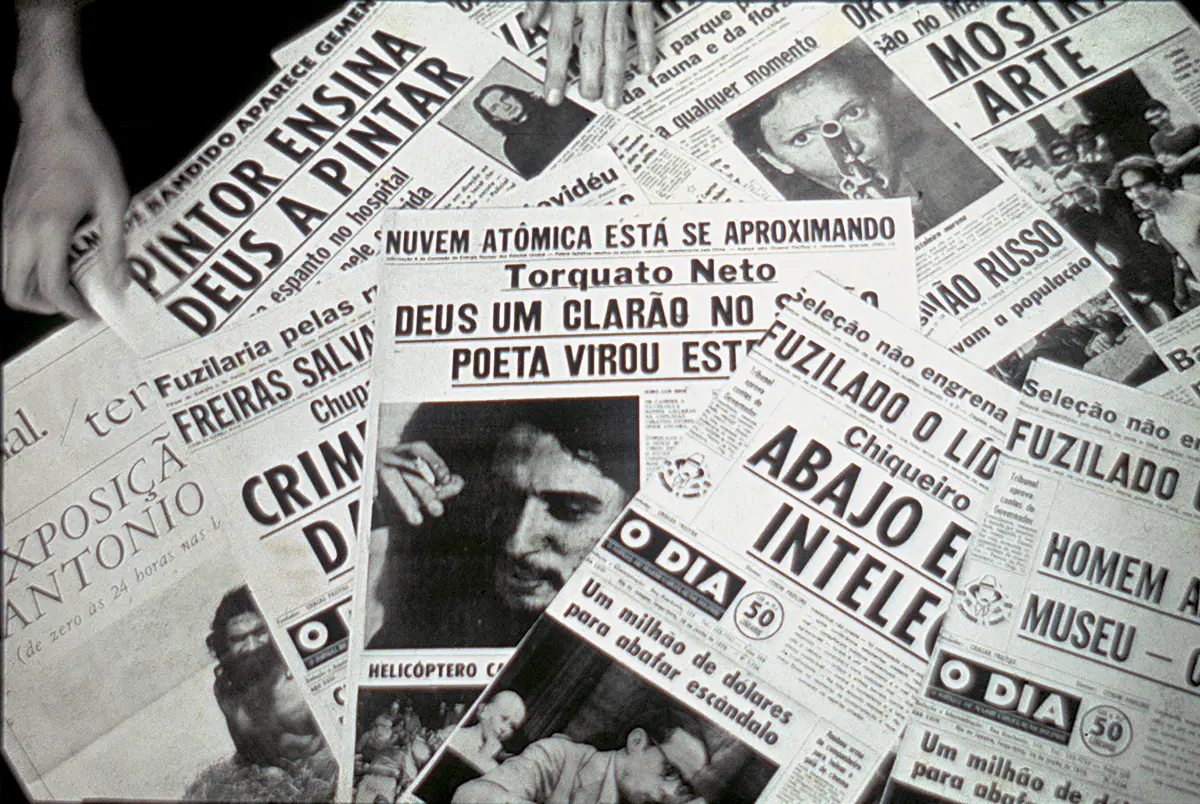
For Antonio Manuel, the newspaper proved to be versatile support, one that could offer a means of resolving the paradoxical condition of inheriting a tradition that seemed so out of touch with the social and political conditions of the moment. Initially, it was nothing more than a support for drawings of numerous figures placed flat on the surface with no reliance on perspective and apparently no relation to the content of the page. However, the content, the layout, and the actual process of production and distribution of the newspaper very rapidly became integral to the work. It is perhaps appropriate to remember that the Jornal do Brasil had been the main avenue for the critical analysis of the progress of the Neo-Concrete experience, and that Neo-Concrete artists Reynaldo Jardim and Amilcar de Castro had revolutionized the graphic design of that broadsheet. The newspaper, for an artist working in the wake of Neo-Concretism, was therefore loaded with art historical references. It enabled an ambivalent practice that implicitly referred to the geometric legacy of Neo-Concretism while explicitly acknowledging awareness of movements such as Pop Art and perhaps what is now known as Conceptualism. Form and content (Forma e Conteúdo was the title of one of Manuel’s recent paintings at Raquel Arnaud) was posited in tension in which newspaper headlines, images, and conceptual interventions with the medium itself naturally gained precedence over the artist’s implicit reference to the geometric structure of the newspaper sheet. Made political by the fact that the artist drew on media coverage of violent clashes between the general population and representatives of the regime, these works have gained a historical significance that irrevocably identifies Manuel with that particular period. One can imagine the difficulty that such precocious notoriety has imposed upon the artist, particularly with regard to the dissemination of his subsequent work.
The significant transformations within the structure of the contemporary art circuit, which began in the late 1970s and were made evident in the 1980s, imposed the necessity for new strategies of production upon artists who, like Antonio Manuel had previously invested in the avant-garde both continuous formal experimentation and the establishment of a practice that related to the praxis of life. For Manuel’s generation, the 1980s represented not only the moment when avant-gardism was questioned with a general fragmentation of creative purpose under the aegis of multiple subjective experiences but also that of the demise of the military regime in Brazil. The regime had been a tormentor, an implacable adversary whose imposition of censorship, imprisonment, torture, and the forced exile of many artists and intellectuals sought to eliminate from the nation what it decreed as inappropriate cultural expression. However, by doing so, it also became an entity against which much creative energy was invested, ultimately unifying a generation around a common purpose.
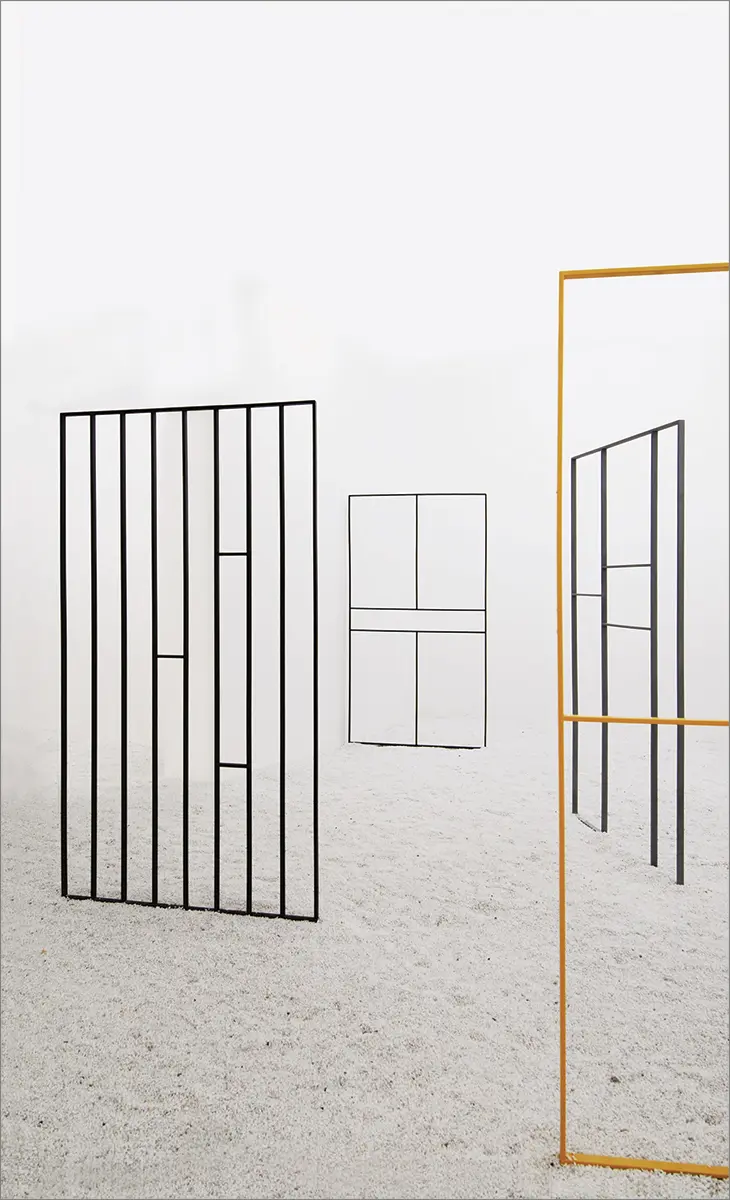
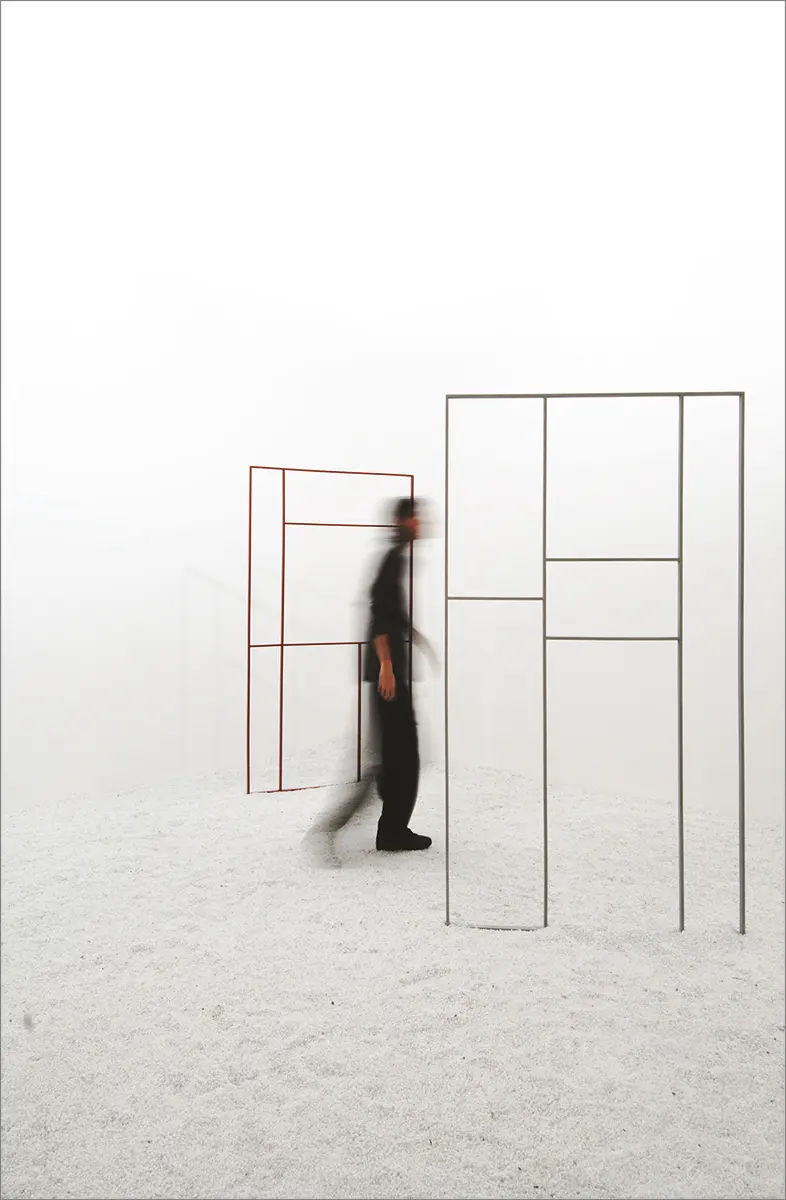
It was perhaps symptomatic of the times that Antonio Manuel produced a series of sculptural works in 1980 titled Frutos do Espaço. These works were formed of vertical and horizontal metal strips that brought the surrounding space into the composition, a Neo-Concrete operation par excellence. Such works appear almost as confessions as they enunciate a tension that had always been present within the work. These two-dimensional structures are essentially “abstracted”—in the Concrete sense of the term—newspaper sheets. They are newspapers that have been emptied of all content except for what remains in between, the blank spaces that divide the columns and headlines. The Frutos do Espaço are therefore pivotal works, through which we can understand a moment of reversal within the forces that provide the dynamic tension in Manuel’s work.
His recent paintings accentuate such a process of reversal. They have brought geometric abstraction to the fore while not entirely abandoning representation. The ambivalent nature of the oeuvre remains as the represented image now slips through the surface in the same manner that abstraction permeated the “mediated reality” of Manuel’s work on newspapers during the late 1960s. Representation still remains, yet it is now implicit rather than explicit, it is present enough only to disrupt the possibility of reading such paintings as proponents of pure form. As the art critic Ronaldo Brito has argued:
"As we become more intimately familiar with them, [Manuel’s] new canvases manage to convince us that they summarize a single, consistent life history."7
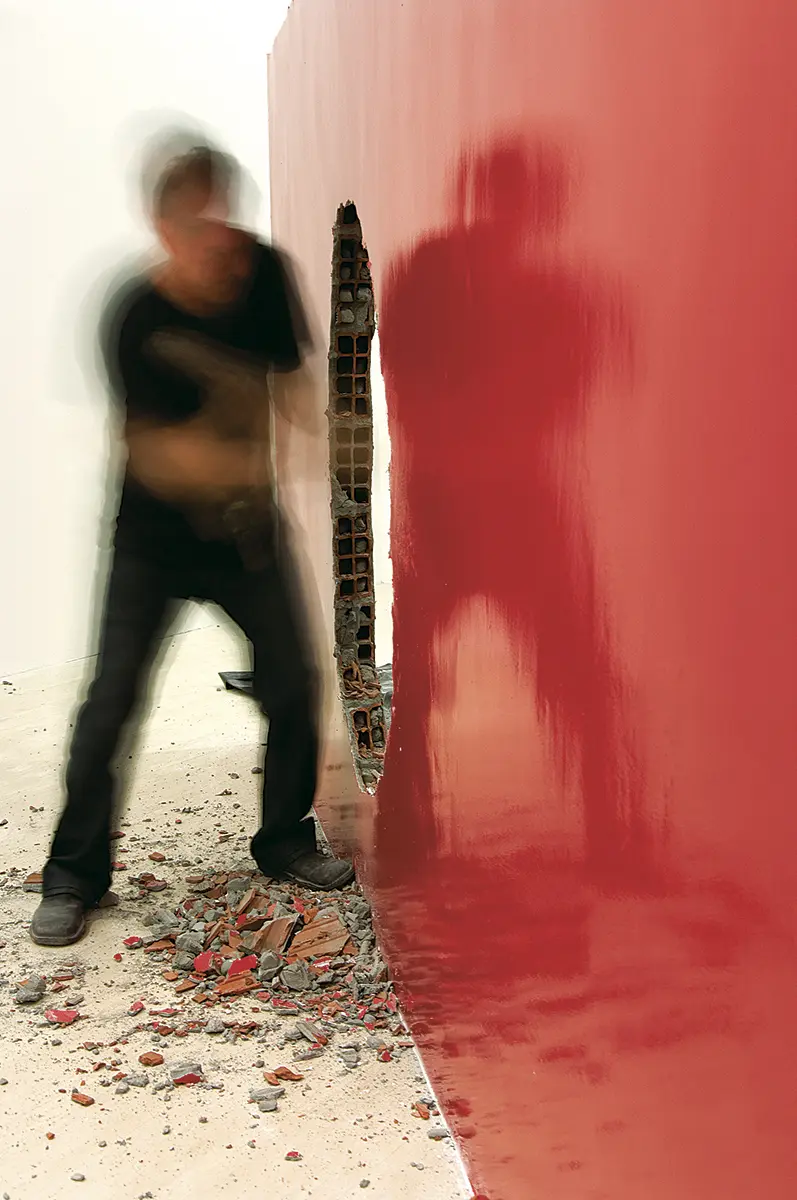
In this sense, it is possible to speculate on the associations raised by one of the paintings in the recent exhibition. Its title, Buffer Zone (2006), refers to the artist’s visit to an active buffer zone while working in Nicosia on the installation of an exhibition at the Pharos Centre for Contemporary Art, Cyprus. The central feature of that exhibition was an installation titled Ocupações/Descobrimentos, which the artist had previously conceived as a poetic response to the celebrations of the quincentenary of the discovery and subsequent occupation of the territory of Brazil by the Portuguese. Like many of Manuel’s works, this piece possessed strong tensions that offered particular resonance within the context of a divided city such as Nicosia. Beyond the characteristic enticement and threat, the dialectic of inside and outside, and the specter of violence, the installation was formed by a structure at once divisive and reconciliatory. Despite being at times confused with the surrounding architecture, the structure eventually revealed itself to be an occupation: the liberating product of a violent blow, its humble passages uncovered the divisive artifice of the walls. These formal tensions relied upon one another; indeed, one set emphasized the other. The ensemble conferred a fragmentation of the gallery space while allowing its revelation. Each section of space received a new architectural identity formed by the delineation of the wall and the quality of its surface. Enticed to discover these new spaces, the viewer traversed the installation through the precarious passages opened in each wall, visiting one environment at a time. This transient experience involved a state of belonging and exile—to discover a territory is to abandon another.
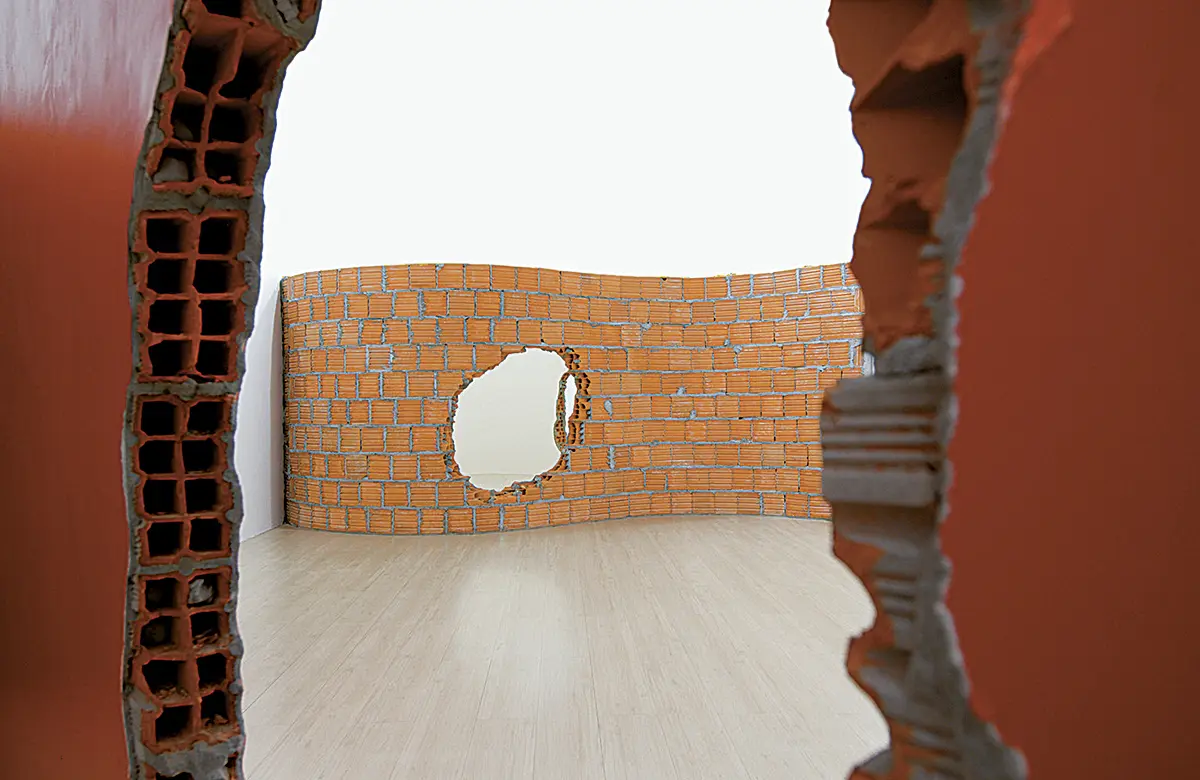
It is therefore interesting that Manuel, having experienced the environment of the Nicosian buffer zone, and being amazed at the resemblances that it possessed with his installation, decided to bring such a culturally specific reference back to Brazil. Not only that but, through the formal play of connections that the artist established between individual works at the Raquel Arnaud exhibition, he also effectively connected both exhibitions and contexts. Indeed, some sense of interdiction that had been part of the artist’s “excursion” into the Nicosian buffer zone existed in the experience of Sucessão de Fatos. This recent installation consisted of a large gallery space covered with ceramic roof tiles. Scattered throughout the space were various containers with pigment, stones, and water. The latter collected an intermittent flow of water drops, which escaped through a perforation in a suspended bucket. The resulting sound reverberated throughout the gallery. The experience of walking over such a surface was one of unbalance, as the unusual inclination of the tiles made gauging the horizontal plane very difficult. The expected brittleness of the material underfoot led to an impression of walking on eggshells. Entering the space, one felt as if an interdiction had been ignored and that particular care was required in order to avoid leaving evidence of one’s passage.8
Similarly, Manuel’s paintings seem to challenge prohibitions: they are themselves buffer zones, between abstraction and representation, pure and applied geometry, reason, and intuition. The symbolic, thematic, and formal associations between paintings and installations maintain a coherent line of critical practice that originated in the 1960s and 1970s. Like other artists such as Hélio Oiticica, Antonio Manuel’s return to the field of the sensible, to the field of aesthetics, serves an ambivalent political purpose. On the one hand, it emphasizes the particularity of recent Brazilian art history; on the other hand, it allows the poetic and experiential nature of the work to build associations with ethical issues that transcend cultural specificity. Such ambivalence extends to the way that the work has always dealt with forms of mediated reality, whether through the press or through personal experiences. It is not therefore a question of the quotidian replacing the specificity of art but of poetic art that invites intersubjective reflections on life.
NOTES
1 Antonio Manuel, in correspondence with the author, December 14, 2006.
2 P. R. Banham, “Mondrian and the Philosophy of Modern Design,” Architectural Review, October 1957.
3 First National Exhibition of Concrete Art, Museum of Modern Art, S
ão Paulo, 1956; traveling to the Museum of Modern Art, Rio de Janeiro, 1957.
4 See L. E. de Andrade, “O ‘Rock‘n Roll’ da Poesia,” O Cruzeiro, March 2, 1957. Reprinted in Luciano Figueiredo, Hélio Oiticica: Obra e Estratégia, exhibition catalogue (Rio de Janeiro: Museum of Modern Art, undated), 23.
5 The text is available in English as F. Gullar, “Theory of the Non-Object” (1959) in K. Mercer, ed., Cosmopolitan Modernisms (inIVA and MIT Press, 2005), 170–3. It is accompanied by an essay: M. Asbury, “Neoconcretism and Minimalism: On Ferreira Gullar’s Theory of the Non-Object,” in the same publication, 168–89.
6 Antonio Manuel, Entrevista a Lúcia Carneiro e Ileana Pradilla (Rio de Janeiro: Série Palavra do Artista, Lacerda Editores, 1999). The interview has been translated into English (from where the above quote was taken) in: Asbury & Keheyan, eds., Antonio Manuel, exhibition catalog, (Nicosia, Cyprus: The Pharos Centre for Contemporary Art, 2006), 121.
7 R. Brito, Antonio Manuel, exhibition catalogue (Rio de Janeiro: Centro de Arte Hélio Oiticica, 1997), 65.
8 The descriptions of the installations Ocupações/Descobrimentos and Susseção de Fatos have been adapted from the author’s essay “Antonio Manuel: Occupations/Discoveries” in Asbury & Keheyan, eds., Antonio Manuel, 46 and 44–45 respectively.
MICHAEL ASBURY
Dr. Michael Asbury is a research fellow in the history and theory of art, and an independent curator. He is a core member of the Research Centre for Transnational Art, Identity and Nation (TrAIN) at the University of Arts London (UAL).