
Manchuria:
Visión Periférica (Manchuria: Peripheral Vision) is a retrospective exhibit
that reviews and confirms Felipe Ehrenberg’s artistic trajectory over the last
forty years. It opened on November 15, 2007, at the University Cultural Center
located at the Civil College of the Autonomous University of Nuevo León in
Monterrey. Originally planned as a traveling exhibit, this show has been
scheduled to appear at the Museum of Modern Art in Mexico City. Its sponsors
include the regional promoters La Máquina Arte Contemporáneo, other
international organizations, Conaculta (Mexican National Council for Culture
and the Arts), and the Mexican Ministry of Foreign Affairs.
The exhibit aims for a personal and even intimate look at an artist defined by his public activism. There is evidence of Ehrenberg’s process of affirmation and resistance displayed on screens, contrasting rigorously conventional and schematic drawings that describe possible places and the preponderant violence that propel his silkscreen prints, collages, manipulated prints, and Xerox copies. These are symptoms of a guerrilla who celebrated (and suffered) with uneven results (based on the terms and postulates of an ideological, experience-based, and artistic nature) throughout the 1970s.
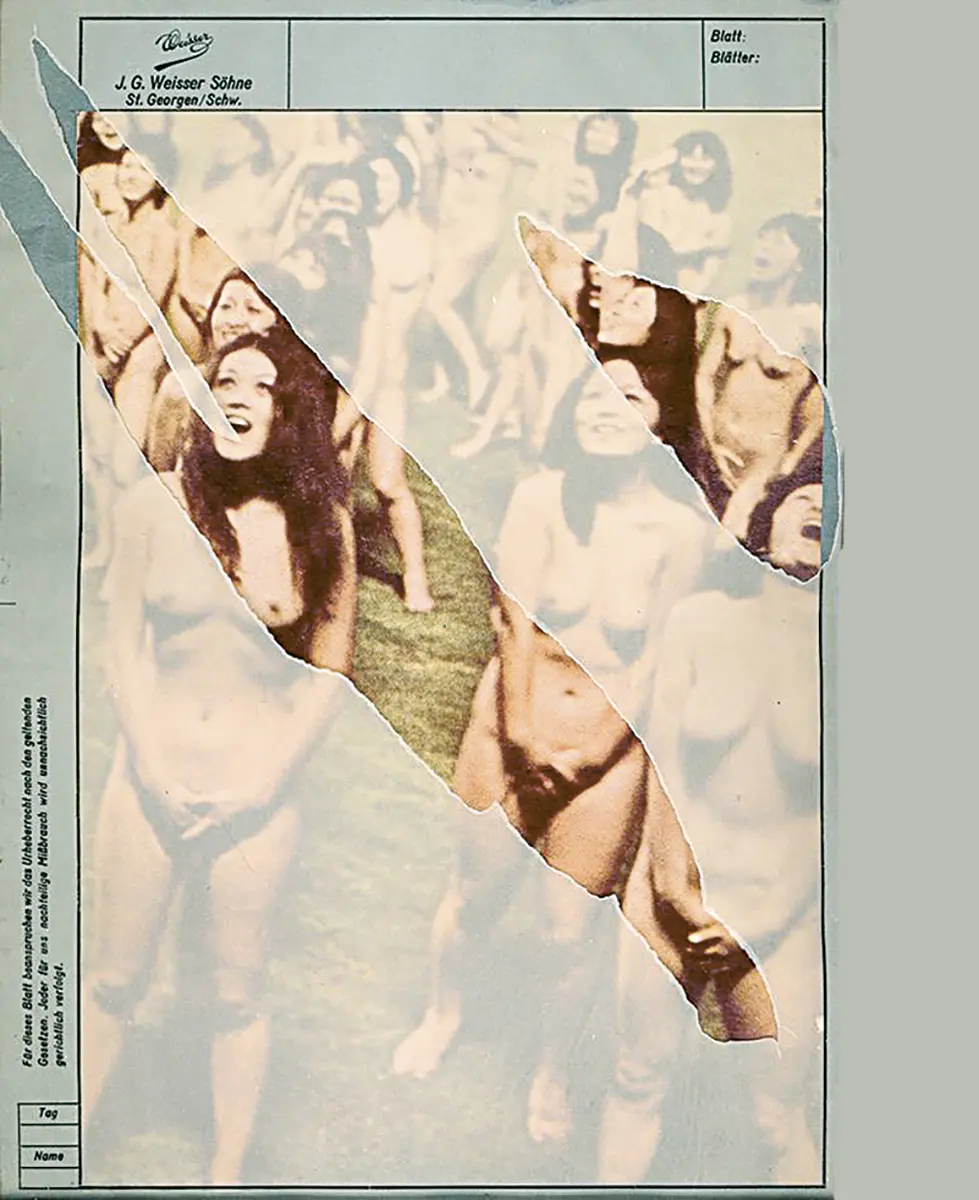
Curated by Fernando Llanos (but originally under the direction of Sol Henaro, the former Director at the now-closed Celda Contemporánea exhibit space), the exhibit is supported precisely by the precariousness of its elements, its transitory nature, the documentary requirements of the works, and by Ehrenberg’s artistic prominence. Llanos’s effort looks into vestiges and places, including Ehrenberg’s living between Mexico and London, his experiences in the Mexico City barrio of Tepito, his stay at Xico (in Veracruz, Mexico), and his recent exile in Brazil. All of these elements makeup Ehrenberg’s persona and also explain him. It can be argued that his historic/geographic path can be described as an evolution, as an affirmation of purpose.
The majority of the works shown were borrowed from the collection of Mattias Ehrenberg. A few additional pieces (such as recent sculptures fashioned with various materials) were lent by Lourdes Hernández-Fuentes. Prominent among these latter pieces is the collection of photomontages entitled The 7th Day Chicken, owned by Cuauhtémoc Medina and based on photographs by Rodolfo Alcaraz that document action and the Richard Kriesche exhibit at the Sigi Krauss Gallery. The elements of fragmentation and superimposition constituting The 7th Day Chicken (subtitled Five Reflections on Garbage) inform the viewer of Ehrenberg’s process, which reflects one of many versions of the artist. The artist’s formal values presume an invasion, a transgressive revaluation. He makes interventions of interventions like a performing political magician. He invades territories and conventions to achieve both syncretism and dominion. An obvious example of this need to assimilate both culturally and organically is seen in the posters and photographs documenting Ehrenberg’s 1998 political campaign for the Unified Socialist Party of Mexico. The boundary between performance and political campaigning is confused as it relates to the role being played and the ultimate intentions of the action, the militant goals themselves. This confusion between elements and finalities suggests a symptomatic picture: the artist as ailment, a reflection of cultural megalomania that chronicles the turn of events.
Ehrenberg’s artistic endeavor is measured by criteria based on discovery and conquest. Thus, he has perhaps reinvented (or postulated) himself as a neologist. There is not much left to conquer or discover out there; indeed, there has not been anything left since the second half of the last century, when humankind began to opt wisely to improve on previous novelties. In attempting new attacks, Ehrenberg exposes himself as a revisionist. Although he is unable to escape the use of modern rudiments, his stubborn result is historic nonetheless.
In his text for the exhibit’s catalog, Fernando Llanos conveys the alternative and marginal qualities that define Felipe Ehrenberg. The artist becomes nearly intangible in his unidimensionality: everything in the exhibit points to peculiarity and confirms the artist’s leap into exhaustion. There is almost a disdain for painting within this retrospective. According to Fernando de Llanos, “There are a few paintings, but only those necessary to illustrate certain interests and some periods of artistic production.” The few paintings appearing in the exhibit are not conventional examples. Luna y Sol (Moon and Sun) is an acrylic-on-canvas painting but is also (according to the object label) a “recycled military cot.” Created in 1980 during Ehrenberg’s stay in Xico, assumes the conciliation and contrast between theme and material. It invokes and also reveals. The cot is dispossessed of its essential meaning by the artist’s intervention, to such an extent that its former self has to be explained in its exhibition label. Ehrenberg does not wish the viewer to forget the materials that make up his objects because they illustrate the origin and process of his work. A manual of instructions is not necessary, but the artist’s formal directives are as transgressive as they are spontaneous, appealing to complicity similar to that required of a political cartoonist. Name, situation, and actuality are required to get the joke. Ehrenberg’s works are celebratory of a moment in time. They only live in the present that they address and then tire and become historical remains.
RICARDO POHLENZ