
The
tradition is long and illustrious. Toulouse Lautrec and Picasso. Seurat and
Henry Moore. Even Bruce Naumann and his pathetic, humiliated clowns. Colombia
can also provide a precedent: Ignacio Gómez Jaramillo’s frustrating, somewhat
strident clowns.
But in the case of Fernando Botero, it was his encounter with a poor circus in Mexico, during his yearly vacation in Zihuatanejo, that brought to him one of the three aromas identified by Jean Cocteau as the most perdurable, alongside the smell of the ocean and the smell of opium: the wet wood shavings of the circus’ ring floor.
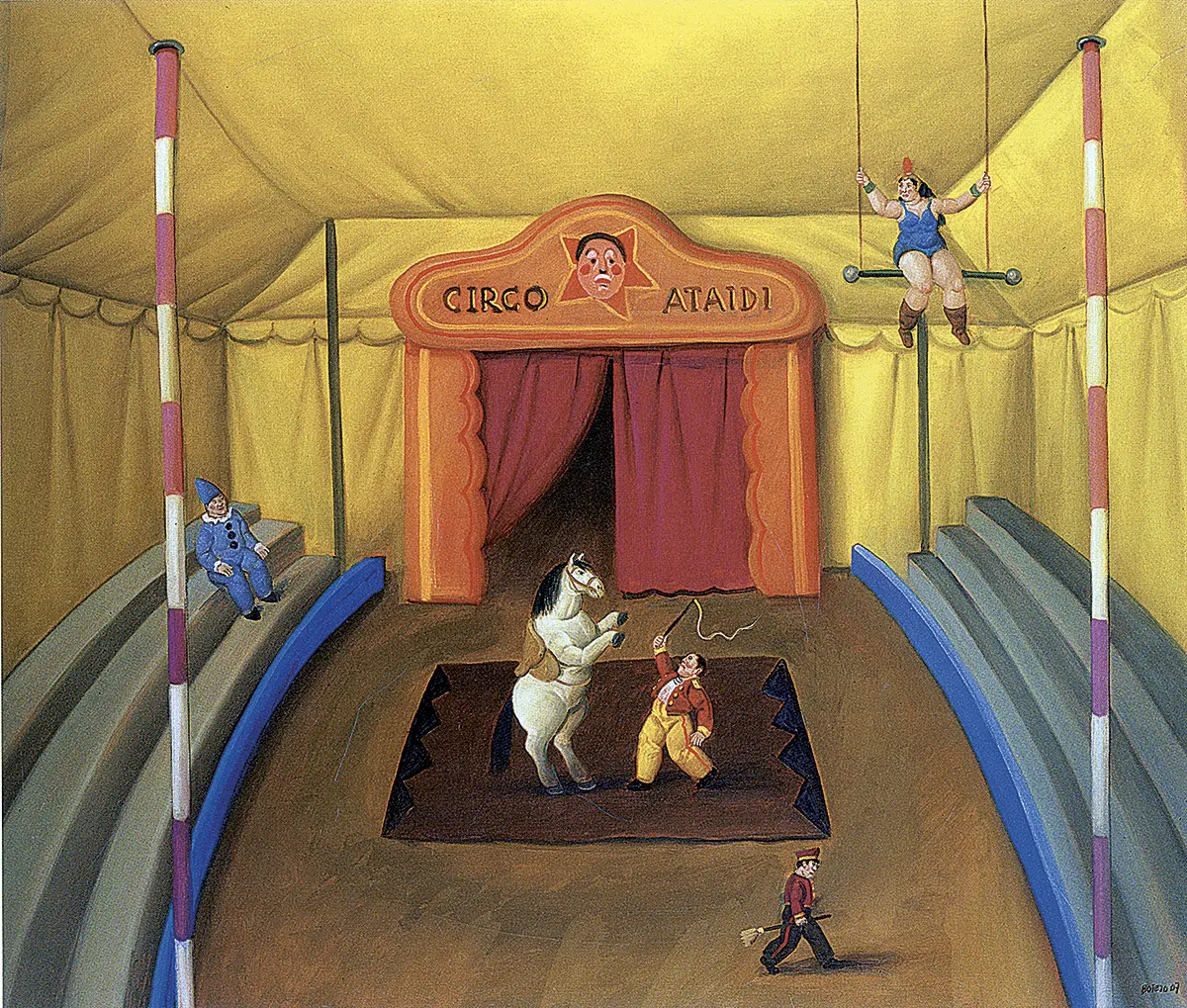
A circus of skinny animals, its own clowns selling refreshments at the door: Botero has recreated one of his deepest childhood dreams, the Ataide circus seen in Medellín. And he has recuperated it in its multicolored splendor, with a compositional wisdom long unseen in his work. Reds, blues, browns, and yellows burn with grave intensity between those tents and those wagons. And in that stage —because the circus is, above all, theater—, such an abundance of gilds in the Master of Ceremonies. What a happy contrast between the airborne horse rider and her sturdy mount, both in turn very Botero-like. What a well-rounded interplay and what unexpected contortions between balance artists, trapeze artists, saber-eaters. And, above all, what a sumptuous pleasure that of the tiger-tamers, oblivious to all, that rest on one of their magnificent animals, a Bengal tiger, perhaps already extinct but ever larger in our memory, more ferocious, more unique in the joy of a color that expands limitlessly and is traversed by those defining black stripes. Also found there is a clamoring the spectacle of pictorial wisdom and creative fruition. Botero knows of the pleasure that the art of painting reserves for those who engage it, and the shared joy it gives the viewer.
On the other hand, some of the drawings and watercolors acquire a classical feel by dealing with dogs or elephants, a clown or a contortionist, that astute fusion of Pierrot and Harlequin in a possible Commedia De L’Arte, with the full popular impact of an art form that already in 1820 brought together children and artists under the stripped the roof of its movable tents its tilting masts, those figures that, up therein their trapeze, seem even higher than the sky, exciting and dangerous in their flight. All of which is all the more outstanding if we realize that the physical characteristics of a typical Botero figure are rather inadequate for such feats. But their concrete, orotund physique levitates and is suspended in the space of its specific poetry, this one upside down, supported only by the legs, this other one demonstrating great, seemingly boneless elasticity. Botero has taken great advantage of all of this, restricting himself to the circle of the ring, its figures and working tools (hoops, whips, trumpets, large balls,) and also evoking the feeling, so common in a circus, that the explosion of music and the astonishing pirouettes are to be followed by the profound melancholy of a show that ends and a splendor that dims down, between solitude and emptiness, when only the janitors and their brooms occupy the floor.
Once again Botero has been able to stop time in these canvases, drawings and watercolors that at the Royal Palace in Milan reconstitute the vertiginous quietude where the living doll stands on one foot on the head of the strongman while her hands handle birds, hoops, and a multicolored ball that dances on her nose. This is Botero’s rebirth after the anguished pain of his Abu Ghraib series. But both torture and circus demonstrate his outsized painterly ambition and the felicitous tenacity with which he pursues it, in all aspects of humanity.
JUAN GUSTAVO COBO BORDA