
As
the first in a series of collaborations between the Dia Art Foundation and the
Hispanic Society, Dia invited Francis Alÿs to install his conceptual work
entitled Fabiola in the
nineteenth-century painting galleries of the Hispanic Society. From September
20, 2007, to April 6, 2008, the public could see Alÿs’s collection of over
three hundred images of Saint Fabiola hung as though they were part of the
Hispanic Society’s collection. With this dizzying display of copies of icons,
Alÿs showed how he finds images of the Christian saint in flea markets and
street fairs, where paintings are still bought and sold for the miraculous
protective powers they are believed to possess. Enigmatically more valuable in
their multiplicity, as generations of inexact copies, this collection of paintings
stands in direct contradiction to the art market where art is valued for its
originality.
The popularity of Fabiola devotional icons arose during the nineteenth century when a British Cardinal popularized her story and Catholics across Europe embraced this formerly obscure saint who was considered a protector of nurses and abused wives. The original painting of Fabiola, which served as the model for all of these copies, was lost.
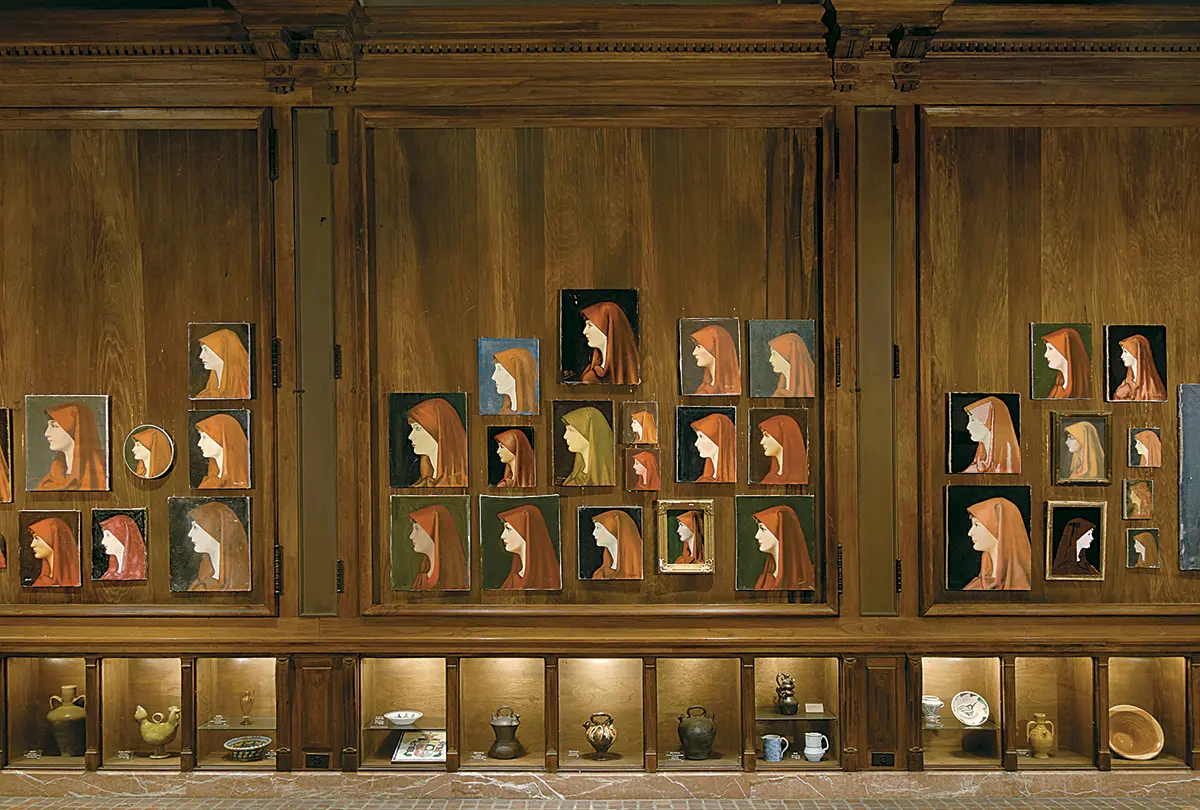
In the course of walking through these galleries, a viewer was struck by the contradictory sense that these paintings were at once relentlessly similar and individually unique. The works were installed salon-style on dark mahogany walls; at first glance, the paintings’ iconography and palette were strikingly uniform. The composition and palette varied little from painting to painting. Even the folds of the drapery around Fabiola’s face and the tones of red cloth were quite similar, and almost all of the paintings showed her facing the same direction.
Yet one almost instantaneously recognized that this uniformity was only apparent. Within the strict iconographic formula that a typical Fabiola painting follows, one noticed differences that marked each painting as unique, suggesting the presence of makers and owners, or the age or origins of the paintings. Many were painted on pre-stretched rectangular canvases in standard small, medium, and large dimensions, giving them a Sunday-painter quality. Oil and tempera paint was the preferred media, but at least eleven were made of needlepoint, which likely meant that a great deal of these paintings of Fabiola was made by women. Handicraft popped up again in a Fabiola collaged entirely of legumes and grains, hinting that her creation occurred in Italy or in Mexico where these foodstuffs are at hand. One cannot say for sure, but these clues reinforced the personal and spiritual value involved in owning or creating a painting of Fabiola.
Alÿs is likewise devoted to his collection. A three-ring binder with detailed information about each painting was available in the exhibition: the dimensions of each painting, the date each painting was found by Alÿs, its condition, the location where the artist found the painting, and how much he paid for it were all meticulously recorded. The act of collecting the Fabiolas has been, for Alÿs, a marker of the geographical movement of his life and of his development as an artist.
Alÿs’s collection of Fabiolas clearly sparked his own early collaborations with Mexican sign painters, in which Alÿs hired them to copy his own paintings. But, in the context of the Hispanic Society, a setting decidedly different from the more typical white-cube gallery, the Fabiolas related more to Alÿs’s practice of inserting himself into an existing aspect of an institution. (Similar examples were when he recorded an endless circuit of recordings for a toll-free number at the Wadsworth Atheneum in Hartford and when he installed a series of his small paintings throughout the permanent collection of the Louisiana Museum in Denmark.) The challenge of these projects is that they always occupy an in-between status within the host institution. In their refusal to clearly define themselves, these projects raise questions that only the most ambitious of contemporary art ever accomplish in posing. How, for instance, can a collection of art express a desire for spiritual transcendence? Or, what do collections and art tell us about how power and beliefs circulate globally? Within the context of the Hispanic Society, Alÿs brought these kinds of questions—ones so relevant to our world right now—to bear in a setting that added historical urgency to their importance.
HARPER MONTGOMERY