
For
some years, the work of Gabriel de la Mora (born 1968 in Colima, Mexico) has
attracted interest for the multiple themes it raises. The artist tackles a
subject from different angles without giving the appearance of merging
individual series, although these do meet once they unexpectedly come
together—like a gigantic jigsaw puzzle—in an abundant and generous whole.
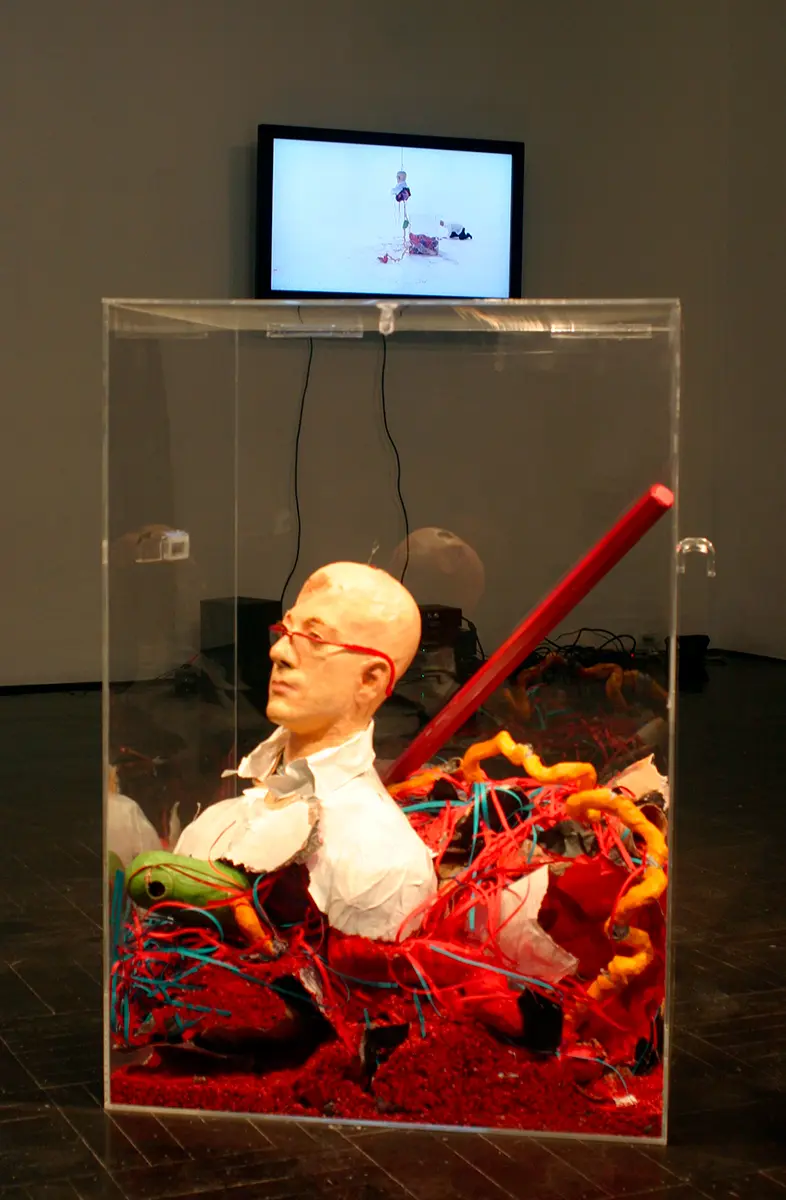
Brújula de Cuestiones (Compass of Questions) represented a defining exhibit within de la Mora’s artistic trajectory. Welcoming the visitor into the gallery was the work Autorretrato a los 39 Años, 23.Sept. 07 (Self-Portrait at 39 Years of Age, Sept. 23, 2007): an acrylic box containing a mannequin cast from the artist’s body, which he had repeatedly flayed with a stick until it was deformed and mutilated. Strictly speaking, this was not an instance of destruction. The artist has stated that the related video entitled Gabriel de la Mora vs. Gabriel de la Mora is a construction/deconstruction of himself on his thirty-ninth birthday. The video lasts twenty minutes and twelve seconds and was recorded with three video cameras. In this peculiar video, the same amount of time is spent showing the hitting of a piñata in the shape of a male figure—from which cardboard, paper, and confetti representations of a heart, kidney, lung, and blood emerge—as of the collection of the pieces and placing them inside the acrylic box, where they became part of the exhibited piece. The video was recorded in one continuous take.
In an adjacent room of the exhibit, a portrait of the artist’s deceased father was displayed. This image was reconstructed from a 1951 family photo of de la Mora’s father at age twenty-five, when he became an ordained Catholic priest and delivered his first sermon. This piece was made entirely of hair collected from the exhumed bodies of his father (who died in 1993) and unnamed sister (who died at birth in 1971), along with hair from his mother, his youngest brother, his two sisters, and the artist himself to give form to this work, titled Don Gabriel de la Mora.
The next piece was one of the most powerful works of the exhibition. This video installation consisted of a projection on two walls, showing eight marionettes that appeared to be moving on their own, thanks to a special mechanism. The characters represented the artist’s family: his father (Don Gabriel), mother (Doña Rosalva), maternal grandmother (Justina), oldest sister (Yunuén), the artist himself, his younger brother (Luis), his youngest sister (Rosalva), and the unnamed sister, whom de la Mora represented as faceless and dressed in white. The marionettes’ eyebrow and eyelash hairs originated from members of the represented de la Mora family. Projected onto two synchronized screens, the video depicted improvised scenes that described the family in four acts: an introduction, the parents, the children, and acknowledgments and closing thoughts. There were many ways to read the work, and meaning could be found in elements such as the motors, strings, marionettes, and the strings’ shadows within the video, as well as in the video itself. The effect of the piece was extended to the white floor, on which each marionette left shoe prints, generating black drawings of scuffs or traces. The constant and repetitive movements of the marionettes created an unsettling sensation. Their glass eyes unexpectedly met one’s gaze, effectively rendering the viewer an accomplice of an intimate and personal story.
On the gallery level, one saw an autobiographical book written by de la Mora’s father entitled El Manumiso (The Emancipated), a narration of Don Gabriel’s life as a priest. Each word, line, and page from the tome (which was also displayed in its original book form) had been transformed into a sculpture formed by an equal number of letters taken from a well-known brand of pasta. Thus, there were 42,485 forms of the letter A, 4,919 B’s, 15,278 C’s, etc. Each had been classified and separated from the other letters and occupied its own space in an acrylic compartmented receptacle. Prior to his father’s death, de la Mora had believed that El Manumiso was solely a novel. In 1993, during his father’s wake, the artist realized the autobiographical nature of the book when he came to know about his father’s religious past and ordainment as a priest.
The family portrait displayed in one of the OMR Gallery salons included, for the first time, all the members of the artist’s immediate family, including the two who passed away. For them to be present, de la Mora had their bodies exhumed and their skulls reconstructed. Then, he requested that the rest of his family have computed tomography (CT) scans of their skulls made to obtain exact-scale, three-dimensional replicas composed of calcium sulfate, superglue, and lacquer. The height of each skull corresponded to the actual height of each family member represented, and the skulls were arranged in order from left to right.
Although at first glance Brújula de Cuestiones appeared to be a compilation of unconnected works created over the past several years, the works converged harmoniously, for they shared important questions regarding the reconstruction and identity of the family. Relatives, friends, and other characters were portrayed with strands of hair that were used in the place of drawn lines. Letters from alphabet-soup pasta mimicked famous texts in a furtive attempt to reassemble a discourse, or at the very least to momentarily possess it. Writings and identity-conferring fingerprints were reproduced using hair strands from the represented person. In the three-dimensional skulls and sculptures, lives were reconstituted—that is, brought back to life.
These introspections began fourteen years ago, the day that de la Mora’s father died and the day on which the artist learned his father had been a priest. “A secret is not a lie, but rather a hidden truth,” the artist wrote in a note on this exhibit. It is very probable that de la Mora’s future works will take several directions and that, in retrospect, this present exhibit will be a noteworthy place on one of the richest and most enigmatic artistic trajectories within Mexican contemporary art.
SANTIAGO ESPINOSA DE LOS MONTEROS