
The sculptor lole de Freitas (born 1945, Belo Horizonte, Minas Gerais) presented her most recent solo show, titled Dynamic Letters, in the generous space of Gabinete de Arte Raquel Arnaud, from October 25 through December 8, 2007. This exhibition featured two projects by the artist: an installation of transparent polycarbonate, steel cables, and concrete that engaged the gallery space and three small-format objects in steel and nickel silver. The works in Dynamic Letters had been previously unseen. For de Freitas, her three-dimensional works, whether small-, mid-, or large-scale, are “systems of relationships” because they question the notion of the boundary or border of vision and attempt to disorient the viewer, who ceases to be just a viewer as she interacts with the work. This path allows the viewer to become a protagonist or actor in the work’s process, perceiving one’s moving body in different “poses” that modify de Freitas’s multi-dimensional space.
The works were organized following the tensions established by the materials and the generated spatial experience. The labyrinthine nature of the space was a challenging dissolution of volume based on the industrial material of transparent polycarbonate. Rather than an abstract or ideal spatiality, it was a living situation. This existential space encouraged concepts—such as pathway, direction, place, enclave, center, periphery, expanded fields, inside/outside, psychophysical properties, circumvolutions, occupation, and refuge—that outline a field for action and imagination within the art that is communicative and functional.
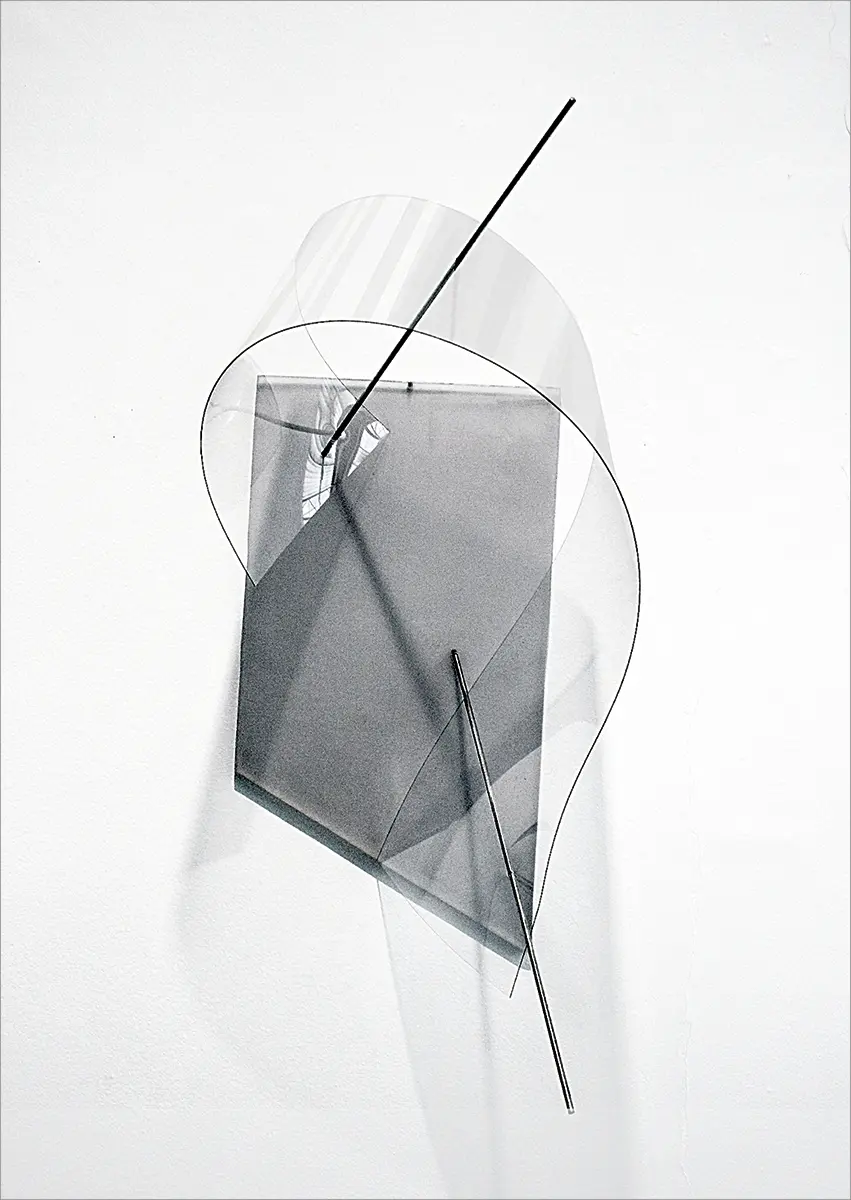
The installation (measuring 363 x 760 x 500 centimeters) had folds and curves that explored the “inside” as a new relational space and presented a large-scale work with incisive post-conceptual results, in the same way as in de Freitas’s monumental work exhibited at Documenta 12 (Kassel, Germany, 2007). The shapes were simultaneously organic and timeless—slightly spiraling, axial, or in blocks—with dynamic folds that transformed them into almost invisible weightlessness: a fantastical architecture. An association between the large work and the three small ones connected them in the way promoted by Novalis. Indeed, the works by de Freitas were like three-dimensional metaphors of slippage or of passage, in a context that was wholly ascetic and neutral: the white-walled gallery, which approaches the minimalist notion of the white cube.
The show presented the concept of sculpture both as a monument and as an object. With the interference of small concrete blocks that seemed to reinforce and support it, the installation was a paradox and an ironic comment on the monumental. It was an anti-monument, destined to disappear or to be relocated to a new context through the strategies of display and assemblage; the material’s transparency also evoked other building-related memories.
Of the same proportions as these two works-in-progress were de Freitas’s 1999 installation in the Museum Fridericianum’s inner courtyard. And for her Kassel project, de Freitas had to travel twice to create a work of spatial continuity that unfolded mirror-like reflections. The curved steel structure was extremely complex, and it was accentuated by the use of large laminate sheets in flexible and transparent polycarbonate. At the Fridericianum, steel and polycarbonate were dislocated in space and occupied the architectural space already colored by its own history, the passage of time, and the spatial intervention made by de Freitas on the museum’s façade and its interior.
All of this has been recorded in the new monograph, lole de Freitas: Documenta 12, published especially for the occasion by Laura Marsiaj Arte Contemporanea in 2007. The book is filled with rich images of the installation and intervention project brought by the Brazilian artist to Germany’s most important artistic event held every five years. There, the doors, windows, and walls were painted a light shade of green that articulated a neo-classical interior, which was dramatically modified by a sculptural, biomorphic mutation. Opening and unfolding with dazzling visual and spatial whims, the interlocking curves had references to flight and transformed the imperial building. As is known, all museums are highly ritualized institutions, and everything in them takes place in the name of art, their true raison d’être.
CLAUDIA LAUDANNO