
There’s
nothing particularly sophisticated about the objects that Jarbas Lopes
produces, perhaps because they are not so much art as manifestations of
will—belief and actions in a world different and somehow, vaguely, better than
whatever is here and now. Lopes is a contradiction: he is a walking
advertisement for every person to be an artist, and at the same time he is so
egocentric that his fictional and fluid environments are named after him, such
as Jarbalopolis. But recall that Renato Poggioli listed infantilism as a major characteristic of the sophisticated avant-garde.
For example, Lopes’s art project for the Carnivale in Rio consisted of gathering friends (or believers) to carve and glue Styrofoam pieces into something sufficiently architectural-looking to evoke some of the modernist white structures in Rio. Across the forms, Lopes made an equally vague ecological protest, writing the large red letters CO2 and HFC, symbols for two greenhouse gases. After coating their mostly nude bodies with mud (it was Carnivale after all), the group carried their ark of an earthly covenant through the streets, tore it to pieces in front of the grandstands, and washed off the mud.
Was the world a better place after this? Not likely in any measure. However, many of Lopes’s objectives were accomplished: art was common and participatory action, vaguely utopian but certainly idealist and celebratory, and who knows how many at Carnivale were affirmed or informed in their ecological beliefs. Besides, if that’s art, then sign me up, because it is clearly fun. Life within spectacle demands spectacle: theater derived from drunken rituals celebrating seasons, crops, and stories.
Lopes’s objects are more thoughtful but perhaps too much so. The objects are crude because they are crafted less from a belief in the look of materials and more from thought and a belief in the function and symbolic meaning of materials, in much the same way that religious icons appear and function. Art in this sense becomes the site of meaning, a place marked by the attributes ascribed to the object, while at the same time all aspects of the materials carry some meaning. For instance, Lopes made a piece onsite at the Daniel Reich Gallery, an untitled sculpture of a human-like form opened like a cocoon that confronted the viewer at the entrance; the clay left on the floor remained on one’s feet, marking the Biblical transience of the visitor across the gallery. The clay residue was not accidental but nonchalant yet well-conceived messiness that subtly became a ritual of everydayness.
Some pieces in the show were more symbolic than others, but their functions were to witness, convey, and convince. This makes the artist a bit of a shaman or ritualist, a guide for one who cares to make the leap of faith. At the same time, there is an equal and contradictory belief in the artist as both special and not special, which is thus a belief in the greater potential of every person. Joseph Beuys, who influenced two generations of artists, comes to mind. Beuys believed in the ways that artists and materials transmit information, especially spirituality and the psychic energies of history; hence art was an economy and politics that linked individuals to broadly defined forces.
In Lopes’s work, one of Beuys’s favorite metaphors, the transmitter, is given form and appears as an independent sculptural object (Antenna) and as a drawn form. When integrated into the drawings, it remains a pulsing beacon signal and is also more clearly inserted into Lopes’s ongoing concern over the double-edged sword of technology (along with computer screens and bits and pieces of industrial debris).
In opposition to technology, Lopes’s Short Environment is made from rough-hewn vegetable fibers. This object covers and isolates the wearer in a cocoon but also allows one to see and transmit through the open weave. The artist intended the viewer to disrobe before putting the object on (good luck there—one has to be as thin as Lopes for it to fit) and to look ridiculous; everyone laughs and laughter is liberating.
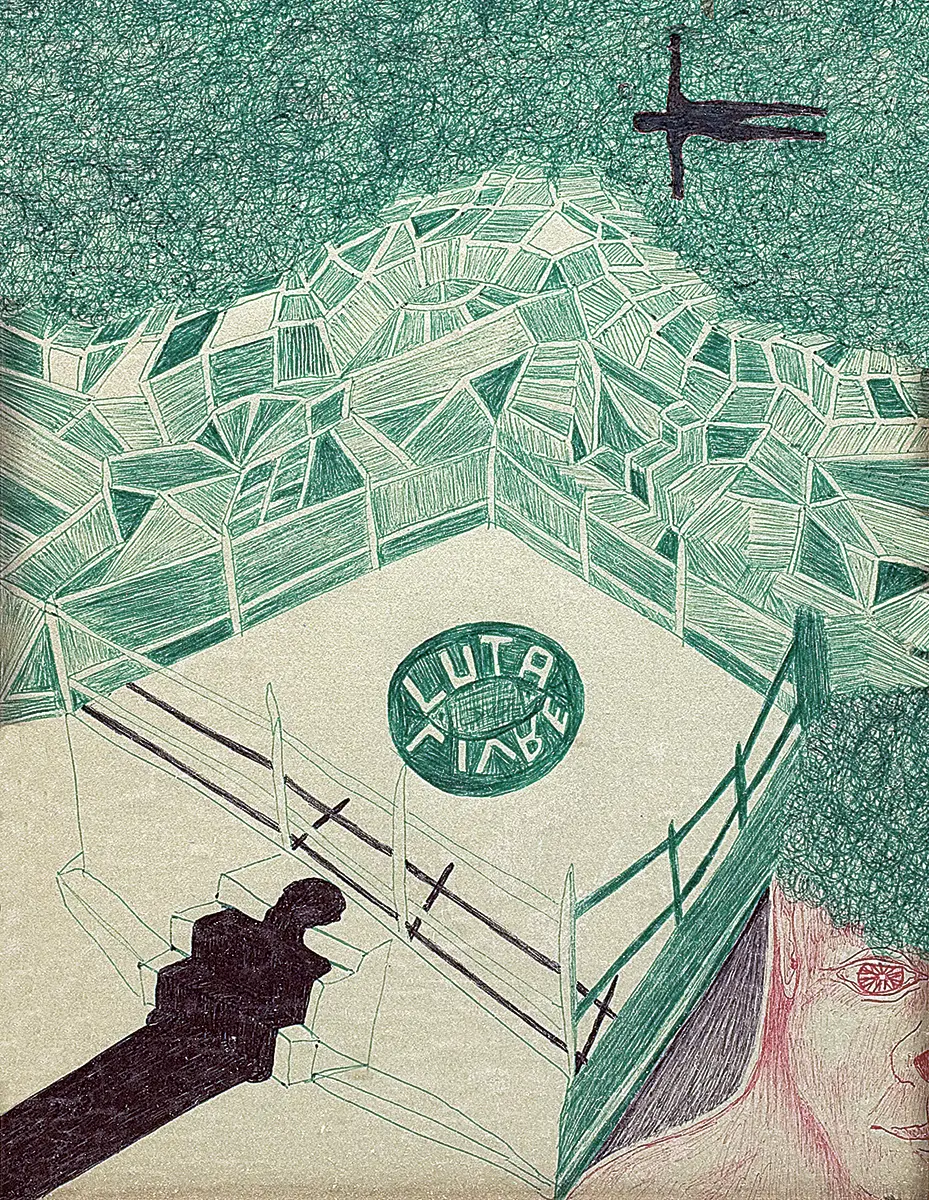
While Lopes questions our relation to technology, he clearly believes that the technological development with the greatest saving grace is the bicycle. The bike he rode while in New York to install the show was on display (price available on request), and his suite of fifteen drawings made from ballpoint pens on construction paper was titled the Bicycle Airway Drawing Series (Série de Desenhos Cicloviaérea). In Rio and New York, Lopes conceived of using the freedom, community, and ecological benefits of cycling as a metaphor for a community or place, his Jarbalopolis, in the same way, that New Yorkers conceive of the soon-to-be-renovated High Line, an abandoned aboveground railroad a track that snakes through the art district of Chelsea. One drawing in particular shows bicycles and a general structure for this bikeway in the sky. Yet while part of Lopes is indeed located above it all, he remains grounded in many ways, whether having his children help in his drawings or through community gatherings and actions at Galeria A Gentil Carioca in Rio. Being in both worlds simultaneously seems terribly adult for a child, don’t you think?
RICHARD LESLIE