
The
natural environment has always been a powerful stimulus for human action, exploration, and invention. It constantly challenges human beings, driving us to
outdo it, to conquer its powerful presence, to place ourselves above its status
as a primeval scene. Similarly, this essential aspect has been an incentive for
artistic creation, and artists have always risen to the challenge, but never to
subjugate or profit from it. On the contrary, the interest of artists has been
to discover via reflection and study the keys to nature’s simple yet complexly
articulated structure (which it hides but does not deny), only to recreate and
reinvent it as an illusion in the work of art.
From the contemporary standpoint, art moves toward a reinterpretation of narratives and a reshaping of frameworks, rather than a search for truth. Contemporary artists are interested in finding new meanings for past experiences and value the communicative act. Present in the creative realm is everything that has to do with life itself and, fundamentally, with the natural environment.
José Antonio Fernández’s exhibition Bifurcaciones, presented November 18th through December 9th at Galería 39 in Caracas, was inscribed within this millennium-long relationship between art and nature, as seen from the present. Fernández, who recently received the First Prize award at the Francisco Narváez National Sculpture Biennial approached the marine world in his work, conveyed by forms resulting from intense intellectual activity (as could be seen in the show’s drawings) but not alien to their inspired materiality. Fernández’s work situated the viewer inside an illusory world that, paradoxically, brought one to an encounter with the dimensions of the real.
The show opened with Infinito, a small-format work that integrated an abstract vision with the dynamic tension of the organic. The small, twisted filaments that composed it were conjoined so that the viewer could not determine their beginnings or their ends; it vaguely recalled the fruitless clusters of a date palm. This fragile, subtle structure was suspended in space and became an object of intense presence to the viewer’s eyes as well as a tiny cosmos as perceived by the viewer’s body. In the Bifurcaciones series, the works’ dimensions expanded to fill the small space. The line segments came together at numerous points and multiplied in new directions, creating an immense network, a woven plot that grew infinitely. Of this, the artist displayed only fragments: svelte and harmonious silhouettes outlined against the gallery walls.
At times, these works evoked a series of branches seen against the dense tangle of the forest and, in other instances, the signal presence of a bare tree against the immensity of the desert. More properly, they referred to sea anemones, enigmatic beings that, although they belong to the animal kingdom, have a vegetal appearance and remain firmly attached to the ground, adapting to the changing conditions of their environment. However, Fernández’s works went beyond such references to the sensible world; they were forms charged with multiple meanings.
Another set of works in the exhibition, the Paisajes submarinos, were of the type the artist calls Motivos; in this case, they were half-spherical constructions articulated by lines. Undulating, flexible lines created arabesques, sinuous and strangely efflorescent events, and curved labyrinths—in sum, an entire ornamental repertoire inspired by the bizarre creatures found on the ocean floor. Unlike the open, expansive Bifurcaciones, the Paisajes submarinos were self-contained, devoted to their own form. Beyond the decorative diversity, their expressiveness was based on the symbol of the circle as beginning and end.
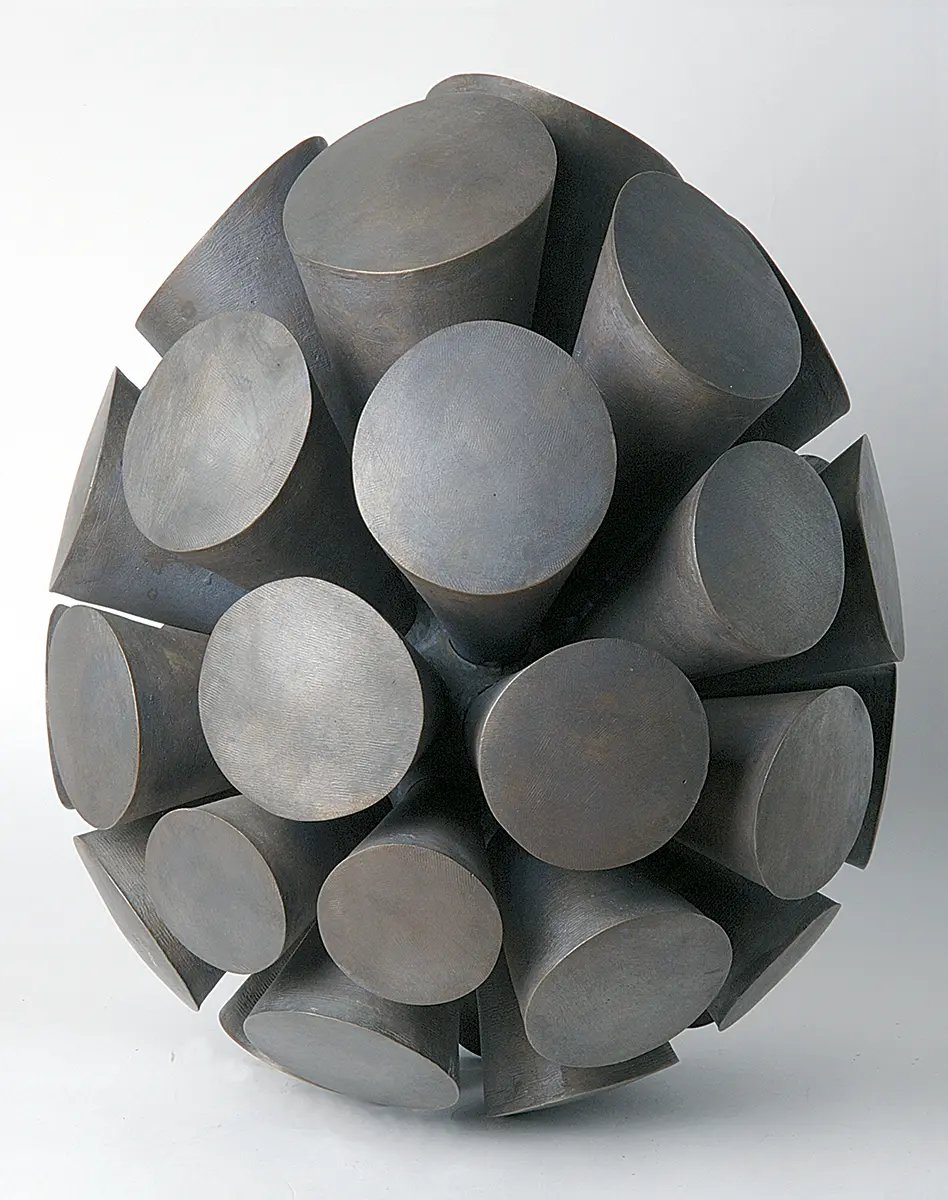
On and Off were two surprising works within the group, not for their volumetric nature but rather their forceful materiality, a clear counterpoint to the transparency of the Bifurcaciones. Although contradictory in their definition, they were similar and complementary objects. To the closed solidity emanating from Off, On presented an expansive character and a powerful dynamism: it contained energetic elements as if ready to detach from the nucleus and to project into space.
With rigorous execution, José Antonio Fernández’s show displayed the freshness and the self-assurance that are features of young art. The work was driven by critical perception of the environment as an essential space for the survival of human beings.
FREDDY CARREÑO