
José
Bedia has long explored the cultures of tribal and indigenous societies through
travel and personal interaction with tribal people, their elders, and shamans.
He also studies artifacts that are significant to tribal daily life and its
rituals and has a significant collection of books and objects that also serve
to inspire his works. This interest began when Bedia was a young soldier in
Angola and with his initiation into Palo Monte, a religion brought to Cuba in
the nineteenth century by African slaves from the Congo. Believers in Palo
Monte ascribes to a cosmic view of human existence in which man and woman are
one with nature—the animals, the earth, and the sky. Believers worship the
spirits and plead for their beneficence with offerings prepared on altars and
shrines and empowered with magical accumulations. In Bedia’s highly charged works, the process of artistic creation
echoes the ritual of calling forth the spirits as well as the presence of
African cosmic symbolism.
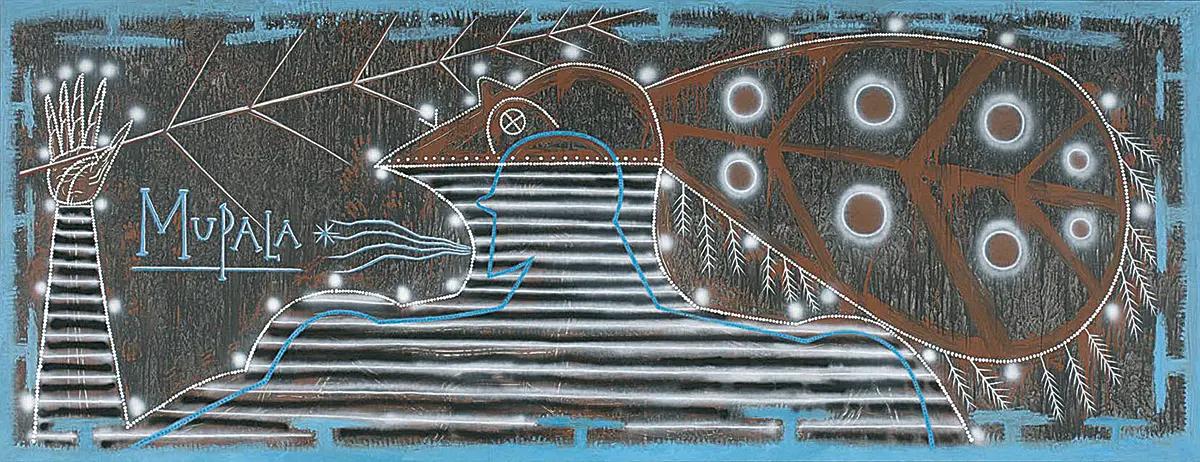
The works for Bedia’s recent exhibition were created after two trips (in 2004 and 2006) to northwestern Zambia, home of the Chokwe people, where Bedia experienced first-hand the power of ritual and the energy contained in ritual objects. He explains that such a direct form of experience is absolutely vital to what he does (and has always done) that it goes beyond inspiration. It is more knowledge-based, driven by affinities and perceived philosophical tendencies and synchronizations that are not possible with superficial or merely formal attention to aesthetics. It is a holistic approach to the appreciation of tribal objects through experience, away from the museums where objects are displayed out of context. After Bedia’s travels, the objects that he studied and collected were imbued with new meaning. He was also privileged to participate in the painting of a house in the village of Lunda with a master artist, where he contributed a scarlet image of a lion in homage to a famous elder who had passed away. Collecting a new group of objects (including masks, figures, and textiles) created by the tribal members or their ancestors—and interacting with these people—added a new layer of authenticity and significance to Bedia’s own creative pursuits.
The combination of the newly collected objects with large mixed-media paintings on handmade paper responded to their extraordinary physical and spiritual energy and set this exhibition apart from previous installations by Bedia. The Chokwe people use a variety of natural materials to make masks, textiles, beadwork, ancestor and fetish figures empowered as reliquary containers, and other ritual paraphernalia. Each character in their pantheon of spirits has a specific role in the village; they often teach young males in initiation ceremonies and inspire good behavior through example. Bedia captured the energy of these characters in paintings that were carefully arranged in relation to his collection of objects, which includes life-size clothed wood figures and masks.
In the work Mupala, the aggressive antelope spirit of the same name was rendered in forest-brown pigment with slashes of white and blue; it conveyed the spirit’s control of nature and role as protector and enforcer. The same lessons against aggression appeared in the spectacular orange painting dominated by Utenu Kazaye (Angry Utenu), who wielded a weapon and wore an antelope mask/headdress. The actual masks with elongated heads were placed with the paintings. They were made of painted wood and fibers, with painted slashes of white. Bedia carefully replicated the patterns of textiles and rows of beadwork, contrasting against the rough and immediate technique that he used to render the figures themselves. Each color, design, and pattern is an authentic comment on the spirit residing in the objects. In the ceremonies, some spirits teach young boys the dangers of destructive behavior, and other spirits inspire more positive messages. Bedia approached these themes with humor and a modern sensibility.
The mask that inspired Kazwazwa (Butterfly/Airplane) was a butterfly with collaged details on painted wood and wide “wings” projecting from its head. The mysteries of the butterfly’s flight were equated with those of the airplane in a striking image in which a striped body replicated the details on the mask located nearby. Other smaller works of mixed media on paper paid homage to the profound African tradition of ancestor and fetish figures empowered as receptacles (nkisi) for potent substances or even the soul of the dead, which are often wrapped in layers of cloth, as was the one from Bedia’s collection. In the drawing Nkisi Yombe (Power Figure), the figure stood in protection of a smaller image. This combination was one of the most impressive in the exhibition, and both works performed as sometimes-frightening containers for cosmic forces beyond our comprehension. José Bedia’s world is dominated by the idea of sacred space, the journey between earthly and spiritual reality, and the presence of spirits and deities as ancestors, guardians, and protectors both benign and malevolent. Presiding over all is the concept of spiritual authority, represented by a huge looming figure guiding earthly existence.
CAROL DAMIAN