
Lilian
García-Roig has been practicing the art of landscape painting en plein air over the past several
years, primarily in New England, the Pacific Northwest, and North Florida. The
latter is the subject of her exhibition at the Carol Jazzar Gallery, a stunning
display of fourteen paintings arranged as an all-encompassing installation that
engulfs the viewer within a tangle of gnarled vines, scrubby brush, and jagged
palms.
García-Roig’s technique is truly remarkable. Not only does she manage to capture nature directly and accurately, without the help of photography or other mechanical devices, but she does so employing such a thick and palpable stroke that it transforms the plane of the canvas into a painterly relief. From afar the paintings appear highly realistic but upon closer inspection, the representational image fades into pure abstraction. In its place appear configurations of color arranged haphazardly and describing the most random, often amorphous shapes that defy the boundaries of form.
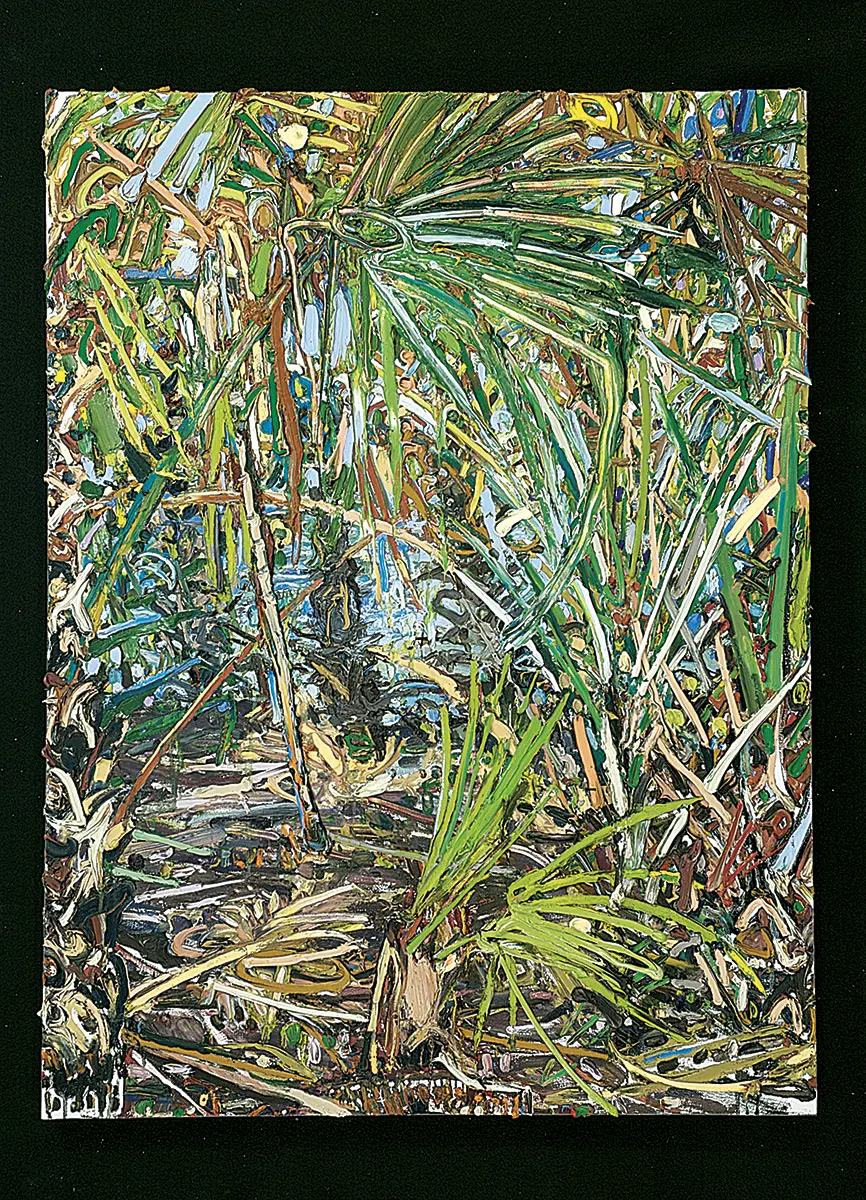
Though the landscape genre has a long trajectory in the history of art, García-Roig’s images are unique for both their subject and form. North Florida has dense forests with oaks, pines, and lush tropical plants. The air is heavy with the constant hum of insects, and this jungle-like setting is illuminated with a soft, diffused light. The beaches have more pines than palms, and, at the coast, the forest floor is often covered with sand, creating an uncanny impression of snow, an effect which is particularly evident in one of the paintings. Overall, it is a strikingly beautiful setting, which provides a rich point of departure for the artist’s interpretations. She chooses views that are dense and chaotic, where the palm meets pine or where vines take a life of their own, and daringly describes them in accents of orange, red, and purple, as well as the more conventional colors of nature.
Because of her insistence on pure painting and her choice of subject, rendered directly from life, García-Roig elicits comparisons to the Impressionists. Certainly, Monet’s Water Lilies create a point of reference for her painterly installation. The feeling of being enveloped and also disoriented is a constant in both. However, whereas the Water Lilies are calm and meditative, García-Roig’s paintings are abuzz with activity, demanding a dynamic spectator. Their surfaces reveal but also deny our access, and they do so through different tactics. Some images contain patches of sky and water visible through the palm fronds, but the emphatic diagonals that compose the leaves force the gaze to remain focused on them, blocking deeper penetration. In others, the lines are more curvilinear; they describe branches and vines that create a foreground screen which serves to refuse the viewer’s entry into illusionistic space.
García-Roig’s painterly technique might also be compared to diverse forms of expressionism. Her impastoed surfaces, created with brushes, gloved fingers, and squeezed out paint, bear some resemblance to de Kooning’s gestural strokes. The work, however, lacks the subjectivity implied both by de Kooning’s paintings and those of the neo-expressionist painters of the eighties, who in some cases also reinterpreted the landscape. Despite the overwhelming presence of the artist’s hand, García-Roig’s persona is absent from these paintings. Her work reveals itself only as painting, pure and simple.
For a long time, García-Roig’s work did not mesh with the art world’s penchant for Minimalist aesthetics and conceptual strategies. Recently, however, painting has come back with a vengeance. The legendary collector Charles Saatchi rocked the establishment when he sanctioned painting, after having spent the nineties promoting conceptual art. Now, painting is everywhere, and it embraces a variety of styles. Works by such internationally renowned artists as Dana Schutz, Julie Mehretu, and Cecily Brown, though stylistically different from García-Roig’s, share a number of commonalities. All of these painters reject the Greenbergian limits on how a painting should function. Rather than making their visual information accessible at a single glance, their canvases demand focused attention and sustained looking. They also inspire awe for their technical prowess and present multiple possibilities for the future of painting.
A self-proclaimed Maximalist, Lilian García-Roig spent a long feeling isolated from the dominant artistic trends. Now, the art world has caught up with her. She well deserves this moment in the spotlight, and, given her talent, her fame should continue to grow.
TATIANA FLORES