
Los Primeros 10 años con Rubbers (The First 10 Years with Rubbers) is an exhibit celebrating the relationship between Luis Felipe Noé (Buenos Aires, 1933) and the well-known gallery and it presents a panoramic view of his remarkable paintings. Within the framework of this exhibit, he also presents Noescritos sobre eso que se Llama Arte (Noé-Writings on That Thing Called Art), (Adriana Hidalgo Editions, Buenos Aires), a compilation of his writings from the past four decades. Just as he has done in his other books, the artist deals with both the theory and the practice of contemporary art.
More active than ever, Felipe Noé began 2008 by receiving the distinction of “Illustrious Citizen” awarded by the Legislative branch of the city of Buenos Aires to prominent figures. He also presented an anthology at the Museum of Modern Art in Buenos Aires. On this occasion, Noé en Línea (Noé in Lines) brought together more than 250 drawings, including installations on the wall, and mixed techniques on paper, in which he displayed enormous vitality and provocative excess, precisely as he does in this current exhibit at Rubbers.
Noé paints ideas. In Marabunta (Plague of Ants, 2007), he recreates once again reality and atmosphere of agitation and prolific work. Anyone who knows Yuyo (as his friends call him) Noé’s vast artistic trajectory and unstoppable work rhythm—thus, presenting a new exhibit at least every two years—is within his rights to wonder whether this artist can continue to surprise us through his work. Noé has put together more than 80 individual exhibitions since 1959, in Argentina, the U.S., and Europe.
The recipient of several awards and never wasting a moment, Noé has also exhibited collectively on innumerable occasions. In addition, there is his well-known and decisive participation in the group denominated New Figuration, which also includes Ernesto Deira (1928–1986), Jorge de la Vega (1930–1971), and Rómulo Macció (1931). This was a group that through abstraction and figuration rebelled against prejudices and opened the doors to freer painting. To this gesture of rebellion against the status quo, Noé added others, such as leaving behind the rectangular frame, his complete withdrawal from painting in 1966, and his return to it in 1975. The artist’s voice and his affirmations of freedom never come to a halt, inside and outside of his work. With his considerable energy, Noé is determined to search for a path from the ostensible to the intangible.
His paintings are contagious with regard to something that is difficult to point out. Could it be his enthusiasm? In observing Guerra Interna (Internal War, 1997), Saldos (Balance, 1988), Racatapatán (2000), Expectativa (Expectation, 2001), El Estricto Nombre de las Cosas (The Name of Things in the Strictest Sense, 2006), it is possible to confirm the artist’s coherence and to remember his reinvigorating take on painting. “At a time when many in the art world talk about painting in the past tense, I paint believing that the novel, revealed in technological changes, relies before anything else on a conception and vision of the world beyond the media used to manifest it”, the artist affirmed in 1999. There is a desire to return and observe these works that are in such opposition to the predictable and paralyzing order. In contrast, chaos—which is not the same as a disaster— functions through a creative motor that also conveys its contagion to the viewer.
Noé is not a distracted man. In addition to occupying himself with painting, he also chooses to commit to social matters. The grave issues throughout the broken weft of a society in a permanent state of exasperation as it spits out and forgets millions of people also comprise a central part of his work. His painting, touch by the awareness of uncertainty and the unrest in today’s world, continues to return to the artist’s surroundings, as in Cuadro de la Intolerancia (The Picture of Intolerance, 1999), ¿Hasta Cuándo? (When Does It All End? 2002), and Tiempo de Austeridad (Austere Times, 2005).
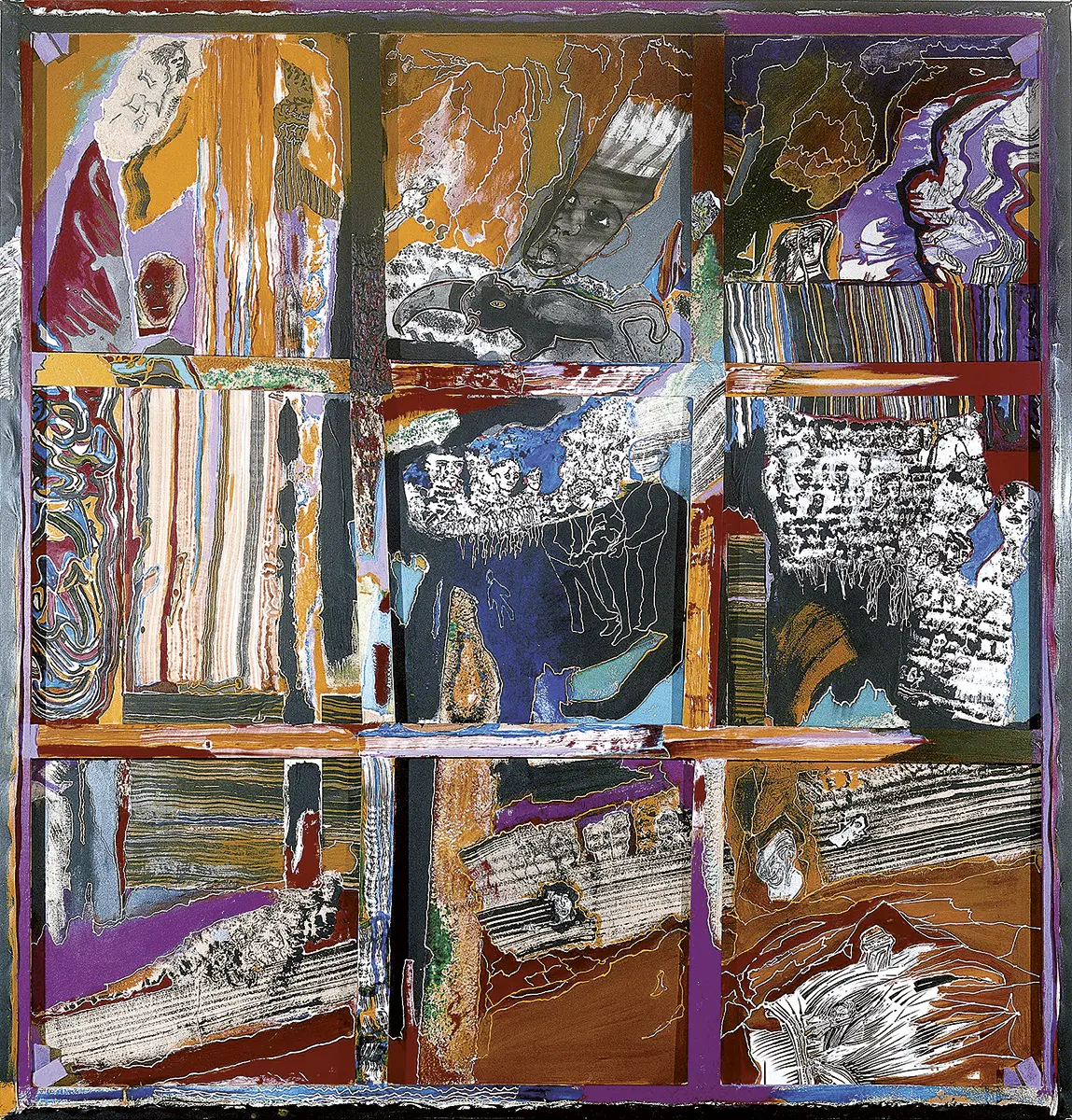
A mosaic of several fragments, each of Noé’s nine paintings in Acumulación de Acontecimientos y Situaciones (Accumulation of Events and Situations, 2003) could be considered individually. Painted in the backs of the canvases and exposing the frames, the images appear to condense the artist’s search. The spectator’s gaze is able to register some barely insinuated faces and figures, without clear meaning, and superimposed patches of color. “I pretend I am directing an orchestra made up of my past. This is my present, in other words, my future”, says Noé in referring to his constant moving, searching, and defying work.
VICTORIA VERLICHAK