
En
Sangre Fría (In Cold Blood) was the most recent exhibit that the Peruvian
artist Miguel Aguirre presented in Spain. This excellent show in the city of
Gijón told a story that combined cold-blooded analysis with conceptual
delicacy. Such a story is a rigorous metaphor of today’s culture and its
disproportionate sense of tragedy and alarmism. The exhibition consisted of a
selection of drawings and paintings taken from two series that have occupied
the artist’s creative production for the past several years: DD/MM and Dramatization. Aguirre’s predilection for small-format works and
crude scenes of a contemporary culture characterized a presentation that avoided
grandiloquence and looked at the secondary effects of monomaniac gestures.
Both series were products of the research project titled La Pintura de Historia: Un Discurso Contemporáneo (Painting in History: a Contemporary Discourse) that was developed for the Faculty of Fine Arts of Barcelona. In the words of the artist, the project “departed from several reflections by some theoreticians and critics about the series 18 October 1977 by the German artist Gerhard Richter and established the possibility and pertinence of the painting as a historical genre from the beginning of the twenty-first century.” This genre was forgotten in the previous century. In DD/MM, Aguirre transferred images from the print media to his canvases to address numerous tragic events of the past. The series, unlike a sensational aesthetic exercise, attempted to counteract the mental adaptability of the spectator when confronted by harsh realities. This reflection not only impacted the realm of subjectivity but also commented on the nature of artistic occurrence and in particular on the reach and dimension of narrative genres within the pictorial universe.
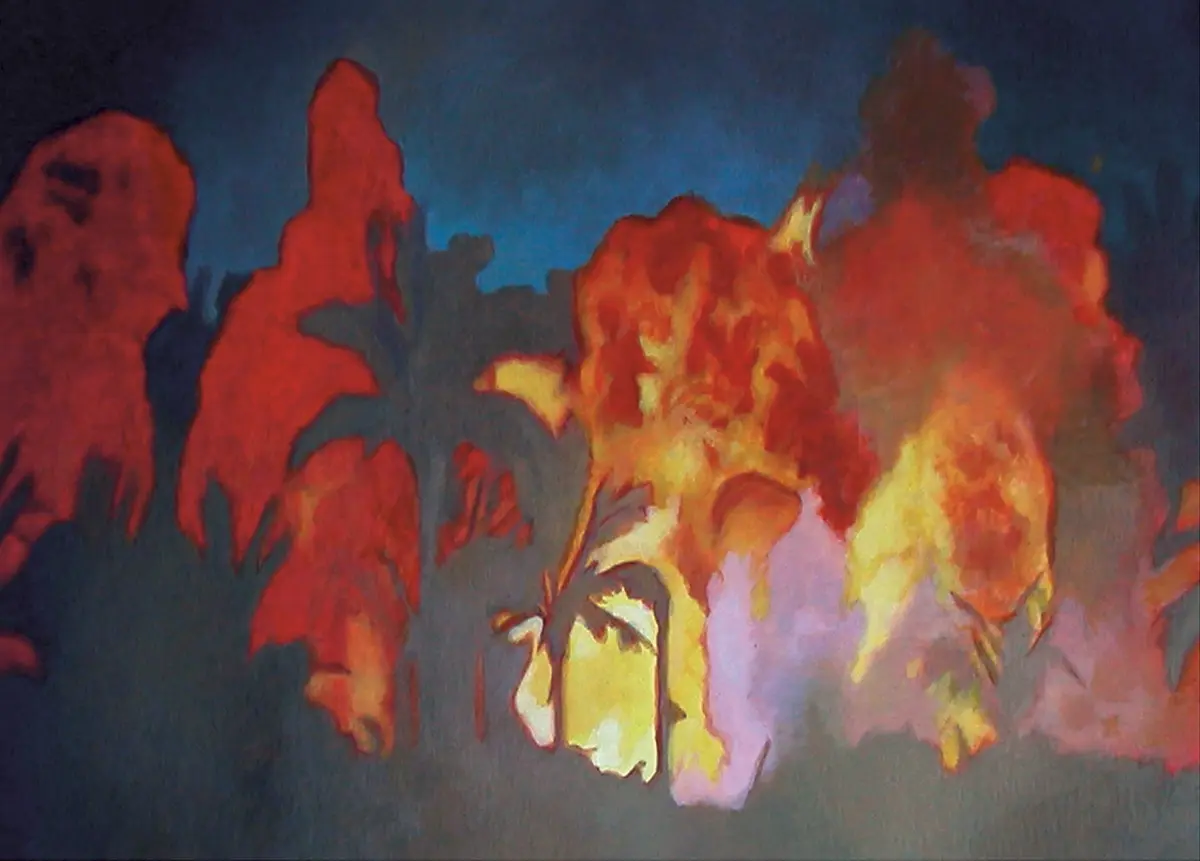
Dramatization was a series on paper titled after U.S. television shows in which usually violent and dramatic situations—such as kidnappings, robberies, and accidents—are recreated in extraordinary detail. Dramatization replaced these events of limited consequence with others of more historic gravitas. Aguirre summarized his proposal in Espacio Líquido (Liquid Space) as “an encounter with formal and content-filled historic rigor.” “The trigger in every work,” explained the Peruvian artist from Lima, “is a sentiment generated by a tragic event through visual representation and/or staging (dramatization). Nonetheless, the work does not attempt to transmit this feeling to the viewer; rather, it seeks to create a distance that allows for critical questioning of the event and its undercurrents.” Thus, the work established a space for critical thinking about sensational media manipulations and the excessive display of morbidity to attract a mass audience. At a time when art world presentations often alternate between “more of the same” and “everything goes,” it is good to see artists willing to take on projects of personal importance if, as in this case, the artist proposes a relevant contribution and stimulates the practice of criticism to move away from stale speeches on national identity and the typical questions that have become entirely tautological.
Aguirre’s work was interesting because it embraced self-regarding postures of questionable taste. This approach, articulated according to the series’ criterion, characterized a cycle of paintings from 1988 dedicated to the events and circumstances of the anarchist group Baader-Meinhof. In this series, the artist adopted the familiar tendency of German painting to refer to recent history, not only as testimony and critical reflection but also as a genre that situates painting in relation to history, a reference alien to vanguard trends. Many German artists have adopted this position, principally due to the enormous influence of Nazism in the past. However, to better approach the characteristics in Miguel Aguirre’s work, one can reduce the examples to two artists: Anselm Kiefer and Gerhard Richter. In the construction of historic memory, Kiefer focuses almost explicitly on the Nazi phenomenon and his artistic approach is generally expressionistic with a hint of romantic symbolism. On another hand, Richter is a remarkably eclectic painter, as is well known; he alludes to a wide range of real and specific events because, like Aguirre, he conceives of artistic pictorial representation as separate from expressionism and instead focuses on the mediation of images in mass communication, photography, and film.
The titles of Aguirre’s small-format paintings in his Dramatization series were quite meaningful: According to Pontecorvo, Loach, Costa Gravas, Attenborough, and many others. Through interpreting and pictorially formalizing what some great filmmakers had captured with their cameras, Aguirre created a pictorial staging of “reality” regarding contemporary historical events as seen through the eyes of these other artists. The result assumed a doubled artistic transformation of reality.
ANDRÉS ISAAC SANTANA