
-
A letter addressed to the U.S. Senate regarding Watergate
- A book by Ruscha
- A catalog by Yves Klein
- A Palestinian map
- A copy of Père Ubu by Alfred Jarry
- A letter from the Whitney Museum addressed to the artist
- A catalog by Dan Graham
- Stationery that belonged to Hitler
- A copy of the Communist Manifesto
- An issue of Life magazine with Picasso on the cover
- A report by CBS of attitudes that black and white Americans have while performing similar activities
- A copy of the pamphlet titled To Be Attacked by the Enemy Is Not a Bad Thing But a Good Thing by Mao
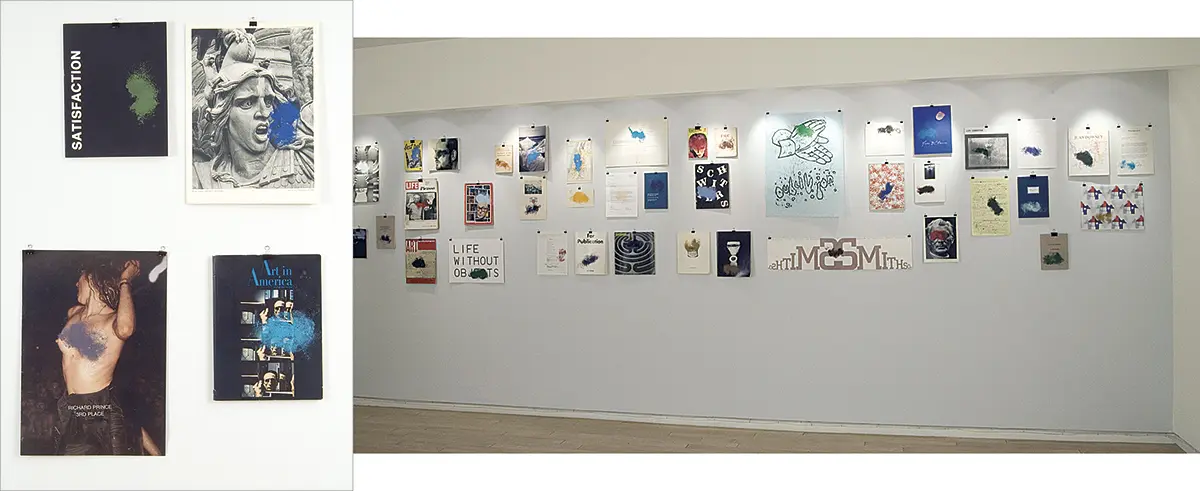
Displayed in Nicolás Guagnini’s recent exhibition, these twelve and sixty-five other printed materials—including museum catalogs, personal letters, poems, and notes—had been subjected to the imprints of the artist’s testicles, which had been dipped in oil paint and pressed onto each item. These materials were held together with binder clips and installed in three rows in the manner of a nineteenth-century painting exhibition. The seventy-seven paintings made up the 77 Testicular Imprints exhibit that the Argentine artist presented at the Andrew Roth Gallery in New York in late 2007.
In this show, the artist’s physical presence was inescapable. In a 2002 exhibit at the Ruth Benzacar Gallery (in Buenos Aires), Guagnini presented his work Homo Ludens (Man at Play), a pool table modified to resemble a painting by the Argentine artist Raúl Lozza (1911–2008). In this work, Guagnini played pool against visitors for the entire duration of the exhibit and he used some of his drawings to place bets. There, the artist’s aesthetic preoccupation was of the utmost importance, as evidenced by the production quality of the table. In contrast, and notwithstanding the precise execution of the Testicular Imprints, the stimulus in the recent show was not found in the visual materials. Here, the viewer’s interaction with the works was similar to that established in a history museum: one wanted to go through the pages and read them, but the artist’s intervention prevented one from doing so.
The pictorial intervention of the Testicular Imprints modified the function of the documents, which informed their content. The only information available was contained in the titles of the printed materials, which in turn generated a novel text, an inventory of nothing other than a list of indexes. But in this instance, the indexes were also the objects they referenced, such as the 1:1-scale map of a kingdom that was as large as the actual territory. The coincidence between the object and its representation, one limit of indexes, appeared to be the opposite of the operation employed by Magritte in his work This is Not a Pipe. Nonetheless, this coincidence was also canceled by Guagnini’s genital mark. The mark altered the document by transforming it into a painting, and—as its nature had been forever transformed—the document could no longer refer to itself as such. At the same time, the intervention added a new index to the work: its contiguity with the artist’s body. If the inventory pointed to a mental survey of Guagnini, then the very personal imprint referred back to his body.
The works were completed in conjunction with the book accompanying the exhibit, or was it the book that was completed? If this were true, then the manipulated materials, now photographically reproduced, would be transformed into a new complete piece in this newly printed form, thus replacing their original references, and would transform the reproduction into the original. The referent/work relationship created by the altered printed materials and their reproductions would be similar to the relationship between reality and photographs. This added to the Borgean labyrinth, another of the paradoxes of which Guagnini is so fond.
The authoritative character of the books reduced all possible narratives into one: that which the artist proposed in the sequencing of the final book. This narrative was rendered even more solid by the inclusion, in the majority of even-numbered pages, of quotes related to the material printed on odd-numbered pages.
It would be easy to give in to the temptation of elaborating a personal atlas, or a reading of the history of the twentieth century, or a demonstration of the relationship between art and the power structures proposed in the poem titled Concrete, which introduces the book:
patriarchy
private property
power
progress
position
packaging
personality
Any narrative could be chosen and it would be correct and provable.
The nature of Guagnini’s new work broke with the controlled and severe aesthetic that he had maintained until recently, one learned from Roberto Aizemberg (Argentina, 1928–1996), a metaphysical painter and Guagnini’s maestro during his early years. Guagnini’s Imprints subscribed to the approach of avant-garde provocation, and the artist demonstrated this in previous works. His Pirámide Social (Social Pyramid) of 2001, in which an architect worked in the Buenos Aires exhibit space on the infinite construction of a pyramidal castle made of playing cards was carried out under deplorable conditions that resonated with the socioeconomic reality in Argentina. In the work The Seven Reviews of Monkeys and Shit (2004), Guagnini wrote reviews that inevitably mentioned primates or excrement and were published in the magazine Time Out-New York.
Testicular Imprints was an accumulation of the knowledge that Guagnini has gathered from his origins and artistic education, theoretical and critical works, and erudition. Lastly, these self-portraits revealed his years at the southern wing of La Bombonera, the stadium in Buenos Aires that houses the Boca Juniors, the artist’s favorite soccer team.
JULIO GRINBLATT