
Oscar
Machado has consistently used basic construction-trade materials in his career
as an artist. Concrete, plaster, plastic, chain-link fence, and ties as well as
sequins are some of the varied and differently textured materials he has
explored to show another facet of the real: that which is found in the humble every day. The raw, spontaneous quality of these materials—their roughness and
fragility, the perception of volume resulting from their molding, and the
entwined textures somehow alien to each other—is what Machado wants to
underscore. “My interest,” he says, “is to create something extraordinary
[with] a simple material. That is a principle. I don’t express myself through
other materials [like] stone, marble, [or] bronze.”
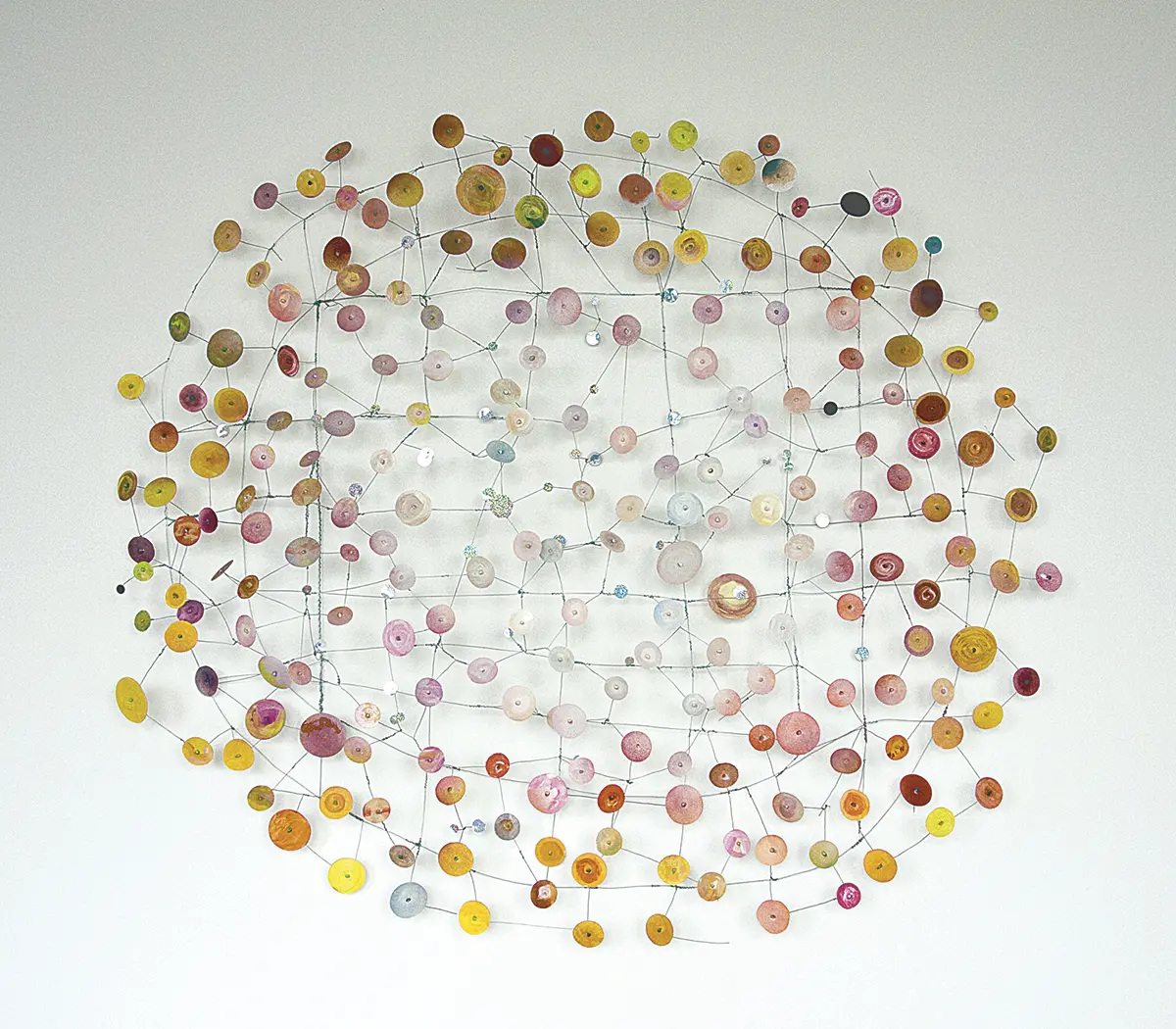
At the end of the 1990s, Machado directed his investigations toward weightlessness; as a result, the wire structures that already appeared in his earlier works later became protagonists. The density that characterized his compositions crumbled, and what appeared were ever lighter, freer, and more fluid shapes. After seeing a Gego retrospective, Machado confirmed these quests. What had been sturdy lost strength and size; in turn, space and ferrous filaments became expressive entities, and the visible and the invisible described the facets of a reality that was essentially dualistic. Machado explored in depth these concepts that throughout the twentieth century have fascinated both artists and physicists.
The results of these investigations were seen in his recent exhibition, Siderales, at La Carnicería, Arte Actual, from October 10 through November 21, 2007. Featured were fifteen works in a variety of formats—squares, rectangles, circles, radial or variable shapes— and compositions that agglomerated or dispersed, showing a kind of internal elasticity. Installed at different heights, the works formed a visual circuit that transformed the ambiance of the space. These artificial constellations incorporated the architectural space: the walls supported assemblages that seemed on the verge of detaching and forming an autonomous ecosystem as if impregnated with particles that would disperse and invade the entire area. The idea of a reality based on a relational schema, as Mondrian had established, dominated the scene.
The show revealed the interconnectedness between fullness and emptiness—a network that grew without an established route, a tangle of sinuous fibers that subtly intertwined knots, points, and lines. Like a paperless drawing that described the initial shapes of creation, the forms followed an unexpected rhythm in the eloquently evanescent and immaterial. The viewer was led to astrophysical notions and descriptions about the microscopic, the macroscopic, galaxies, and the mysterious universe. Machado captured these images through an intuitive vision of the cosmos and built them with the help of components such as stainless-steel wire. According to him, this material “is more organic,” giving him “guidelines to do something else... It is like seeing a star or an atom turning on its orbit.” The handcrafted nature of the works provided an intuitive element, creating an affective closeness with materials that usually have a metallic, cold quality. In addition, the irregular shapes radiated spontaneity and formed a weaving or armature that underlined the bifurcation between the finite and the infinite.
A new chromatic range was present in this work. The renewal of Machado’s palette gave greater dynamism to the grayish tangle within each work, a kind of atomized rainbow trapped in the circular ends that crowned the compositional relief. Aura (2006–2007), for instance, was made of wire, galvanized iron, PVC laminate, acrylic paint, and sequins. Its circular shape was affirmed by a band of warm hues like reds, oranges, and yellows; this gleaming crown slowly degraded into a colorless state that evoked the luminous iridescence of celestial bodies, at the center of the grid. With these compositions, Machado created the notion of an extended, immeasurable universe. Like the sequins that shone within this imaginary cosmos, the minuscule position of our own planet in the immensity of space was conveyed through Machado’s purely creative act.
GLADYS YUNES YUNES