
The centerpiece of Santiago Borja’s show at the Enrique Guerrero Gallery is Chaque fois unique, an installation, accompanied by photographs, drawings, and paintings that develop different ways to envision the image of a skin blotch caused by vitiligo. The artist starts with a pattern created by genetic chance and transforms it both bi-dimensionally and in the surrounding space to represent an aesthetic form with diverse possibilities based on drawings made on it.
Thus, the artist delineates on glass some selected points of the blotch, which in turn is not evenly pigmented, the outlines of which are built as if expanded from a bullet-time This effect, in which one is submerged in the details of the figures, causes the conical shapes in waterproof purple plastic to elongate towards the wall that tenses the canvas. In this way, an impenetrable installation is created; however, sunrays filter through and generate an interplay of light and shadow on the work, giving it a versatile configuration. The space created under the “expanded pores” must be warm and resemble a strange sky. Frontally, up close, and from a certain distance, what prevails is the visual, due to a tactile incapacitation suggested only to the gaze.
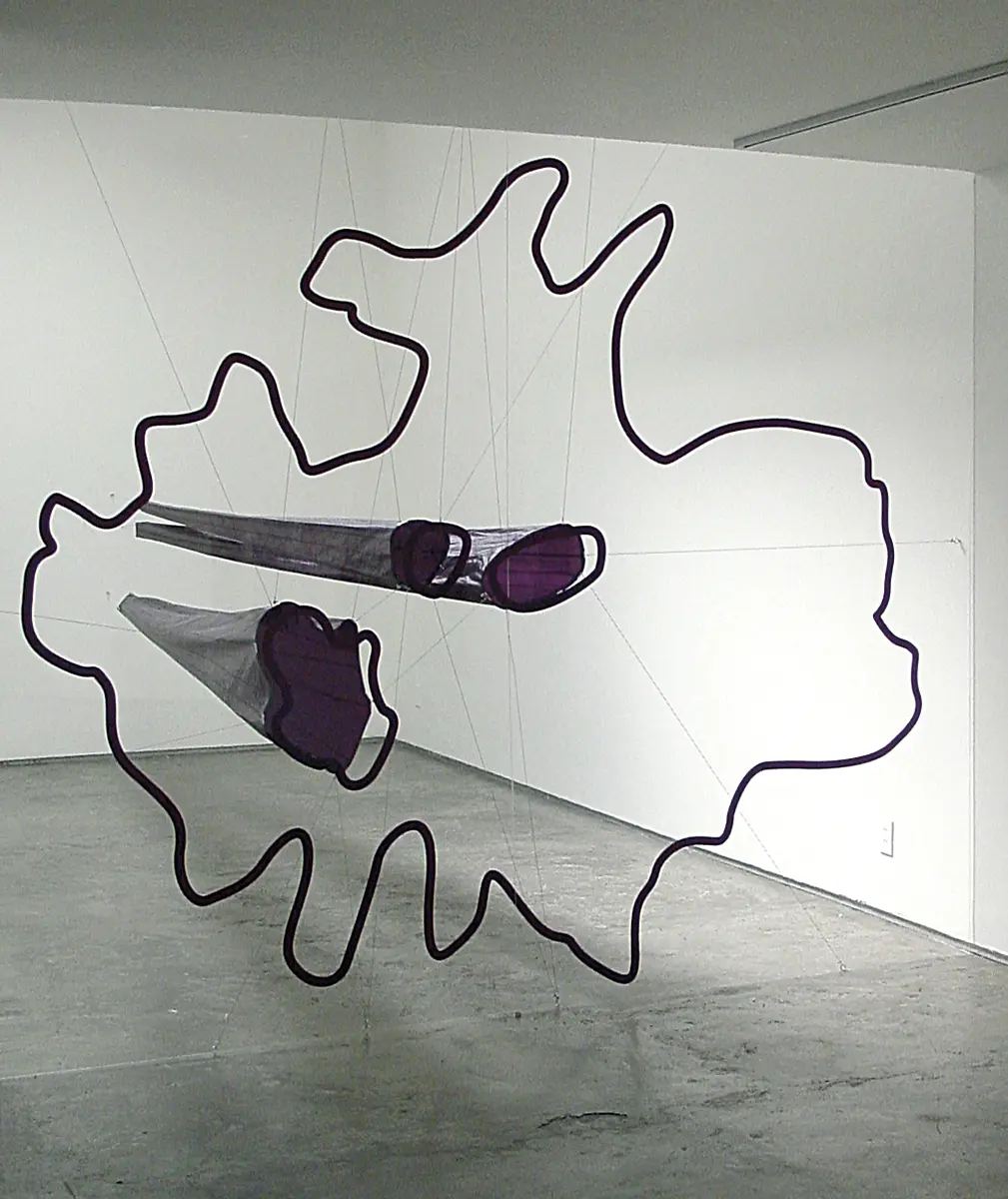
Vitiligo is a degenerative skin illness that kills melanin cells, so that certain regions of the epidermis cease to produce pigmentation and whitish blotches are formed. Although the ailment is defined in outline, contour, and body, it is the result of an absence: melanocytes –the cells responsible for skin pigmentation— die, resulting in the appearance of blotches following a pattern comparable to camouflage devices in animals. These disruptive patterns originate in the alteration of the established order through chance, and the image is modified in ways that might even gain greater relevance than the original. Santiago Borja plays with the natural process of skin de-pigmentation, building on it geometric shapes that resemble cybernetic constructions in the imagined space, without falling back on predictable results. The complete freedom granted by the blotch’s formal lack of definition opens up the field to experimentation and to the generation of results hovering between surprise and expectation, the predictable and the unknown, repetition and variation.
Borja recreates a specific blotch and enlarges it on the computer screen, transforming the orthogonal nature of the pixels into spheres that he imposes on the canvas like concentric circles that expand, clash, overlap, superimpose, and intertwine with one another. The circles in primary colors plus white, black, and green create an optical illusion, akin to the impressionist’s methodology in which, once a distance is taken from the particles, the original form is recreated.
In another work, a series of five portraits arranged in six rows reproduces the profile of people presenting some sign of de-pigmentation, highlighted or hidden by means of pixilated bars. To one side, the framed image of the amplification of a blotch is positioned as a map indicative of the conformation of some border. However, highlighted on it appears a city with suspension bridges, conical buildings, and other geometric shapes that dance over the intervened blotch. The blotch itself does not define borders; rather, it activates their potential for dispersion into a different dimension. The artist combines diagonal-line drawing with the tracing of ovoid, spherical, and conical shapes using a fine black marker, which accentuates the intangible character of the almost holographic, ethereal construction.
Just as the city expands without acknowledging borders, the pigment-less blotch results in a largely homogeneous, flexible mesa on the remaining skin. Yet, far from representing a unitary construct, the coloration, shape, and visual texture of the blotch’s various shades allow us to perceive imperfection as a complex, rich, almost seductive form. In the city suburbs, alternate centers are created, and around these, a new micro-city emerges. In the same way, the white blotch is made polysemic, set up in divergence, by its different pigmentations.
LUZ SEPÚLVEDA