
Víctor
Escobar (born in 1966, Neiva, Colombia) has lived in Europe for twenty years. At a
very young age, while in the first semester of his fine arts studies in Bogotá,
he won a scholarship to study visual arts in Moscow. Later, he traveled through
Europe and settled in Switzerland, where he lives today. Autostop (2005) was the first work of his I ever saw. In this work,
he is the protagonist in a video that shows him unsuccessfully hitchhiking on a
European highway while holding a sign that reads “Colombia.” Buses and cars
fight past him, sometimes subtly breezing the shorts of this Colombian traveler
who remains stoical. Of this work, Escobar said, “I wanted to invert a
situation so that feelings toward Colombia related not only to people wanting
to leave the country. I wanted to express to people leaving Colombia the
feelings of many others who dream of coming back.” On another occasion, I saw
his videos on eating tamales, in which people devour this traditional Colombian
dish, humming like bees. I also saw the intensely red photographs of city
streets in the developed world, showing the homeless sleeping on their backs.
I think Escobar’s images touch on human issues of a nearly biblical nature: devouring, hoarding, neglecting, desiring. They remind me of Marcel Duchamp’s late work in that they also generate in the viewer an irresistible desire to find out what is behind the door, only to discover that the work is the viewer’s own voyeurism, that his desire constitutes it. It could also be argued that the idea does not reside in the objects, nor in the context, but rather in a place between these and the spectator, who brings to the experience his own desires and preoccupations. I believe their power comes from their impeccable execution, which borders on pretense and which deals with very popular but rarely articulated themes, such as the subject of money.
At the Fortieth National Artist Salon in Bogotá in 2006, Escobar made a hole in a museum wall to install a fake but very realistic wad of bills. (I won’t say they were identical to real paper money because, in reality, how genuine are those anyway? After all, they represent pretense in the purest state.) Encaletado (Hidden), as the work is titled, is a very popular word for something that is buried, as if referring to a pre-Colombian treasure or guaca, as it is also known in Colombia. These hidden deposits (caletas) in the museum were similar to those that drug dealers build in their homes.
Many viewers were surprised by this intervention in the wall. The fact is that the millions of dollars that drug dealers hide in their homes or bury in their land have been a daily staple of the Colombian news diet for the last thirty years. Nevertheless, it does not faze us a bit. This is perhaps because of the hypnotic power of money, or the surreal action of burying it, or the perception by us Colombians that the stories are exaggerations or tales of Ali Baba. Or it may be our inability to confront traumas, or our national tendency of lying to each other. For whatever reason, these stories about buried, stashed money do not mobilize us. We need a Colombian artist, who has lived abroad for a long time, to be troubled by this problem and to point it out to the rest of us.
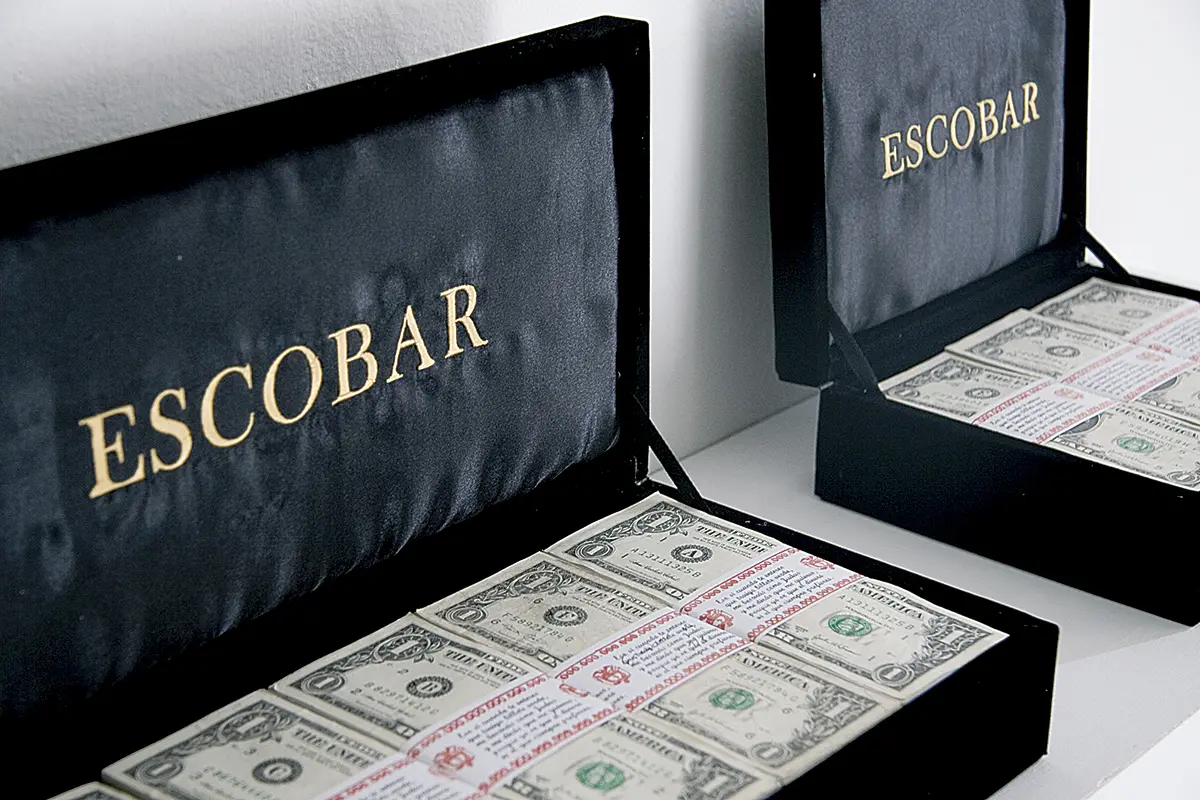
In his recent exhibit, Víctor Escobar presented several caletas and boxes. These demonstrated that when money is transformed into a spectacle, it acquires hypnotic powers. The black velvet boxes were open to allow a wad of bills to be seen, becoming a sensual trap for the eyes. This exhibit spoke to the hypnotic power of money and to desires transformed into spectacles: the desire to hoard and to buy. Escobar conveys this when he says: “The exhibit’s theme is an ironic game of greediness and longing for money.” Meaning the money that guarantees affective transactions as conveyed in the following song: “Eso sí, cuando te enteres / que traigo billete verde / me besarás como judas / y me dirás que me quieres, / porque yo sé que el dinero / es el que siempre prefieres” (Now, when you find out / I have green bills / like Judas you will kiss me / and you will tell me you love me, / because I know money / is what you prefer). This is money that secures sinister power transactions. Escobar affirms: “The theme of the exhibit is about the enormous quantities of money circulating clandestinely and the recent historic and deep-seated relationship in our culture between corruption and drug trafficking.”
The boxes spoke of the power of a name: the boxes had the name “Escobar” written in golden letters on their black velvet surfaces. As inscribed on a passport, it is a name a Colombian may find impossible to inhabit. These boxes expressed a paradox of Colombia: the most hospitable and generous place, and the inhospitable and unjust.
NATALIA GUTIÉRREZ