
A Natural History Museum or a fishbowl is
possible interpretations of the appearance of the Servando gallery, thanks to
its architectural features, which distinguish it from other exhibition sites in
the capital. The sui generis nature of the space was singularly protagonist in
Douglas Pérez Castro’s recent solo show, presented at Servando October 26 thru
November 62 with the title El tiburón y la sardina. The external decorative
metalwork, as a boundary, and the two glass walls, defined the ascending
directionality of the show, in particular, the resemblance the artist found
between the gallery and Natural History Museum, a type of institution that
flourished throughout the world in the Nineteenth Century. The enclosed space
could also be posited as a zoo, resembling a moment in the history of such
institutions when “dangerous” animals were held behind thick bars, at a prudent
distance from human visitors. The fishbowl suggested above was also connected
to the notion of captivity, of prison: an idea that holds fast to the min of
the Islanders.
The many texts that are Douglas Pérez’s works referred to animalism as a contemporary sensibility. His purpose manifested itself by way of thirteen works, eight oil-on-canvas works that went from medium to larger formats, for instance, Ahorrative and Evaporador, complemented with prints and temperas from the Atlas del Caribe, the artist has been working on, island by island, connecting geographic forms to members of the animal kingdom that bring to mind the region’s native species. His career has made us see him as an appropriator and re-evaluator of the Island’s Nineteenth Century visual arts, but much more than that he is an assimilator of varied languages and narratives. His discourse is arranged layer upon layer of history, knowledge, time, and on the basis of this manner of working he arrived at an authentic and challenging intertextuality.
The shark and the sardine, title taken from a 1970s humor magazine gave a precise character to the construction of fables based on the situations of those animals “placed” behind bars. In its origin, this title represented the opposition between the island and the empire, in a strictly political sense; now, however, it allowed Douglas Pérez to give a protagonist role to the metaphor of power, to recreate it on the basis of the new bestiary.
The confrontation of forces —of dominations— that are protagonic in the exhibition reflect powers as a great devourer in itself, destroying everything in its wake. Peculiar contrasts reveal the dangerous relationship between the gigantic and the minimal as hierarchies that highlight certain pairs: dominator/dominated; wealth/poverty; strong/weak; big/small; a coherent sequence of equivalencies for the dealings between sharks and sardines.
A subtle reflection was present in Sound Track, a journey or peregrination of small human figures searching for food in a dinosaur skeleton. The referent was in nature and in the food chain; however, the artist proposition in this trope was much more tremendous, expressing as it did the certitude of a succession of predators in the implacable reiteration of a process: to eat and be eaten.
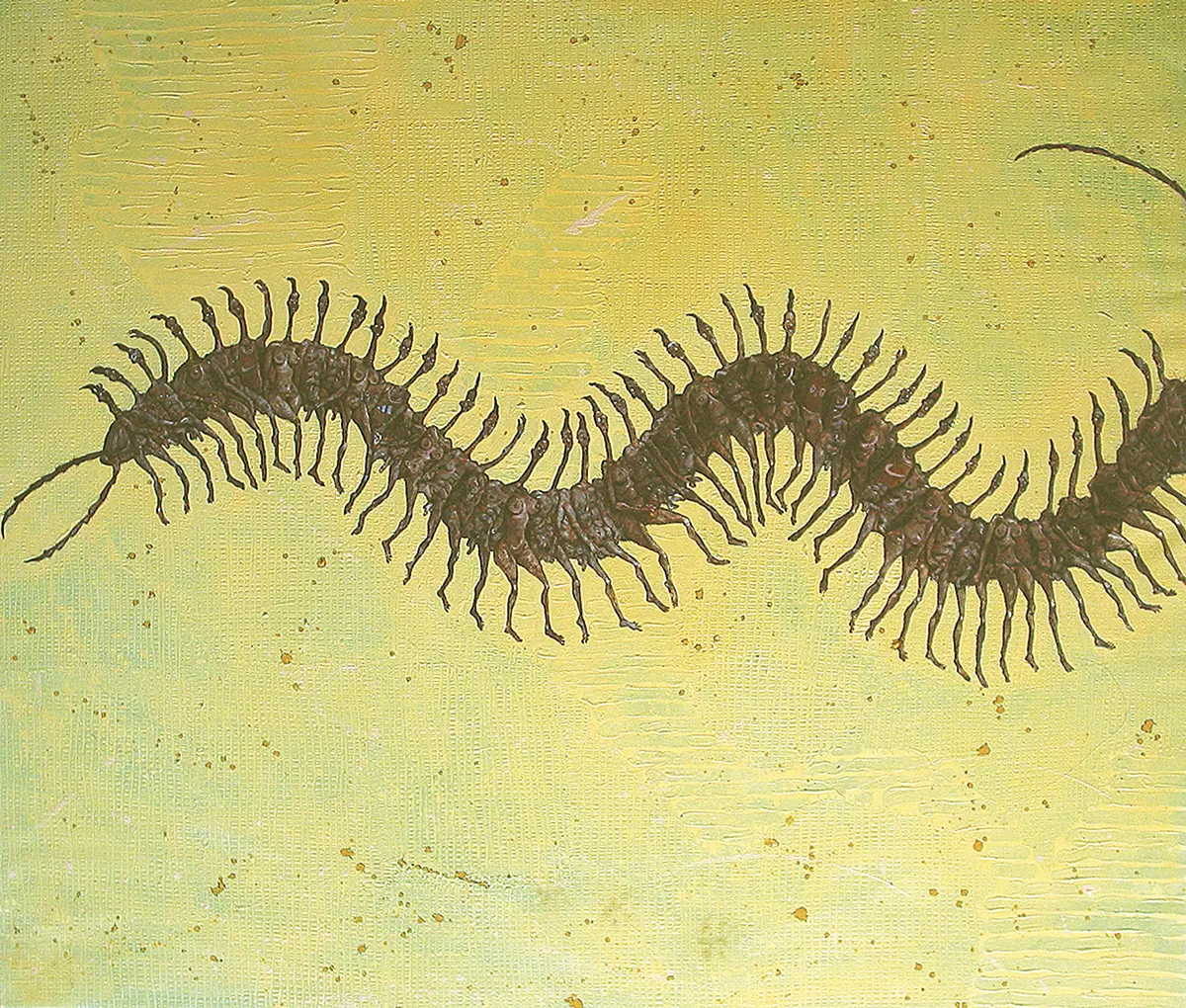
Douglas Pérez reflected on the human condition and was able to identify new forms of barbarism in a world that is “mediatized” and technological in the extreme, giving us details of the metamorphosis like the disrespect for the presence of the South that is felt in the North, despite which men of the South do not cease to seek an alternative fortune in the First World. The price they are willing to pay for it, the bone-chilling drama and the frailty of the human condition are the themes of El trencito mexicano, which synthesizes the crossing of the US border via cargo trains, something that implies enormous risks for migrants. Each segment of a Escolopendra (centipede) is a mestizo woman pressed against others. The body of the invertebrate simulates the trajectory of the suicidal journey, something also seen in Polinización, with an outward appearance that belies the terrible aspects of the theme.
Douglas Pérez’s works use the past as an excuse referring to the current times, playing with the circularity of history. The shark, whose jaws are ready to bite in that theater of naturalistic appearance —which this project at times was in its allusion to power— not only trained its gaze on a besieged environment, but also pointed emphatically towards the defining forces of the economy and the violent push of politics, domains that are leading humanity to the abyss it is approaching at maximum velocity, while Douglas Pérez’s voice notes it critically with its anti-violence metaphor.
CARIDAD BLANCO DE LA CRUZ