
As part of the International Council of
Graphic Design Associations (ICOGRADA) 2007’s International Design Congress,
the exhibit titled Bachs: Images for the Cinema opened at the end of October
at the National Museum of Fine Arts in Havana. Although this retrospective
consisted of posters created by a well-known designer who is deceased, it
nevertheless had a surprising impact that reached almost novelty status, thanks
to the little-known or little-remembered posters that it exhibited.
The exhibit comprised several decades of Bachs’s creative career, which grew from the 1960s through the 1990s and into 2001, the year of the artist’s death. However, the exhibit concentrated on the first two decades of Bachs’s career. During this period, Cuban posters reached the pinnacle of international recognition; at this time, this national endeavor was benefiting greatly from international avant-garde currents, experimentation, and the heuristic Cuban ability to turn obstacles stemming from material shortages into creative solutions (as has been noted by experts on this subject).
In 1960, Bachs created a poster to promote Stories from the Revolution, a fictional Creole film produced by The Cuban Institute of Cinematographic Art and Industry (ICAIC). Aside from its pioneering qualities and its aesthetic and historic value, this poster was exceptional because it employed photography, a medium that the artist had never previously used. Equally unusual was the expressive use of the negative space observed in the poster for Missing Children in 1985.
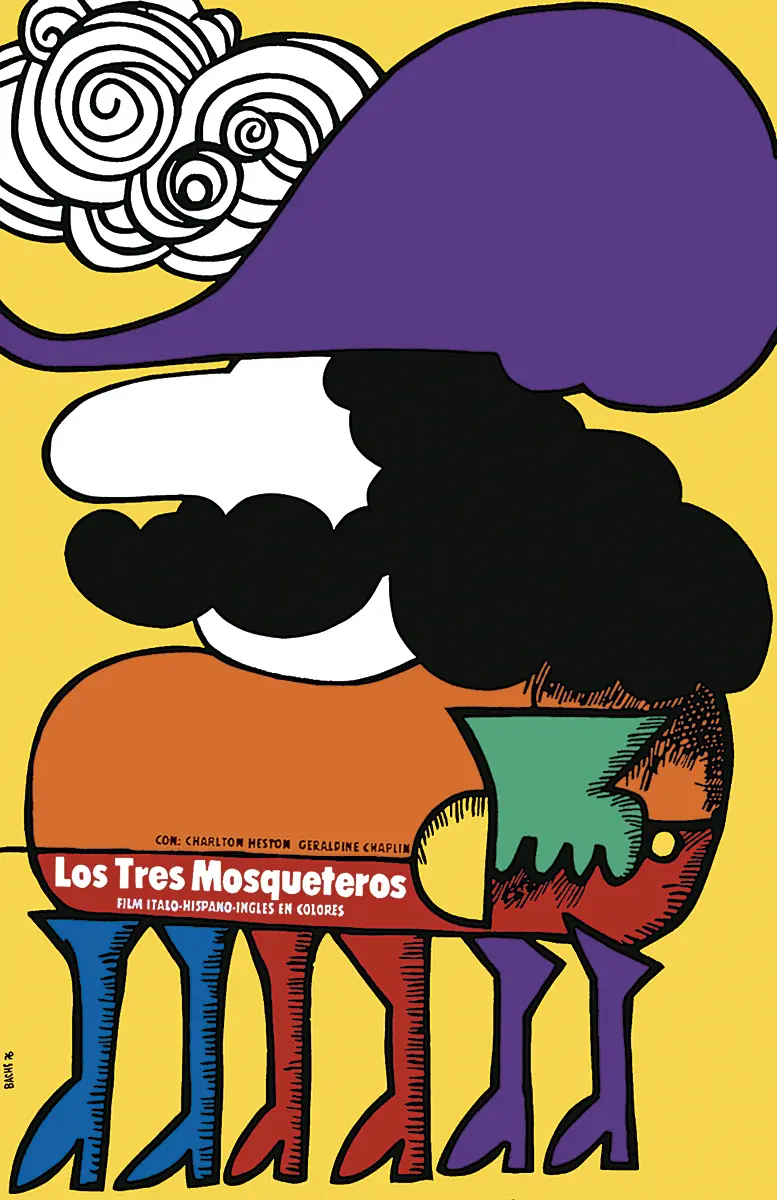
Bachs’s idiosyncratic style is recognized more for the belligerence of its images than for its typography. In his posters, the human figure, the face, or the entire body, are predominant and recurrent. Although colors are eye-catching and wide-ranging, they are never shocking. The line, nervous and informal, recalls Bachs’s work as an illustrator of children’s books. Through creative synthesis, he attempted to infer and shape the essential ideas from literary or filmic texts.
That was also the goal at ICAIC, an entity for which Bachs worked for a long time. ICAIC was determined to uphold the principle of not importing printed foreign-film advertising. The Bachs retrospective generously presented posters originally created to promote films of different nationalities, authors, genres, time periods, artistic currents, and sociopolitical positions. These posters were characterized by the use of silkscreen, and economical printmaking technique similar to painting in its use of pastes and layers of color. The exhibit’s inclusion of work tables from ICAIC’s silkscreen workshop with poster sketches by Bachs added an organic quality to the presentation. These preliminary works were made of graphs portraying samples of the characters, as well as the typographic layout but not the final text. They were proportionately smaller than the finished works and in some instances were hung on the exhibit’s walls.
Appearing concurrently with the Twenty-ninth International Festival of New Latin-American Cinema, the exhibit centered on cinematographic posters created for the promotion of films and events surrounding “the seventh art.” It also included some works conceived to promote events related to design, underscoring the profile of the sponsoring Congress. The show gathered dozens of posters contextualized as works fixed to the wall and devoid of their original advertising function. Although the posters transcended the purpose of their creation, their texts were clear reminders that they had not lost the connection to it. Despite the historic and aesthetic value that confers a museum quality and collectible status, some of the posters—such as those created for films—could actually recover their original purpose, their supporting function.
Having been exhibited some months earlier in Valencia, Spain, where Bachs was born in 1937, the retrospective also celebrated the seventieth birthday of this visual communicator who received awards in highly regarded international film festivals—including Cannes—and in cinema poster competitions such as those conducted in Hollywood. Bachs deserved the Coral Prize that he received at the Havana Festival for the quality of his poster designs, with their inherent use of allegory and sense of humor.
ISRAEL CASTELLANOS-LEÓN